Walking through the show, Jaya Ganguly: A Retrospective, 1982-2025, at CIMA feels like entering a psychological landscape where memory, rage, vulnerability and endurance coexist. Spread across more than four decades of practice, the exhibition charts the evolution of an artist who has remained fiercely committed to examining the human condition through the female body. The result is an immersive survey of a singular visual language that has grown increasingly complex, visceral and emotionally charged over time.
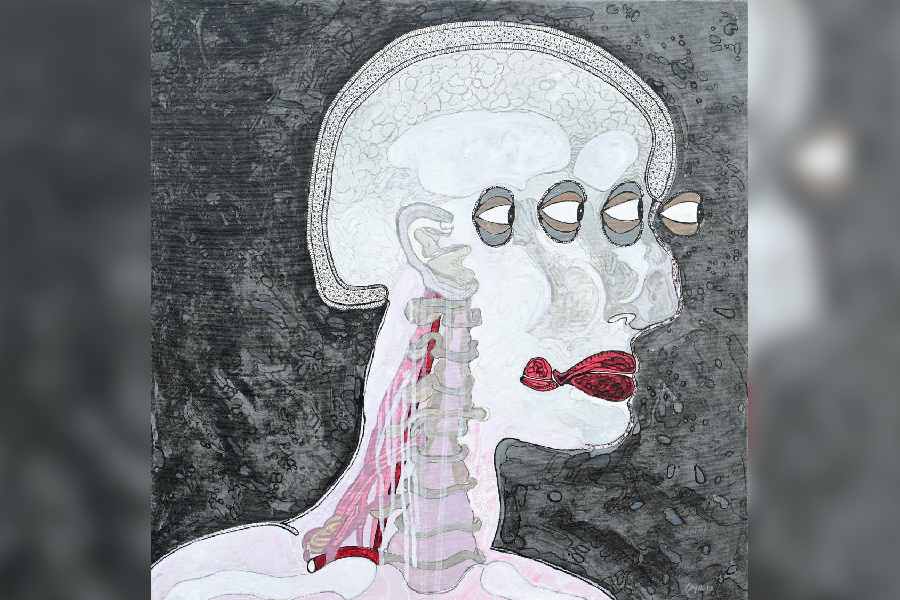
Ganguly’s paintings are populated by distorted faces, burgeoning eyes, swollen limbs, hybrid bodies and seemingly human forms that appear to be perpetually transforming. At first sight, these figures can seem unsettling. Yet the apparent grotesquery is never gratuitous. It emerges from a sustained engagement with lived experiences. Ganguly’s paintings reveal wounds, exposing psychic scars, social prejudices and emotional burdens that conventional ideals of beauty often leave unspoken.
The retrospective demonstrates how Ganguly developed her vocabulary over the years. Her earlier works reveal a stronger reliance on structure and line, while later paintings become denser and more fluid, allowing figures to dissolve into intricate networks of symbols and organic forms. Flowers, seeds, roots, breasts, eyes and mouths recur throughout the exhibition, creating a universe in which the body functions as a site of memory, fertility, trauma and resistance. The paintings often appear to grow from within themselves, as though one image gives birth to another.
Black occupies a central role in Ganguly’s practice. Whether outlining forms or dominating entire compositions, it lends the works an emphatic physicality. Against it, flashes of red and blue acquire heightened intensity. These colours carry emotional and symbolic weight, evoking blood, regeneration, violence and life. The chromatic tension mirrors the psychological tension embedded within the figures themselves.
There are resonances here with the oeuvre of artists such as Francis Bacon and Paula Rego, who, similarly, used distortion and unsettling figuration to probe the darker corners of human experience. Bacon transformed the body into a vessel of existential anxiety while Rego employed theatrical narratives to expose systems of power and repression. Ganguly’s paintings belong to this broader international lineage of expressive figuration, yet their roots remain distinctly local. Her imagery draws upon the visual culture of Bengal, the cult of Kali, the contradictions of social conservatism and the realities of women negotiating unequal worlds.
What gives the exhibition its emotional force is the inseparability of life and art. Ganguly’s experiences as a woman artist working against social expectations are embedded within the works without them becoming narrowly autobiographical. Her figures stand for countless lives shaped by exclusion, resilience and struggle. The recurring eyes that gaze out from the canvases seem to register every injury and every act of defiance.
Viewed as a whole, Jaya Ganguly: A Retrospective, 1982-2025 reveals an artist who has spent decades creating an uncompromising visual language capable of expressing what ordinary description cannot. These paintings do not seek comfort or resolution. They confront viewers with the complexities of human experience and, in doing so, affirm the enduring power of art to transform pain into insight.