The exhibition titled Destination India: Foreign Artists in India, 1857-1947, held at the Alipore Museum and organised by DAG, was an eye-opener. While we may be familiar with such names as Thomas and William Daniell, the uncle-nephew duo, Balthazar Solvyns, William Hodges and Johann Zoffany, this exhibition introduced viewers to a host of hitherto mostly unknown artists from the United Kingdom, Germany, Australia, the Netherlands, Denmark, France, Italy, Bulgaria, America, and Japan.
In the accompanying publication of the same title as that of the exhibition, the commentator on Indian history and architecture, Giles Tillotson, writes: this exhibition “breaks new ground for the first time on the later period of foreign painting in India and by adding the Indian chapter to the larger story of Orientalist painting”.
This is part of a series of exhibitions that DAG has been mounting in
the recent past using art historical material from its phenomenal collection that we may have seen images of or read about but rarely got a chance to view in actuality.
The exhibition presented a kaleidoscopic array of paintings and graphic prints of spectacular views of the grand architecture and equally breathtaking landscapes of a country that the British had subjugated but whose wildly diverse peoples and cultures they could not grasp. The works were executed in the time period between
1857 and 1947 — a time marked by violence of the most extreme kind.
In the accompanying publication, the art historian, Pheroza Godrej, has
written that this cache of paintings and prints was lying in “forgotten
archives”, and besides art work, the administration took much interest in the documentation of historical events, making surveys and maps.
In 1826, the first photographic images had been taken, and photography was introduced to India in the 1840s. But visiting artists as well as amateurs and wives and daughters of officers in service continued to produce these watercolours, oil paintings and graphic prints. Some artists used photographs as aide-memoires.
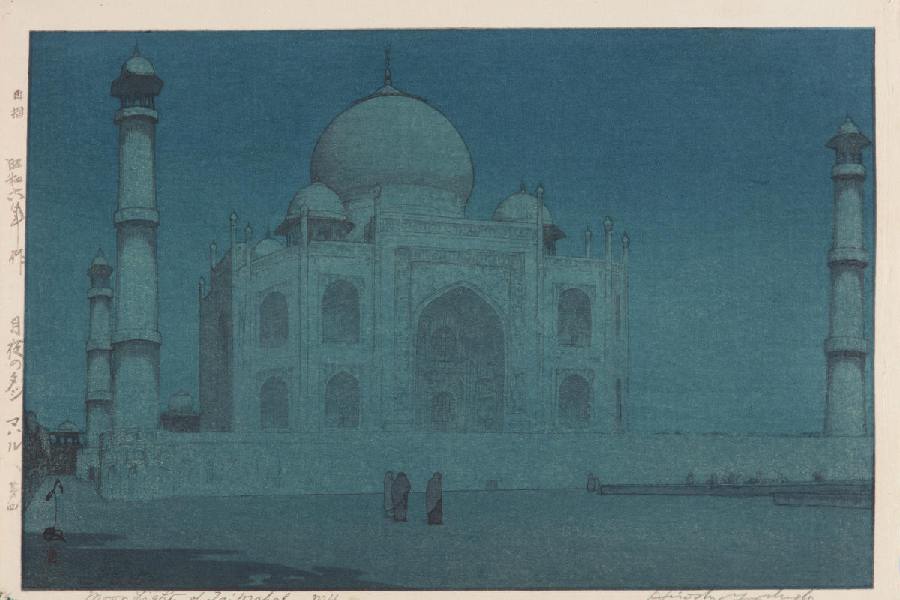
Of the scenic Indian views, the favourites were the Himalayas, Kashmir, the colourful and exotic splendour of Rajasthan, the Taj Mahal, the ghats of Benaras and the wide expanse of the Ganga whose waters were still noticeably clean. The most enchanting of these is Hiroshi Yoshida’s traditional Japanese woodblock style print of a magical, moonlit Taj (picture). Another nocturne of the same view is by Hugo Vilfred Pedersen of Denmark. Theodore Howard Somervell’s ethereal View of Kanchenjunga reminds us of Nicholas Roerich’s paintings of the same subject. The Hungarian painter, Elizabeth Sass Brunner, along with her daughter lived in India for over 70 years and she had painted the Amarnath cave. The icy shivalinga resembles melting wax. The Dutch painter, Marius Bauer, had chosen to represent Benares with his romanticised view of a solitary Indian with the majestic Ganga flowing past. His etching of a funeral at Manikarnika Ghat is austere yet monumental. Olinto Ghilardi had given Abanindranath Tagore his first art lessons and he had painted some fine portraits. There is one of elderly Indians and another of a young
hill girl.