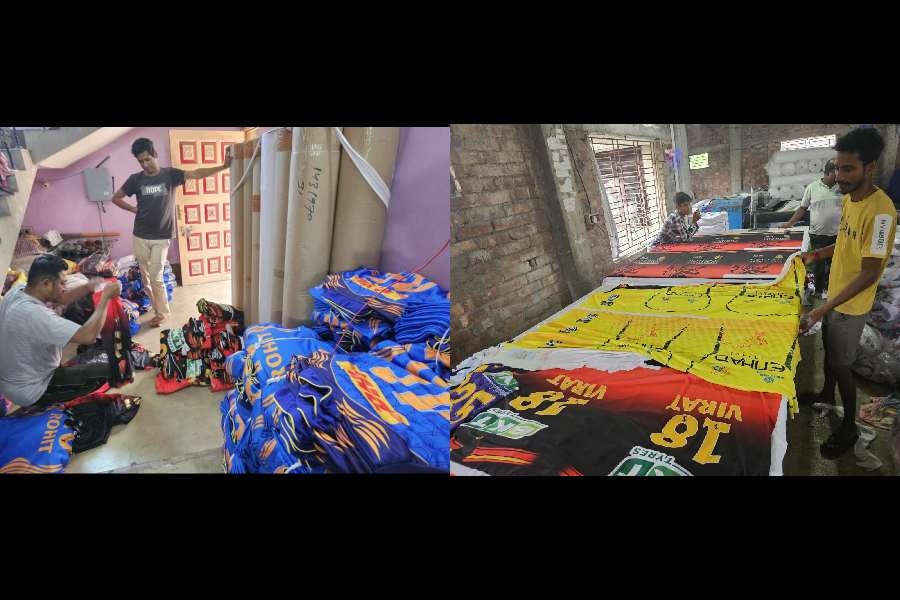
Tucked deep within the refugee colonies off Jessore Road and close to Calcutta airport, Jogendranagar has quietly evolved into a hub for the production of non-branded IPL jerseys. In the narrow alleys, half a dozen homes double as jersey manufacturing units. From these, hundreds of local youth source their stock — the jerseys, headbands and wristbands that are hawked at bargain prices along the approach to Eden Gardens. The more enterprising among them travel by train to IPL venues across the country, chasing match-day crowds.
None of them has seen an IPL match up close; the only time some of them have been inside Eden Gardens was for the felicitation in 2012 when the gates were thrown open to celebrate KKR’s win.
At the centre of this cottage industry is Manikanta Bar, a manufacturer who stands apart. While others purchase printed fabric to cut and stitch, Bar has built an
end-to-end production set-up inside his two-storey home. “I employ about 35 people,” he says, gesturing towards his machines with evident pride.
On the ground floor, in an air-conditioned, unmanned room, two large digital inkjet printers hum. Linked to computers loaded with jersey designs, they print mirrored images onto continuous rolls of sublimation transfer paper. Upstairs, on an unpartitioned floor with bare, unplastered walls, the process continues. Blank fabric is fed through a heated drum for sublimation printing before emerging, dried and imprinted onto a rewinder spindle.
At a long table nearby, two youth spread out the printed fabric and cut out jersey fronts and sleeves. Tailoring unit head Pradip Das watches with growing impatience.
“Bhai chhara amar business ochol... without him, my business cannot function,” Bar says with a laugh. The flattery bounces off Das. “I have a dozen men waiting for fresh material. Work will have to go on till 2.30 or 3 in the morning, including stitching the material I take from here,” he says, as freshly cut Chennai Super Kings and Royal Challengers Bangalore pieces are bundled for him.
Downstairs, the finished goods are being tallied in a thick exercise book by Bar’s wife. “Adult RCB 250 pieces, junior RCB 130, small MI 100…” she calls out, barely pausing as she coos to the crying baby in
her arms.
She is the gatekeeper of the business. When asked about the machines, she responds with a quick warning, “Don’t write the machine’s name. Everyone will buy one.”
Three retailers wait by the door for their consignments. “Boudi, is it possible to get 50 more of MI,” one of them asks. “This is all you get for now,” she replies, pointing to a designated pile of Mumbai Indians shirts.
“Without her, Dada’s business wouldn’t run,” one retailer chuckles, drawing nods of agreement.
That night, they will leave for Guwahati, where back-to-back matches promise brisk sales. “Business is good there because sellers from western India don’t travel so far,” says Chiranjib Saha, who has been in the trade since 2010. “Nearly 200 families here are involved in this work,” he adds.
Demand is driven less by teams and more by star power. “We always carry RCB and CSK jerseys, no matter who is playing,” says Surajit Roy. “Virat has the most fans everywhere, followed by Dhoni and Rohit.”
This season alone, Bar has produced around 40,000 Virat Kohli jerseys, and about half as many for Rohit Sharma and M.S. Dhoni. “If demand spikes, we keep production running till just three hours before the sellers’ train departs,” he says.
The work cycle begins as soon as the official jerseys are launched. Fabric is sourced from Surat and Ludhiana, all of it feeding into a system that has grown more sophisticated over time.
Bar himself made the transition from seller to manufacturer in 2016. “Back then, we dyed fabric manually and screen-printed logos. Flags were our main product,” he recalls. But when teams began distributing free flags in stadiums, the business pivoted to jerseys.
In 2022, he took a significant leap, investing in machinery with a bank loan. Encouraged by steady returns, he expanded within 18 months, upgrading both equipment and raw materials. “What used to sell for ₹60-70 now fetches ₹80 to ₹175, depending on quality and size,” he says.
The origins of Jogendranagar’s merchandise trade, however, go further back. Bar credits a local policeman who ran a side business selling caps. “In the late ’90s, he would hire 30 to 40 youths to sell Tricolour caps outside Eden Gardens. That gave a few of us the idea to start making flags,” he says.
Bar’s own journey began with an ODI against England in January 2002. “Seven of us pooled money and tried it. Three did very well, four didn’t. But we had to split the profits equally — ₹3,000 each,” he recalls. The experience pushed him to strike out on his own. The launch of the IPL in 2008 transformed the scale of operations, turning a sporadic hustle into a seasonal industry. Now, it is a year-round enterprise.
“We now make jerseys for the Indian Super League as well and supply to the Maidan market,” Bar says.
Yet not every global tournament brings opportunity. The upcoming Fifa World Cup, for instance, holds little promise. “Local shops source football merchandise from Burrabazar on specific orders. There’s no mass sale at a single venue as in cricket,” he explains.
In Jogendranagar, the rhythm of life still beats to the IPL — a quiet, industrious counterpoint to the roaring stadiums their work ultimately serves.