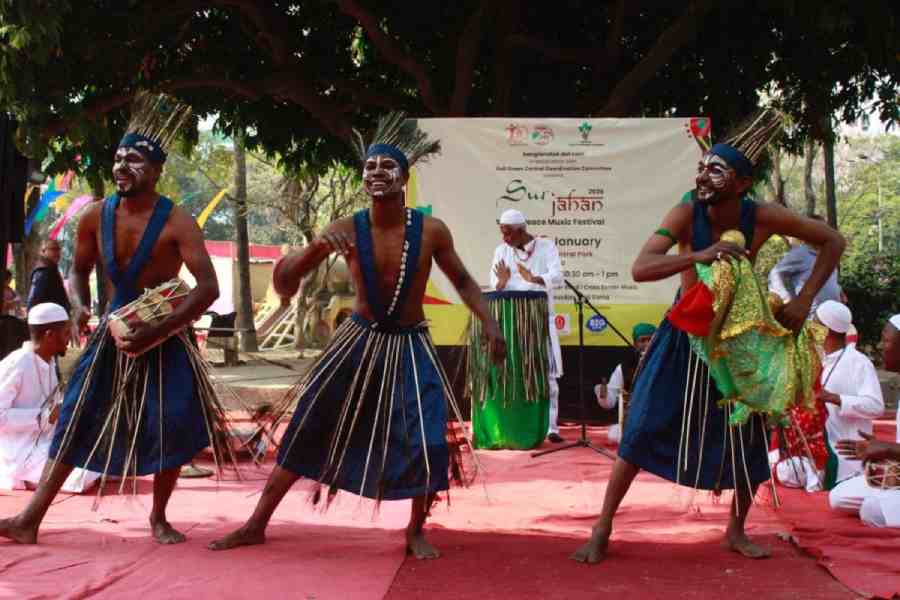
The stage was alive with the rhythmic throbbing of drums, ululations and frenetic dance. The performers had their faces painted. They wore feather skirts and headdresses much like the hunting tribes of Africa.
The performers were the Sidis from Ratanpur in Bharuch district of Gujarat. This form of high-energy folk dance is called dhamal or goma. The troupe was in Calcutta for a concert that was part of Sur Jahan: World Music Festival organised by Banglanatak dot com, a social enterprise working to “foster inclusive and sustainable development using culture-based approaches”.
This was not their first visit to the city. Said Sabir Sidi, who is the leader of the troupe, “We first visited Calcutta in 2015, to perform in a Sufi festival.”
The Sidis trace their origin to what used to be known as Abyssinia, and is today known as East Africa. They came to the Indian subcontinent as merchants and sailors. Many were brought over as slaves by Arab, Portuguese and British traders, some as far back as the 10th century. Many Indian rulers recruited them as security guards or mercenaries, though some Sidis are said to have become feudal lords.
Sidis primarily reside in Gujarat and are also found in Karnataka and Maharashtra. The Sidis of Gujarat are Muslims but in Karnataka, there are Christian and Hindu Sidis too. There are about 50,000 of them in India, and they are often referred to as India’s “forgotten African tribe”.
The Sidis of Gujarat are wandering fakirs who go from shrine to shrine singing Sufi songs and performing their dance. Their performances are meant as a tribute to the Sufi saint Gori Pir who arrived in Gujarat in the 14th century.
“My ancestors possibly arrived with Gori Pir, who lived near Zanzibar on the eastern coast of Africa,” said Sabir.
Also known as Sidi Gori Shah, the saint’s urs or death anniversary, is commemorated every year at Ratanpur where many troupes perform dhamal to the accompaniment of the malunga or single-stringed bow; musindo, a cylindrical drum; dholak and the harmonium. The language of the songs is a mixture of Swahili, Gujarati, Hindi and Arabic. “The songs are known as zikr and their ecstatic Afro-Indian rhythm of dance is unique,” says Amitava Bhattacharya, who is founder-director of the event organiser Banglanatak dot com.
Dhamal dance has two formats, baithaki and dance. Baithaki dhamal is more devotional in nature as performers focus on the lyrics and remain seated while invoking Sufi saints. Members of the community — including women and children — participate in the ritualistic performance with light music. Men dress in white kurtas, pyjamas and caps. The lead performer goes into a trance when the spirits of ancestor saints possess him. Each song can continue for more than an hour in a ceremony that can last longer than a whole day.
Dance dhamal is usually performed on stage. “We mimic animals and birds of the forest,” said Sabir. As the drumming and thumping of feet reach a crescendo, a coconut is thrown up into the air, and the lead dancer hits it with his head and cracks it open. Sometimes they also walk on fire.
Sabir reminisced about the troupe’s 2007 tour of Africa when they visited Zanzibar, Mombasa and other cities. He said, “The audience loved our dance and praised our efforts to preserve an ancient culture. Contemporary East African performances are heavily influenced by Western music and dance. We were told that the Swahili language of our songs is pure though archaic.”
He added, “Some of the organisers had suggested we settle down in Kenya. But we refused politely. We are born Indians, and we are happy in this country.”