 |
| Star trek: The Ramanagaram rocks made famous by Sholay |
Surely most of us remember that scene from Sholay where Gabbar Singh fumes atop a rocky terrain, as three gangsters hang their heads in shame, while some haunting music plays in the background.
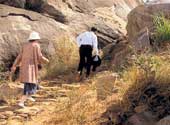
Not only did Amjad Khan who played Gabbar Singh inspire Ram Gopal Varma to remake Sholay, he also inspired us to climb a smooth dome not far from Bangalore, in the large cluster of rocks at Ramanagaram — made famous by Sholay.
The local name for this rock is Kachu Shiva, though we named it Boomshankar when we pioneered a route through it. There are a lot of domes there but we had been searching for one with a crack, so that we wouldn’t need to drive in bolts. We preferred natural protection and would pick natural lines for climbing.
There were four of us — K.S. Dinesh, Shyam Krishnan, Ajay Tambe and myself. On the day of the climb, we reached the spot and began to assess the route. The first pitch was about 40 m, the second about 20 m. The initial crack was about 30 m and it led to a small overhang. To climb over the overhang, we would have to get on to a tree that was growing inside the crack: its roots went all the way up through the crack.
We also noticed something else. There was a huge beehive about 20 feet right of the tree, near the overhang. This was June-end — monsoon time — and I was fortunately wearing a turtlenecked, full-sleeved T-shirt. I pulled my socks over my trousers, feeling somewhat wary of the bees. Then I took the lead, climbing very quietly.
It was a finger crack — about two inches wide — so it was nice classic climbing till the tree. Every 5 or 10 feet, I placed a chock nut for protection. But the rope that was passing down from my harness kept dragging because it would pull on the roots and shoots of the tree. I had to keep stopping and pulling it free.
When I reached the tree, I put a sling around one of the big branches as protection and began climbing another branch. This part was a bit tricky because I was wearing PA shoes (smooth-soled rock climbing shoes) — not the best footwear for tree climbing.
Finally, I was on the last branch so I reached over and grabbed the edge of the rock. I placed a chock nut again for protection and then climbed over the overhang by jamming my fingers in the crack, which was now running vertically on the overhang. Above the overhang was a slightly sloping ledge where I could stand and set up an anchor. I used a flake of rock and a couple of slings with friends (a camming device that is inserted into cracks and niches). As I worked, I tried to move as cautiously as possible because of the bees.
The second man up was Dinesh. Shyam and Ajay kept an eye on the bees. Meanwhile, all of us had also noticed that there were rain clouds in the distance. As Dinesh reached the ledge, we realised it would soon begin to rain.
Then it was Shyam’s turn to climb. He removed the nuts as he came up. As he climbed the tree, there was a gust of wind and then the rain was upon us. It was a sharp monsoon shower and poor Shyam got stuck just above the tree. He couldn’t climb up so we tied him for safety. Then we all stood and waited for the rain to stop. It rained for about 10 minutes. After the shower, there was a breeze so we knew it would dry the rock pretty fast.
Suddenly, a part of the huge hive gave way and we spotted Ajay sprinting off far below, shouting, “Bees! Bees!”
Shyam climbed to the ledge as fast as he could and the three of us stood on it, trying to remain motionless. Thankfully, it worked. The bees didn’t come near us. But it took half an hour for them to settle back into the hive.
By then, the rock was also dry and I led the next pitch. The crack was now wider — fist-sized — and I used friends. Climbing in this section was excellent: steep, with granite knobs. I would put it at 5.8 (American rating system). Once I reached the top, the others followed and the last man up, Shyam, removed the chock nuts I had placed for protection.