 |
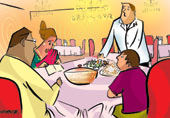
I got up at the crack of dawn to prepare these so that I could bring you something home-made,” Dolly Chakraborty, a chubby, 50-something Calcutta homemaker, chuckles mischievously as she fishes out food containers and jars from her huge cloth sack and places them gingerly on the dining table. As her numerous relatives strewn across various parts of the city will tell you, this is not an unusual scene on one of Aunt Dolly’s regular visits. “But what never ceases to amuse us,” smiles one of her relatives, “is that the food she brings — all Bengali delicacies such as karaishutir kochuris and alur dom — is not home-cooked at all, but obviously bought from restaurants and eateries. In fact, at times she even forgets to remove the evidence, like the clay bowl in which the curry was delivered or a bill.”
While her relatives usually indulge her, going along with the pretence because “she is lovably eccentric and well meaning,” the question is, why on earth does Aunt Dolly resort to this needless subterfuge? And what does she get out of it?
Well, nothing really, except perhaps to try and keep up the old but eroding family tradition of serving home-cooked food, prepared with love and care, as a way of showing affection and fondness.
“Earlier, one of the ways to show that you cared for someone was to take the trouble to cook something for him or her,” observes Siddhartha Shankar Bose, who has done extensive research on food culture and food history and who runs the Bhojohori Manna chain of restaurants along with his partners. He adds, “In the past, your family prestige was directly related to the kind of food you treated your guests to. It was an indication of your family’s wealth and social standing, and for a woman, the proof of her culinary skills and upbringing. It was unthinkable to invite guests to a meal and treat them to food brought in from outside.”
But not anymore. Today you can drop in at any restaurant and you will find people queuing up to take food back home. Not just for their own consumption, but also for invited guests. Which is why restaurants with home-delivery facilities are raking it in.
It’s a Friday evening and at the Bhojohori Manna outlet on Ekdalia Road, Rupa Sen, a 29-year-old chartered accountant, has just placed an order for 12 plates of rice and mutton curry, alu posto and pineapple chutney. “I’ve called a few friends for dinner,” she explains, “and since both my husband and I work we don’t have time to cook,” she says. At a pizza outlet at Jodhpur Park, the person taking down orders on the phone repeats it as he scribbles furiously into his notepad, “Seven large pepperoni pizzas, 11 bottles of Coke, etc.” He confirms later that, “This kind of a large order means that the family has invitees. The same family would order much less at other times.” Even instant noodles have made their way into menus for slap up dinner parties. “I often whip up a simple, easy-to-cook meal of noodles and fried sausages when I invite people over,” says Dipak Choudhury, a 35-year-old working father of two children, whose wife too works. “My friends love it,” he adds unapologetically. But he doesn’t deny that his mother, a 60-something housewife, “would be absolutely appalled if she knew about this”.
Explaining the change in attitude, Basabi Adhikari, a social studies teacher, says, “With the disintegration of joint families and the advent of nuclear families, where usually both husband and wife work outside the house, it is no longer feasible for people to devote the time required to prepare meals. But the culture of inviting guests over for a meal remains as strong as ever.”
According to Siddharta Basu of Bhojohori Manna, part of the reason for starting the restaurant chain was that they had recognised the demand for alternative arrangements to home-cooked meals. Basu says that on an average, approximately 250 and 500 takeaway orders are placed on weekdays and weekends, respectively (about 50 per cent of the total orders). He also insists that even the elderly are increasingly turning to this kind of eating arrangement. “The elderly mothers and grandmothers of today lack the support system and infrastructure that their mothers and grandmothers used to enjoy in a joint family scenario. Also, the lack of proper staff and their own dwindling physical faculties make it difficult for them to go through the rigours of preparing meals.”
But they continue to want to do things the old way — a fact clearly evident from the likes of Aunt Dolly. So while the younger generation unapologetically dishes out restaurant food to guests, someone like Aunt Dolly would rather resort to subterfuges. As what was earlier considered literally in bad taste gradually becomes the order of the day, it is people like her who continue to provide a glimpse into a fading family tradition.