 |
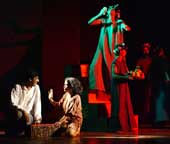
| story in verse: A scene from Kolkatar Electra |
Before Hutch launches its fifth Odeon Festival next year, it should initiate a large-scale media blitz to inculcate mobile manners, instead of the cute Benglish campaign it presently runs. That would constitute an important service to society. The population of impolite and inconsiderate citizens has multiplied dramatically, for whom it apparently seems natural to keep their cell phones on during shows just as they do inside cinema halls. Or else, they probably figured that since a major mobile network had organised the festival, it gave them the right to receive calls in the auditorium. Either way, the jingle-jangle evenings went on until Koushik Sen exploded on stage in the second half of Kolkatar Elektra and threatened to call it a night unless the culprits switched their gizmos off. In the unlikely event that any of those boors read these columns, we must reiterate that telephone etiquette demands that you turn them off at all live performances: music, dance and theatre.
Let me hasten to mention that Indian corporates ought to emulate Hutch’s example regarding sponsorship of theatre: this year, it subsidised two new Bengali productions. This is precisely how enlightened companies abroad support the arts in their communities: unlike our tunnel-visioned breed, they consider it a matter of prestige to be associated with local artists.
The final leg of Odeon (Rabindra Sadan on July 3-4) premiered these shows, both reworkings of classical myths, Western and Indian respectively. Both groups chose their metiers. Swapna Sandhani returned to the medium of verse drama by staging Buddhadeva Bose’s Kolkatar Elektra, itself adapted from the Oresteian legends of Greece, presented from Elektra’s perspective by Sophocles and Euripides in their tragedies named after her. Blind Opera dramatised the Upanishadic myth of Nachiketa in Thake Shudhu Nachiketa, in keeping with their thematic preoccupations of spiritualism, death and the afterlife.
Koushik Sen has taken upon himself the mantle of Bose’s theatrical interpreter. This is a difficult task because Bose wrote closet drama, not primarily meant for the stage. Sen superimposes the context of war today, manifesting it with troops in combat fatigues crossing from one side to the other, news announcements heard on the soundtrack, and Sanchayan Gho-sh’s set with platforms designed in camouflage patterns. These do not add appreciably to the play, since the text focuses on the psychology of the characters, not so much on war. However, Sen compensates with a strong visual approach: flashback sequences suggesting nightmares, colours and costumes mainly of red and black, vertically elongated masks, and pinpoint lighting by Ashok Pramanik.
The principals act their parts intensely, also applying a very physical style rare in Bengali theatre. Sen selects an unsual combination in the cast. Two actresses play Elektra — Sudipa Basu as the Calcuttan and Reshmi Sen as the Hellenic. Basu expresses her near-psychotic personality. Saswati Gu-hathakurta makes a tense Clytem-nestra, at every step afraid of what is to come; she also sings Rabindrasangeet very well. As her new husband, Kunal Padhi towers over all with his height and baritone.
Watching Blind Opera always is an overwhelming experience. We can never forget that the group comprises the visually impaired, more so because they negotiate the stage, props and complicated blocking better than many ordinary groups. Growing with every production, they have become more ambitious, using a larger number of dramatis personae and more elaborate multi-level sets.
For me, their interpretation of Tagore’s Raja remains their defining achievement so far, an ideal combination of theme and performers. With the Nachiketa story too, dramatist-director Subhasish Gangopadhyay clearly allegorises the fate and life of the blind: thrown into a physical and metaphysical hell just like Nachiketa, and continuing to ask why. The shortcoming in Thake Shudhu Nachiketa lies in the script. When we compare it to Raja, for instance, we immediately recognise the difference between a consummate artist and a writer whose relative youth tends to let him ramble rather than economise. Many of the scenes involving male and female spirits in hell (including their dances and music) evoke the fun of a children’s fairy tale more than an attempt at philosophical enquiry.
Subhash Dey (a fearful but hum-an Yama) and Sandipan Chatterjee (an innocent, smiling Nachiketa) complement each other, but there are no other significant characterisations to sustain a full-length play. However, as always, the members of Blind Opera sing with full-throated ease.
The lighting is deliberately and appropriately dim and some sequences evoke impressive grandeur, as when Yama takes Nachiketa on his horse-driven chariot (mimed by the performers).