 |
| A still from Sojon Badiyar Ghat |
 |
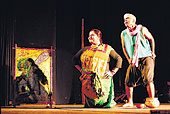
| A still from the play, Orjan |
It would be a cliché to say that Nandikar’s 23rd National Theatre Festival at the Academy of Fine Arts (December 16-25) opened with a bang. But it did just that. To say that the two inaugural plays, especially the first, Orjan (English), was out of the world would sound like an exaggeration, too. And like all exaggerations, one doesn’t know when to stop it from panting.
The festival, featuring 27 plays, commemorated lighting wizard Tapas Sen whose work in Chokh Geylo (Bengali) was evidence of his reputation. The audience was packed with the ‘culturatti’ and theatre lovers whose unending applause rang loud and clear for the one-man show, Orjan enacted by Magnus Lundblad, and directed by Peter Engkvist from Stockholm. A very simple tale of the eagle and the wren and how the eagle, Orjan, overcomes fear by being made to confront it by the wren. The tour de force, using just a small blank screen and a ladder, used mime and mimicry, gymnastics and histrionics, singing and recitation, innocent children’s intellect and profound adult perceptions, all rolled into scintillating theatre.
It was followed by The Man, The Lady and Something in the Belly, enacted by Magnus and Baura L. Magnusdottir, which handled minimal props used magically to tell another simple truth. The couple is thrilled begetting a child, but when they realise that it’s monkey-like, they go through heart-rending pathos. After trying to hide the fact from themselves and the world, they not only reconcile to the fact, but dare to proudly and endearingly claim the monkey-like creature as their own darling child.
There were a lot more of these one-artiste shows, not all of them with the same kind of aesthetic impact. Manjula Padmanabhan’s Hidden Fires (Hindi/English), directed by Arvind Gaur (Asmita, Delhi) sadly seemed to belong to the latter category, leaving many wondering about the criteria for selection. In the main, the pretentious monologue by Rashi Bunny came across as a melodramatic pre-election speech by a paara politician.
On the other hand, Girish Karnad’s Bikhre Bimb directed by Girish and K.M. Chaitanya (Ranga Shankara, Bangalore) almost looked like another of the same, but very quickly built up into rivetting stuff, using closed circuit televisions as a ‘dialogue’ technique with awesome credibility.
Likewise, one found Bhavabhuti’s Uttararamcharith, directed by the redoubtable Prasanna (NSD Repertory Co., Delhi) nothing more than traditional Ramlila. But Munna Dhiman’s Zindagi Retire Nahin Hoti, directed by G.S. Chani and H. Kohli (Ceva, Chandigarh) being deceptively homely. Chani followed up with an open-air homily in Khuli Hawa Ki Talash Mein.
The last day of the festival, defined as Nandikar Day, also ended with a bang. Both Leela Mazumdar’s Dulia and Tarashankar Bandopadhyay’s Chokh Geylo were also primarily one-artiste shows, and played by Sohini Halder and Swatilekha Sengupta, respectively. Both mother and daughter in the garb of much older women. Dulia was good, but somewhat after a fashion; Chokh Geylo however charged it all up again with arguably the best performance in the festival (surpassed only by Magnus, and matched only by Arundhati Nag).
Tarashankar (literature) and Tapas Sen (technique) meshed with Swatilekha (histrionics) to make it an unforgettable experience, as the Dronacharya of Nandikar, Rudraprasad Sengupta, put it.
The last but not the least was the rather long love story, Jasimuddin’s Sojon Badiyar Ghat, directed by Goutam Halder, which poignantly brings out the pangs beyond just love between the beloveds.