 |
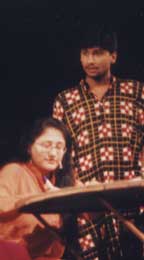
| A scene from Prati Chhoy Second |
Unit for unit, big-timers or small-timers, Indian theatre displays more overt social concerns than any other art form. Bengali theatre has come up with some strong statements in the area of public health lately. Ensemble’s new presentation consists of two one-act plays about AIDS that were created collectively through workshops, and were conceptualised and directed by Sohag Sen. They improve markedly on Ensemble’s last production to emerge from this method. One hopes that enlightened institutions, including schools and colleges, invite Ensemble to stage them.
The first, Aparadh, opens with a tableau of life in a red-light district, which unfreezes as, ironically, a Brahmin walks across, sprinkling holy water on everybody in turn. During the day, a social worker stops by to distribute prophylactics among the prostitutes; an unsuspecting young girl is sold off and brutally initiated into the occupation. The incident at the core involves a sex worker who plans to escape with her lover, but falls victim to the clutches of an AIDS-infected goon, the consequences left to our imagination. The vignette takes barely half an hour, unsentimentalised, with all the performers contributing harshly naturalistic portraits.
In the next, longer piece titled Prati Chhoy Second, the scene shifts to a canteen frequented by college students, their teachers, film workers and other professionals. Again, a very realistic atmosphere develops, aided by the acting, the audience overhearing conversations skipping from one table to another without apparent connection. Only toward the end do we suddenly get to know that one of the gathering has contracted AIDS. Like a classic mystery, it is the person whom we least suspect. Thus, in this double bill Sen juxtaposes the most familiar means of infection with one of the most indirect, stressing that the virus does not discriminate socially.
Unfortunately, the number of cigarettes lit up serially on stage might give the impression that smoking kills equally fast. Perh-aps Sen wants to kill one bird with two stones.
Green Park Abhijan, a small new group, has done good work for social awareness on Uttaran, an original play written and directed by Sumitra Bannerjee. It does not start off or proceed with anything unusual by way of content or style. Indeed, things seem rather too commonplace as a bourgeois housewife prepares for a party. Her husband, an upwardly mobile executive, appears quite progressive.
In the course of the evening, however, the guests persuade a doctor among them to read the hostess’ ultrasonogram and reveal the sex of her unborn baby — all in good humour. After the interval, the husband’s personality changes completely. Uttaran forces spectators to face the subject of female foeticide.
Given this purpose, its somewhat unpolished edges can be excused, though Bannerjee should compress the rambling first half.