 |
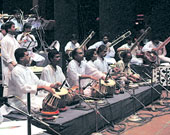
| Members of the orchestra at Rabindra Sadan |
In spite of our liking for preludes and interludes in popular songs, do we consider orchestra as a distinguished musical entity? Even if we choose to listen to the visiting Berlin Philharmonic Orchestra once in a blue moon, do we care enough about our indigenous orchestra? The National Orchestra plays on the All India Radio; when have we last seen them on stage? Is there any future for orchestra in our land? Timir Baran (1904-1987), ace sarod player, a composer par excellence and often described as the ‘Father of Indian Orchestra’, died with this thought etched all over his mind.
His doubts have not been put to rest. Yet the manner in which a packed-to-the-brim Rabindra Sadan sat motionless to a replay of the Timir Baran magic on September 28, one could not help being optimistic. The concert hosted by Paschim Banga Rajya Sangeet Akademi and the department of information and culture of the government of West Bengal witnessed a glorious centenary tribute paid to the composer-cum-conductor. A 29-strong orchestra ? comprising nine violinists, five sarodias, six sitarists, a key-boardist, a guitarist, a flautist, two effect specialists and four percussionists ? played out seven of Timir Baran’s compositions to the absolute delight of the audience.
The 45-minute presentation ably conducted by Goutam Ghosh displayed all the characteristic features of the maestro’s experiments with the orchestral form. Timir Baran, a disciple of Ustad Allauddin Khan, improvised on Indian classical music and use Indian instruments. At the same time he welcomed violin and guitar as two essential components of his orchestra. As for melodic inspiration, he had an ear for the Middle-East.
It was an experience soaked in nostalgia. With Debashis Bose narrating the factual tidbits, Ghosh played to the book. He chose challenging pieces and the orchestra consisting of junior musicians got the act together. There were compositions based on popular ragas as well as extinct ones. In the one dedicated to Rabindranath Tagore, Ghosh took a little bit of poetic liberty by adding a line of melody on the original. Purists might raise a hell over such aberrations, but no jarring note was heard during the course.
At the end, Timir Baran’s illustrious association with Uday Shankar’s dance troupe was recalled over a colourful presentation by West Bengal Dance Group Federation.