 |
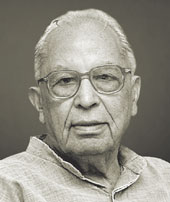
Vishwanath Malhotra, head of the publishing house Rajpal & Sons, is on the wrong side of 80. But he is thinking young. “Our focus is on the youth,” he says. “We plan to do books on specific careers to help young students make informed choices. We have already done about 50 such titles.”
The 90-year-old publishing house sells 40,000 copies every year of more than 200 titles in Hindi and English. It specialises in literature and creative writing, language-teaching dictionaries, management and finance books and encyclopaedias. “Also in the pipeline are projects of fiction and poetry,” says Malhotra.
He doesn’t mind being called a ‘bookworm’. “I love the smell and feel of books. Every book is like a new child and one has to be emotionally involved,” he says.
It was his father, Rajpal, who set up the publishing house in Lahore in 1918. Rajpal died in 1938, and the responsibility of managing the family business fell on 18-year-old Malhotra's shoulders. “Taking over the business was not a matter of choice, but a compulsion. Along with the work, I continued with my education and completed my masters in economics.”
In 1947, during the Partition, he was forced to leave Pakistan. By mid-1948, he re-established Rajpal & Sons in Delhi. “It was difficult leaving a well-rooted business in Pakistan and I was wary of the tough times ahead,” he says.
Those were difficult days. For one, there was very little money. “There were no funds available to us. Being refugees, we could have claimed compensation for the assets we had left behind. But because it was an extremely arduous process, we didn’t do so,” he says. Besides, he was in the “prime of youth” and had a “positive” outlook. “I was able to take the challenges head-on.”
Slowly, the business started flourishing. There was a wider market, limitless freedom and great vigour among the people. And there was a surge of new writing and talent as well. “We had new aims before us. For the first time we got into export, as we realised that Indians settled abroad were a huge potential market.”
Rajpal & Sons is credited with ushering in the paperback revolution in India in the early 1960s. For the first time in India, well-produced books written by top authors ? mostly works of fiction in Hindi ? were made available at the affordable price tag of one rupee. “There was a tremendous response and most of the books were lapped up immediately. These books were easily available everywhere ? at railway stations, bus stalls etc.”
Also, the Gharelu Library Yojana ?Malhotra’s brainchild ? became immensely popular and earned him accolades from then prime minister Jawaharlal Nehru. This was the first book club in India. Under the scheme, members would get 10 new books delivered through the post every month. It ensured that even people in far-flung corners of the country as well as soldiers deployed in remote areas had access to books. At one point the scheme had over 35,000 members.
By the 1970s, Rajpal & Sons was a respected name in publishing circles. However in 1975, differences arose between the owners ? Malhotra and his brother Dinanath. This led to a split. “When two people who are equally competent, educated and innovative work within the limited creative parameters of a business, it leads to conflict. But in hindsight this split and branching out was a blessing in disguise. Since the split, we have found our own niche markets and both the businesses have blossomed,” says Malhotra.
Rajpal & Sons believes in “personalised” publishing. “We deal with every author on a one-to-one basis and form lasting personal and professional bonds,” Malhotra maintains. “In this business the perks of the job are far more than the actual salary ? one gets to rub shoulders with the best and the brightest people.” He concedes, though, that it is a time-consuming profession that does not leave one with much time to pursue other interests.
But Malhotra has a passion. He has just released a compilation of his own poetry. His initial musings were in English, but somewhere down the line Malhotra realised that his thoughts found clearer expression in Hindi. “For the first 80 years of my life I didn’t write a single poem but when I started, it was like a torrent. A few of my author friends urged me to get my poetry published.”
Malhotra did that. Luckily for him, he knew of just the place that would appreciate his poetry. Rajpal & Sons, of course.
Based on a conversation with Amrita Johri and Neha Kumar