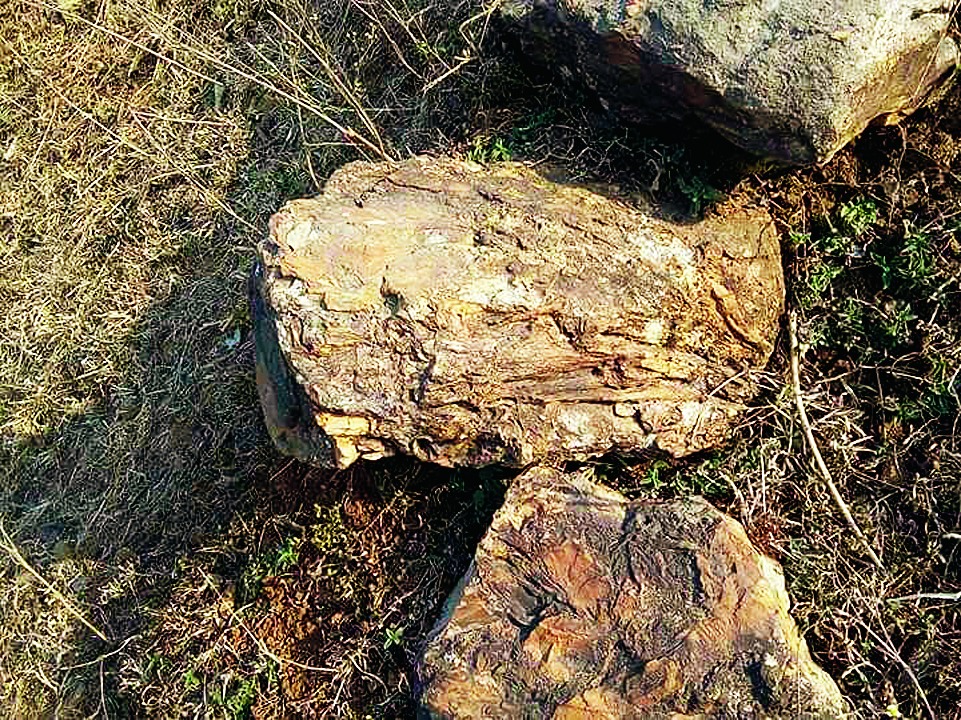

Ranchi, Jan. 31: A chance discovery of Jurrasic Age petrified plant fossils at Sonajori Hills, some 350km from Ranchi, has created quite aflutter in the remote north eastern district of Pakur that borders Murshidabad in Bengal.
"We have never seen this before. Detailed exploration needs to be carried out in the entire region as we are sure that many more plant and animal fossils would be found in the region. Today's discovery of the prehistoric plant fossils is just the tip of the iceberg," Pakur deputy commissioner Muthu Kumar told The Telegraph today.
Among the first steps that the administration has taken is to cordon off the area and ban all mining activities in the region.
Assistant professor of Sahebganj College Ranjit Kumar Singh was immediately summoned. Accompanied by district forest officer Rajnish Kumar, the duo inspected the petrified plant fossils by taking a quick tour of the Sonajori Hills, some 6 km from the district headquarters.
Singh was a part of the three-member team _ comprising assistant professor of botany at Serampore College, Hooghly, Partho Talukdar and assistant professor of APJ Abdul Kalam Government College, Calcutta, Prantik Hazra _ that had unearthed plant fossils and reptilian eggs, believed to be 70-150 million years old and dating back to the Jurassic Period, atop Rajmahal Hills of Sahebganj in November last year. Their find was reported in November 4, 20106 edition of The Telegraph.
"I have asked Singh to file a detailed report on the findings. After that the state government would be requested to create a fossil park at Pakur as an extension of the Mandro Fossil Park proposed at Sahebganj district. We would also request the government to carry out detailed exploration throughout Pakur, particularly at the Sonajori Hills," the deputy commissioner said.
Singh said the petrified plant fossils found at Rajmahal Hills in Sahehbanj district were remnants of Sal trees, while the one found at Sonajori Hills of Pakur seemed to be of another variety. "However, the discovery only confirms our belief that Pakur, along with Rajmahal Hills, might have been underwater millions of years ago," he said.
Preliminary examination of the Pakur plant fossil revealed that it could be apart of a tree trunk called Dadoxylon, or giant trees that were found in abundance throughout Gondwanaland, currently part of the Chotanagpur plateau.