 |
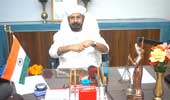
| Inder Singh Namdhari sits pretty at his office in Ranchi. Picture by Hardeep Singh |
Jharkhand Assembly Speaker Inder Singh Namdhari was a telecommunications lecturer at BIT Sindri before he followed his ?inner voice? to join politics. He gave up the job in 1965 and joined the Jan Sangh the following year.
Born on September 10, 1942, in Naushera (now in Pakistan), Namdhari did his graduation in engineering from the same institute. A popular leader of Daltonganj, he won in the Assembly polls in 1980, 1990, 1995, 2000 and 2005. His political associations include the Jan Sangh (and later BJP), Sampurna Kranti Dal and Janata Dal (United).
Namdhari became president of the Bihar unit of the BJP in 1988. In 1995, he formed the Sampurna Kranti Dal and became revenue & land reforms and transport minister of Bihar the same year. Last year, Namdhari was nominated president of the Jharkhand unit of the JD(United). He had been to jail during Emergency.
After Jharkhand was formed, he became the first Speaker of the Assembly. Namdhari?s influences include Guru Gobind Singh, Swami Vivekananda, Sardar Patel and Lokmanya Tilak. A man with a literary bent of mind, the Speaker loves to write whenever he finds time.
A widely-travelled person, Namdhari has visited United Kingdom, Australia, Malaysia, New Zealand, Thailand, USA, Namibia, South Africa and Canada. In an interview with Navtan Kumar, Namdhari shares his views on a number of issues.
• You were the Speaker in the previous Assembly as well. Is the new Assembly any different from the previous one?
Though there have been a few sittings after the new Assembly was formed, they did not last long. Moreover, those were full of turmoil. So, I have not been able to know the talent of the members. But I hope that the present Assembly will turn out to be better than the previous one.
• Kamlesh Singh joined after a long time. It is said that you were protecting him. Is it true?
Why should I protect him? Anyone can become a minister even without becoming a member of the Assembly. In fact, a member who has not taken oath, can even vote in the Rajya Sabha elections. So, where is the need to protect anyone? Now that he has taken oath, the chapter is closed.
• What do you have to say about discipline in the current House?
As I said, I do not know much about the members. So, I cannot comment on this aspect. But, I must say that there are no ?restless elements? in the Assembly. I hope the current crop of members turns out to be a disciplined one.
• You had once said you would strive to make Jharkhand Assembly a model House. Have you made any progress so far?
No Assembly can become a model House on the basis of its building and other external features. For an Assembly to become a model one, a lot depends on the behaviour of the members and decorum in the House. The Speaker has to go beyond party considerations and the Opposition members should have faith in him.
The members should have confidence in him. If there is any communication gap, this cannot be achieved. I have tried to bridge the communication gap and wanted to do more in a bid to make the Jharkhand Assembly a model one. We are trying to increase the number of House sittings every year. My target is to have five more sittings per year so that the number comes to 50 in a couple of years.
• Is there any plan to provide better housing facilities to MLAs?
We are in the process of increasing the number of rooms for the members. Some members have security problems while the senior ones want separate houses. We had requested the HEC management to give some ?F? and ?E? type flats. The management has allotted five ?E? type flats to us. We have asked for another 20 such flats.
• You present the ?best legislator? award every year. How about introducing an award for the worst one?
One should go from evil to good. This is the right path and not vice versa. Therefore, we identify only the good people and reward them so that others are inspired by their deeds. Identifying the evil will not serve any purpose. It will be against the spirit of Indian culture.
• You are an alumnus of BIT, Sindri. While the government gives crores of rupees to BIT, Mesra, the state-owned BIT, Sindri faces a financial crisis. What do you have to say about the special treatment given to private institutions like BIT, Mesra at the cost of ones like BIT, Sindri?
I feel aggrieved over the attitude of the government. BIT, Sindri is one of the oldest institutes in this region. But due to the apathetic attitude of the government, the institution is on the decline. There is an acute shortage of teachers. I forcefully demand that the process be initiated to make BIT, Sindri a deemed university and sufficient money be pumped into it. The government should take proper care of its own baby instead of paying attention to someone else?s baby on whom its has no control.
• You are a literary person. How do you find the time to pursue your hobby?
If you have interest in a particular subject, it will not be difficult for you to find time for it. Yes, you will have to give up luxuries like sleep. I have already written two books, which are compilations of my speeches and writings. I may write more books in future.
• Do you want to become the chief minister?
A man without desire is like a dead man. But there should be a constructive feeling behind any desire. I feel one can serve society better from a higher position. That way I would certainly like to become the chief minister but will not resort to any gimmick to achieve this.