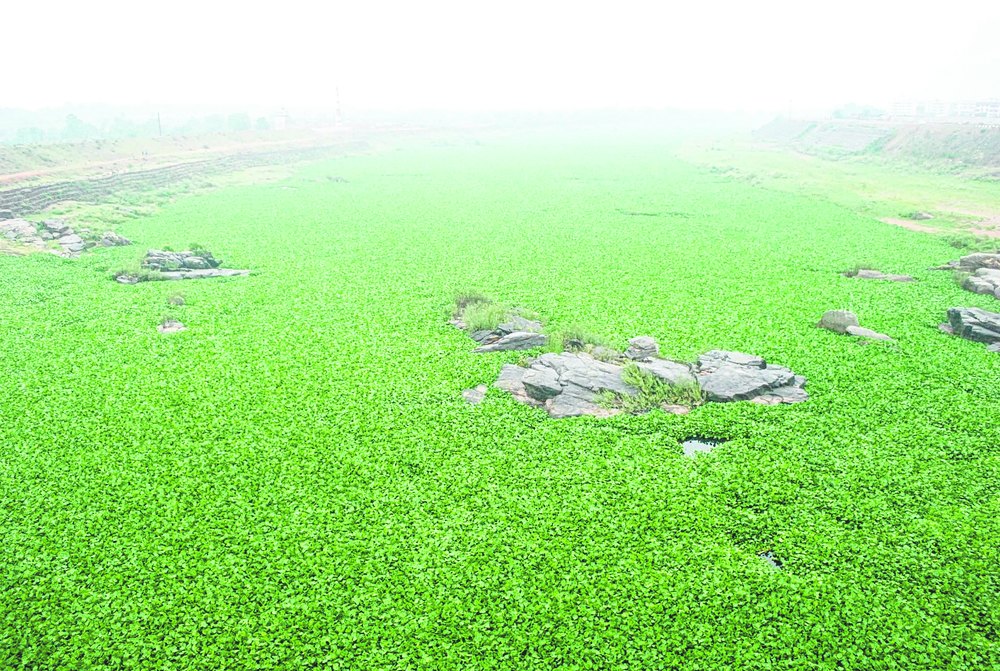

Kharkai, one of the tributaries of Subernarekha, boasts an emerald look these days.
A 5km stretch of the river in Jamshedpur, passing from Shastrinagar near Kadma to Domuhani, is once again choking on water hyacinth whose vigorous growth has further been catalysed by effluents, fertilisers and sewage draining into the waters from industries, farms and homes.
The green bloom is also seen on certain stretches of the Subernarekha near Bhuiyandih and Mango, but is yet to acquire pernicious proportions there.
That the unbridled proliferation of the water hyacinth in Kharkai can dramatically impact its water flow, block sunlight and starve fish and other river species of oxygen has conservationists concerned.
"The common hyacinth or jal kumbhi in local parlance grows in many water bodies during summer when the maximum temperature is high - ideally, more than 35°C. However, the extent to which water hyacinth has spread in Kharkai this year is unprecedented and indicates alarming level of pollution," said K.K. Sharma, an environmentalist and the head of zoology at Jamshedpur Co-operative College.
Sharma elaborated that the hyacinth blooms when there was "nutrient enrichment" in a wet habitat. "Here in Jamshedpur, there can be three ways of nutrients being enhanced in the waters of a river. One, mineral-rich effluents from industrial sources; two, domestic sewage; and three, nitrates and phosphates in fertilisers that drain into the river during rain."
On how harmful the hyacinth could be, the river crusader said the green weed carpet was capable of reducing the level of dissolved oxygen in Kharkai to an alarming level of less than four parts per million.
"The plant also shelters bloodsucking parasites such as leech and restricts flow of a river. Stagnant water becomes a breeding ground for vectors such as mosquitoes," he said.
Incidentally, health department statistics have shown a spurt in malaria and other vector-borne diseases in the area during the past few monsoons.
Sharma stressed that if the state government and urban local bodies continued to turn a blind eye to the green monster now, a time would come when damage control would be more than difficult.
"A massive effort is required by the state machinery to purge the river of hyacinth before monsoon hits Jharkhand and gains momentum. For starters, boats, ropes and garden cleaning equipment can be used for the purpose. The water plant can be recycled as cattle fodder," he said.
Regional officer of Jharkhand State Pollution Control Board (JSPCB) R.N. Choudhary conceded the presence of minerals and nutrients, which are leading to the water hyacinth bloom. "We have collected water samples as part of our routine tests. The report will be sent to our headquarters (in Ranchi) to identify the reason behind frequent hyacinth growth," he said.
Jusco spokesperson Rajesh Rajan said they had cleaned Subernarekha of hyacinth in 2009 and 2010, but it was too late to launch a similar drive in the Kharkai. "Ideally, cleaning work must be carried out in May. Pre-monsoon showers have already begun and the hyacinths will move along with the water current," he added.