 |
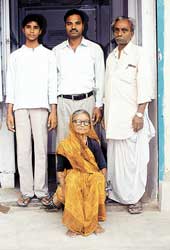
| The oldest lady of Harmu, 95-year-old Baso Devi, with three generations of her family. Picture by Hardeep Singh |
Residents of Harmu acknowledge that there is not much “community effort” visible in the complex. But old-timers cite the example of Central Sports and Cultural Organisation (CSCO), now virtually defunct, which gifted to the residents the Birsa Munda ground at Hospital chowk.
This remains virtually the only playground and open space in the sprawling complex. But even this open space was once sought to be taken over by the housing board, which wanted to slice the space into plots and sell them.
The move incensed the residents. The housing board had pledged to provide a park but had made no effort to fulfil its promise. And now it seemed the board was keen to deprive the residents of the only open space the colony had.
Resistance by the CSCO, comprising youngsters but led by a spirited employee of the electricity department, S.C. Banik, foiled the plan. They launched a spirited campaign and claimed the land in the name of the young.
“The Board had laid a road through the open space and had started plotting the land. We had a bulldozer dig up the road and demolish a small platform to clear the ground of constructions. The campaign eventually forced the Board to relent,” recalls Sukumar Jha.
It is difficult to identify the oldest resident. But Baso Devi (95) is probably the oldest woman in the Harmu Housing Colony and is possibly the oldest “entrepreneur” of the locality, affectionately called dadi by everybody.
She still potters around her house and keeps account of all transactions within the family. Belonging to a family of modest means, she is known in the locality as the lady who popularised ‘thongas’ or paper bags.
So much so that she built up a virtual monopoly in the business for some time, supplying the bags to shopkeepers in not just Harmu but also at Ashok Nagar and Pundag. One hundred paper bags, she recalls wistfully, fetched her just two rupees.
The cottage industry was supported by the family and her band of grandchildren lent her a helping hand, working for small incentives she offered.
The advent of polythene bags dealt a blow to paper bags and she was forced to switch over to rolling beedis.
“My grandchildren have always been my strength and have helped me in my ventures. Things are not the same anymore and people do not want paper bags these days. My son tells me that plastics are not environment-friendly but people still insist on polythene bags,” exclaims the old lady.
Baso Devi claims to have 135 grandchildren and is the head of a large family.
“My grandmother also used to make pickles and different masalas for sale. The ladies of the house used to chip in to meet the market demand. Now people get readymade stuff and no one cares for home-made stuff any longer,” adds her grandson, Gopal Prasad Soni.