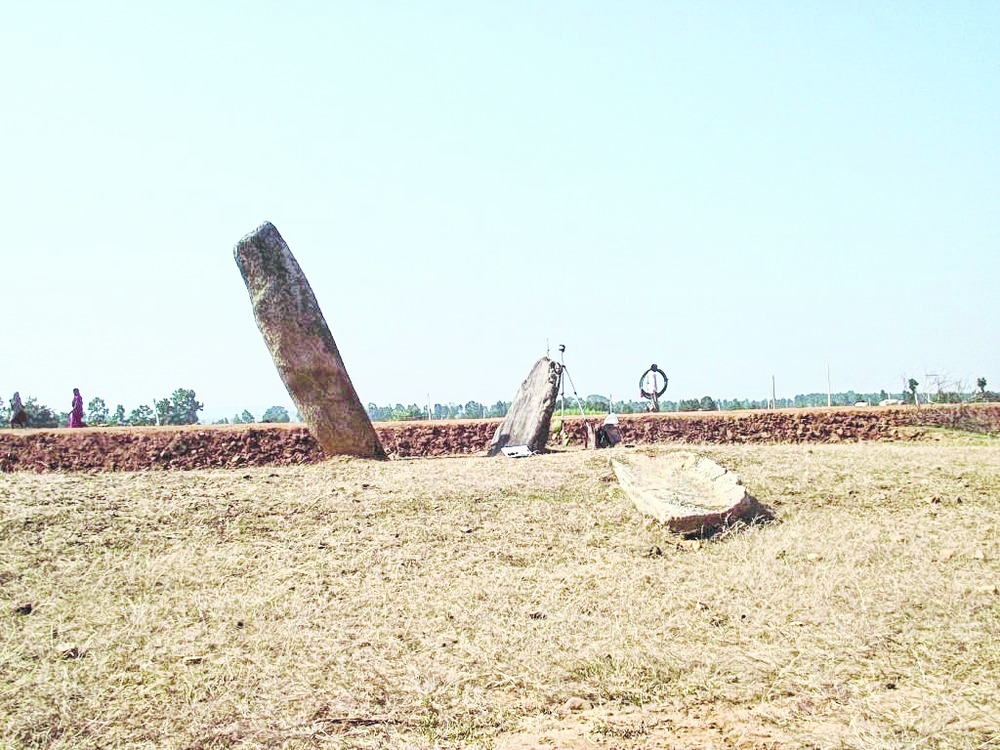


An ancient clay pot discovered with copper items near megaliths in Chatra district may push back the dates of Jharkhand megaliths - large stones to mark burials - from Iron Age to Copper Age, one of the best-known experts in Jharkhand, Subhashis Das has said.
So far, scholars had held all megaliths in Jharkhand were from Iron Age. But, the sudden discovery of the pot in a megalithic site, that's supposedly part of the items ritually buried to mark a death, could change everything, says Das, who shot into fame in 2009 by penning Jharkhand's first book on megaliths, Sacred Stones in Indian Civilisation.
Arriving at the megalithic site on the outskirts of a village called Singhani near Pathalgadda in Chatra, Das found out that land around an ancient megalithic site had been dug up during a road construction initiative. "In fact, the pot was found during digging for this road construction project," Das said, adding he was informed about the discovery by a local enthusiast, Jitendra Tiwary. "What I saw stunned me. The remains in the pot were copper artefacts, including slags, hooks, bars and a small ornamental bell. No trace of iron."
Das said the pot was buried according to a mode known as secondary burial. No remains of bones were found in the pot, Das added. "The pot would have been buried and a menhir, which is a free-standing large megalith, erected to mark the site as a mark of respect to the dead. We've seen this in the Iron Age," said Das. "But, what's significant in this case is that this pot seems to predate Iron Age, suggesting that this megalithic burial was possibly in the Copper Age when iron was not discovered or not known in these parts. However, more studies are required to arrive at a definitive conclusion," he stressed.
According to Das, megaliths may be of Mundari origin as influx of this tribe in Jharkhand occurred around 1,500 BC. It was around this period that practice of megalithism started.
Archaeological experts say Chalcolithic is also known as Eneolithic period that saw the use of metals among which copper was first. Earliest settlements of the Chalcolithic period range from Gangetic basin to Chhotanagpur Plateau, where people farmed, raised poultry, hunted and fished.
Distinctive pottery and the practice of burial of the dead are hallmarks of this period, with plenty of archaeological evidence found in Rajasthan, Gujarat and Maharashtra. Now, Jharkhand may also join the copper club.
"It's high time that Archaeological Survey of India takes up exploring Jharkhand megaliths with sincerity to know ancient ways of life," said the alumnus of St Xavier's School and St Columba's College in Hazaribagh who became a self-taught scholar of repute credited with bringing Jharkhand's megaliths to the forefront.
Not all megaliths were erected as a mark of respect to the dead. Some were for astronomical purposes also, like the Pakri-Barwaddih one used to see equinoxes and summer solstice sunrises, Das added.