 |
New Delhi, Oct. 17: The University Grants Commission today asked the country’s 700-odd universities to incorporate advanced security features into their mark sheets and certificates to check counterfeiting.
In a letter to all vice-chancellors, the higher education regulator cited the example of the University of Mumbai, which has since 2010 been issuing rainbow colour mark sheets that also carry the students’ photographs.
However, it said, the universities may adopt any technology they want. Several technologies exist that can check forgery of mark sheets or certificates.
BJP parliamentarian Anil Desai had written to the commission praising the University of Mumbai for its initiative to check mark-sheet fraud. That prompted the letter.
Manipal Technologies, which produces documents with security features, said about 40 per cent of Indian universities had begun using some kind of technology to secure their mark sheets and certificates.
Sagar Mukhopadhyay, corporate vice-president of the Manipal Group, said Bangalore University and Anna University, Chennai, began doing so in 2008-09.
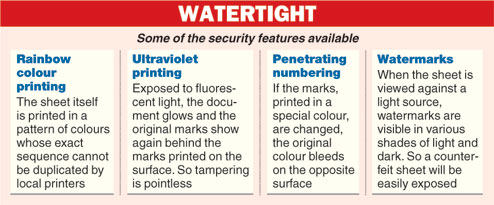
“Rainbow colour printing, watermarks and penetrating numbering are a few of the technologies that insure documents against easy duplication. No local printer can produce counterfeit documents if these technologies are used,” Mukhopadhyay said.
Mark sheets with security features will allow educational institutions and prospective employers to easily check their authenticity without having to consult the certificate-issuing authorities.
Prospective employers now send copies of job applicants’ mark sheets — if they are printed on plain paper — to the university or school education board for verification. These institutions have to manually match the documents against their records.
A few years ago, the University of Mumbai had filed police complaints against 627 candidates who had allegedly secured admission by producing bogus certificates between 2006 and 2009.
Delhi University too came across 31 alleged instances of students gaining admission by using forged Scheduled Tribe certificates in 2009, 2010 and 2011.
IIT Kanpur teacher Dheeraj Sanghi, however, said these technologies may not be needed once the government enacts the law for a National Academic Depository, an electronic database of all the certificates issued by school boards and universities.
“Once the depository comes into being, all certificates will be online. The institution or employer can access the original certificate from the online depository and verify,” Sanghi said.
The National Academic Depository bill has lapsed since its introduction in the Lok Sabha by the previous government, but the Narendra Modi government has decided to bring it back with modifications, sources said.
Sanghi said the IITs use a watermark in the certificates they issue to students.