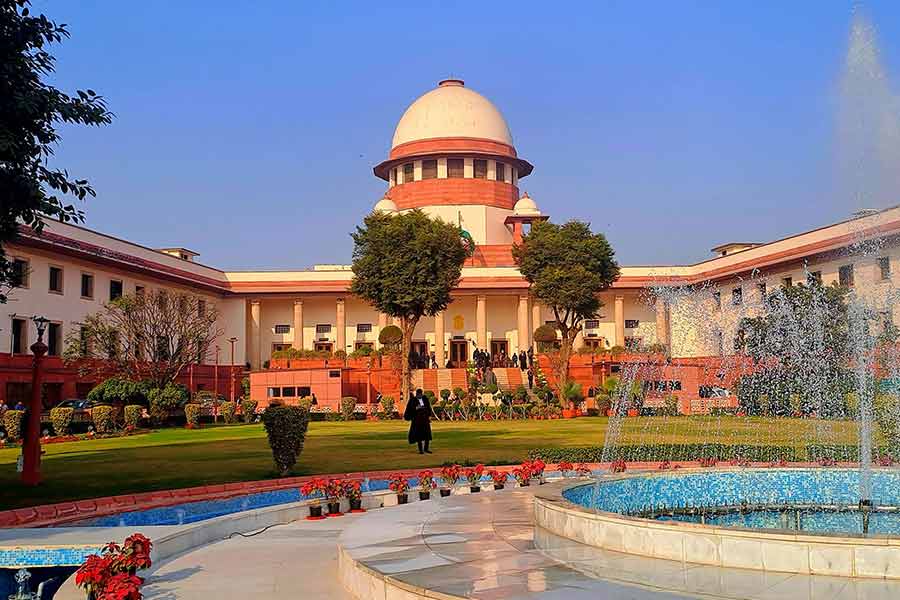
The Supreme Court on Tuesday delivered a split verdict on the constitutional validity of Section 17A of the Prevention of Corruption Act, which mandates prior sanction of a competent authority before prosecuting any public servant.
Justice B.V. Nagarathna, heading the bench, held that the provision was “unconstitutional”. The other judge on the bench, Justice K.V. Viswanathan, took the view that the provision was constitutionally valid, but only an independent authority such as the Lokpal or the Lokayukta should be vested with the power to grant sanction.
“Having regard to the divergent opinions expressed by us, we direct the Registry to place this matter before Hon’ble the Chief Justice of India for constituting an appropriate bench to consider the issues which arise in this matter afresh,” the bench said.
Section 17A was introduced through an amendment in 2018 to protect public servants from prosecution in corruption cases. The section was challenged by the Centre for Public Interest Litigation (CPIL) on the ground that it was introduced to frustrate any police probe into the offences committed by a public servant.
According to the NGO, the amendment was brought in despite the apex court holding twice earlier that no prior sanction was needed for a probe against public servants.
While holding the provision unconstitutional, Justice Nagarathna said: “Firstly, the question is whether prior approval within the meaning of Section 17A of the Act has to be given at all? The question is not about who, within the government or outside the government, should give such an approval. In my view, no such prior approval is required....”
She said Section 17A of the Act was nothing but another attempt to resurrect on the statute book what was struck down by this court earlier.
“...In my view, the requirement of prior approval within the meaning of Section 17A of the Act is contrary to the object and purpose of the Act, inasmuch as it forestalls an enquiry and thereby in substance protects the corrupt rather than seeking to protect the honest and those with integrity, who really do not require any such protection,” she said.
She said she did not concur with Justice Viswanathan’s view to substitute the expression “Government” in Section 17A and the expression “of the authority competent to remove him from his office” with “Lokpal” or “Lokayukta”, as the case may be, as such substitution was impermissible by way of interpretation.
Justice Viswanathan said Section 17A was “constitutionally valid, subject to the condition that grant or refusal of the approval by the competent authority mentioned therein will depend on the recommendation of the Lokpal/Lokayukta”.
He said the Centre or states and “the authorities competent to remove set out in Section 17A will, on receipt of the information under Section 17A, immediately forward the information to the Lokpal/Lokayukta”.
The Lokpal/Lokayukta may initiate an inquiry and forward the recommendation to the appropriate authority, who shall be bound to act in accordance with the recommendation insofar as the grant or refusal of permission under Section 17A is concerned, he said.
“Insofar as the judiciary is concerned, already Veeraswami (supra) and UP Judicial Officers Association (supra) have provided a mechanism. Section 17A(c) could also be attracted in cases where the body/organisation/public servant is not covered within the jurisdiction of Lokpal,”
he said.
In such cases, the authority competent to remove the public servant in question should get the information screened by an independent investigative agency and act in accordance with its recommendation, he said.