SERIAL RALLIES ASSERT MARATHA PRIDE

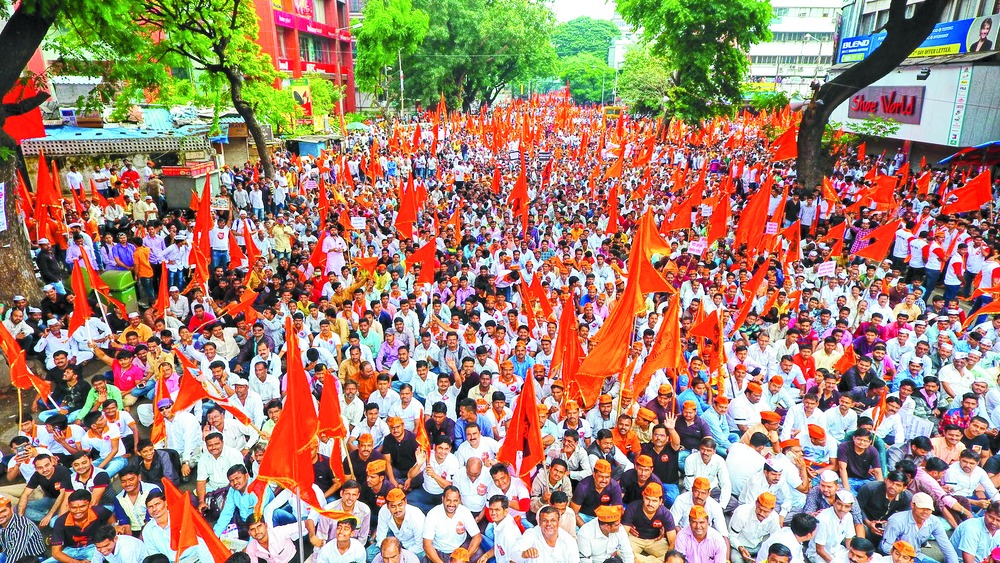
Oct. 2: A series of massive silent rallies by the Maratha community across Maharashtra over the past six weeks has rattled the political leadership and left the backward communities nervous at the dominant caste's self-assertion.
It began as a protest in Marathwada in mid-August after the July rape and murder of a Maratha girl at Kopardi village in Ahmednagar district. Now it has galvanised the entire caste which, after centuries of social and political predominance, is feeling left behind by a quarter century of economic and political changes.
About 20 rallies have been held in various towns and cities - such as Aurangabad, Latur, Beed, Ahmednagar, Nashik and Solapur - and another dozen are planned, with a grand finale scheduled in Mumbai later this month.
One striking feature of the Maratha Kranti Mook Morchas (Maratha Revolutionary Silent Rallies) has been their size. An estimated two million invaded Pune's streets on September 25, and tomorrow's march in Satara is expected to surpass that.
Every rally has been silent but if the turnout carries a loud message, its meaning appears open to interpretation.
Among the marchers' demands, which include a call for the strictest punishment for the three arrested Kopardi accused, two have the potential to pit the Marathas against Dalits and the Other Backward Classes (OBCs).
Of them, the first is a plea to amend certain provisions of the SC/ST Prevention of Atrocities Act which, the protesters claim, are being misused to settle scores against Marathas in the villages.
The second is a demand for OBC status for the Marathas - a landowning upper caste that has traditionally dominated the cooperative farm sector and government jobs.
The first demand has the Dalits, particularly the state's politically assertive Ambedkarites, worried. The second may face a judicial test if implemented by the government.
An Economically Backward Classes quota for poor Marathas and Muslims that the previous Congress-NCP government had introduced through a pre-election ordinance in 2014 is already being contested in high court.
So, is the agitation divisive? The answers can seem evasive.
"The marches are a socio-political assertion by the community," says Pravin Gaikwad, a Pune-based businessman and one of the protesters' most visible advocates.
"We know they are causing anxiety among other communities. That's why every effort is being made to keep the political leaders - divisive forces - away from hijacking the discourse."
During the Pune march, young volunteers quickly spotted and removed posters that demanded implementation of a uniform civil code, apparently put up by RSS supporters who had infiltrated the rally. "This is not our demand," one of them said as he tore a poster.
But other communities' jitters are not so easily assuaged. Dalit and OBC leaders are said to be mulling similar shows of strength. Commentators and critics are asking why a dominant section is suddenly playing victim.
The Marathas say a vast section of the community is poor and feels increasingly under pressure. Conversations threw up three developments from the early 1990s as the possible root of the community's insecurity.
One, the 1990 Mandal reservations turned the OBCs into powerful rivals for jobs and political clout. Two, the 1991 economic reforms faced the Maratha cooperatives with gruelling private competition.
Three, the 1992 Babri demolition led to the rise of the Shiv Sena and the BJP, which identified the OBCs as a vote bank, strengthening the Marathas' feelings of marginalisation.
Shrikant Barhate, a former World Bank consultant and political commentator, says the Marathas fear they would turn politically irrelevant if they don't unite.
One hallmark of the agitation is that they seem to have united without a leadership, without even a recognisable face like the Patidars in Gujarat have in Hardik Patel -and appear none the worse for it.
The Sakal Maratha Samaj (All Maratha Community) under whose banner the rallies are being held seems a loose collection of volunteer-driven local community bodies.
Each rally is organised by a group of 4,000-5,000 volunteers from the district concerned, with the community's traders, professionals and peasantry providing much of the funds and manpower.
Political leaders are allowed to walk as commoners but denied the chance to climb onto daises or make speeches -- although some of them are said to be quietly providing money and logistical support.
There's no sloganeering. A few local young girls make short but fiery speeches at the end of a march, which typically covers 4-5km, and hand over their memorandum of demands to the district collector.
Which highlights a third feature of the rallies: a display of impeccable discipline and organisation that has, paradoxically, inspired awe about the agitators' potential to cause trouble if they want.
Within hours of the Pune march, the streets had been stripped clean of the garbage, hoardings and banners, as if nothing had happened.