|
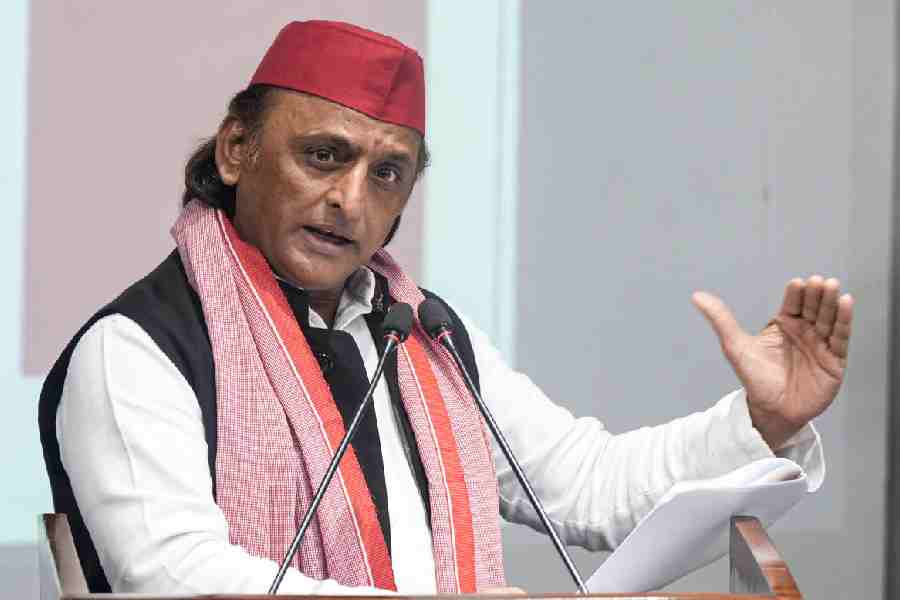
| Aditya Thackeray shares a light moment with father Uddhav Thackeray during a rally in Mumbai on Sunday. (PTI) |
Mumbai, Oct. 12: At 24, Aditya Thackeray has proved he means business and that he will not bask in the shadows of his late grandfather Balasaheb Thackeray and father Uddhav.
As the scion and political legatee of Shiv Sena chief Uddhav, Aditya had last year proposed that if the Sena came to power in Maharashtra, Mumbai would have a 24x7 nightlife.
For starters, Aditya asked the Sena-controlled Brinhanmumbai Municipal Corporation or BMC to relax certain conditions under the Shops and Establishments Act so that Mumbai’s restaurants could stay open all night.
His suggestion, still to be implemented, was enshrined as a statement of intent in the Sena’s manifesto that was released on Friday. “Our government will open up Mumbai to a vibrant, yet safe nightlife by allowing shops, theatres, malls, cafes to remain open all night, especially in non-residential areas,” promised the glossy document.
Like his family members, Aditya seeks the company of film stars and was reportedly starry-eyed even today about Michael Jackson. The King of Pop had called on Bal Thackeray at the family residence Matoshree when the leader had invited him for a show in Mumbai in 1996. Aditya’s iPod is full of his numbers.
For a party that used to unleash its activists on the streets of Maharashtra’s cities to ban celebrations on Valentine’s Day, Aditya is attempting a serious makeover.
When Sena offshoot, the Maharashtra Navnirman Sena, helmed by Uddhav’s cousin Raj Thackeray, stoked an old but forgotten breach between Mumbai’s Marathi and Gujarati-speaking population, the present lot of Thackerays did not bite the bait.
“A non-issue was sought to be made into an issue. Everyone co-exists in Maharashtra,” said Harshal Pradhan, the Sena’s communications cell chief.
Pradhan’s two bits of advice to Prime Minister Narendra Modi were “he should seriously look after India and stop behaving as though he wished to be Maharashtra’s chief minister” and he should “stop using Gujaratis like a vote bank, like the Congress uses the Muslims and the Dalits”.
The Gujarati-Marathi “divide” goes back to 1960 when Parliament enacted the Bombay Reorganisation Act, 1960, and legislated the creation of Maharashtra and Gujarat.
Preceding the act, the Bombay state was formed as a result of the States Reorganisation Act, 1956. The Bombay state was composed of different areas where languages like Marathi, Gujarati, Kutchi and Konkani were spoken.
The Samyukti Maharashtra Samiti spearheaded a movement that culminated in the division of two states set up from the Bombay state, one that comprised areas where people primarily spoke Gujarati and Kutchi and one where Marathi and Konkani were chiefly spoken. But a majority of Mumbai’s Gujaratis and Kutchis stayed put in the city, to carry on with their business and trade.
Shirish Parkar, the MNS general secretary-cum-spokesperson, maintained that Raj would never have resurrected the Marathi-Gujarati issue had “demographics” not forced it.
“Gujaratis have largely integrated with Maharashtra’s society, many of them speak Marathi. But the problem is that most of the residential areas that used to be inhabited by Marathi-speaking people have been taken over by developers and builders who are Gujarati Jains. The first thing they do is to build a Jain temple on the premises and declare that no non-vegetarians will be allowed. And 50 per cent of Marathi-speaking people are non-vegetarians, so you are excluding that population,” alleged Parkar.
He pointed out that when former Prime Minister Manmohan Singh used to meet Barack Obama, the US President never greeted him with a “Sat Sri Akal”. “But why did Obama say ‘Kem chho’ to Modi? Is he the PM of India or Gujarat?” asked Parkar.
The MNS’s campaign resonated, albeit, to a small extent in the areas of central Mumbai like Girgam and CP Tank, which have a mixed population of Marathis, Gujaratis, Marwaris and neo-rich Uttar Pradeshis.
Barring the Marathis, largely a service community, the others who are into business have banded together behind the BJP in the hope that a BJP government will “rein in” the MNS’s “chauvinistic proclivities”.
Although a bookseller like Mahendra Kastur, who spoke Marathi, said he would vote the Sena, other Marathi speakers in the Gujarati-dominated Madhav Bagh felt the BJP “deserved a chance” in the name of “stability and growth”.
For the Sena and the MNS, calibrating the call of modern-day imperatives with their DNA is a challenge in the elections.