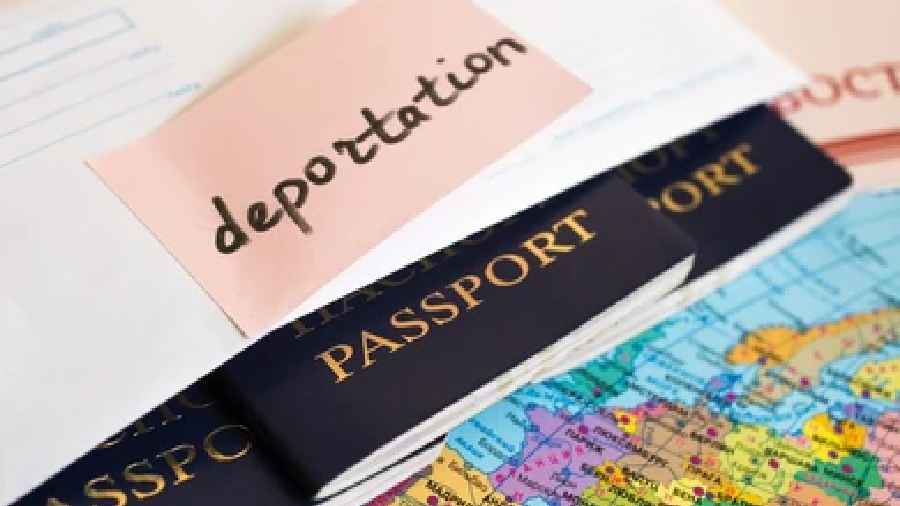
The Parliamentary Standing Committee on External Affairs has taken note of the deportations of illegal Indian immigrants from the United States in recent months and the possibility of "probable mass deportations in the future", urging the government to deal with the situation in a "more empathetic" manner.
The committee is headed by Congress leader Shashi Tharoor.
The Ministry of External Affairs, in its response to the panel, stated that it has taken note of the recommendation.
The report, titled 'Action Taken by the Government on the Observations/ Recommendations contained in the Sixth Report of the Committee on the subject -- Indian Diaspora Overseas including NRIs, PIOs, OCIs and Migrant Workers: All Aspects of their Conditions and Welfare, including the Status of the Emigration Bill', was presented in Parliament on Thursday.
"In the wake of deportations of illegal Indian immigrants back to the country from the United States and probable mass deportations in the future, the Committee had expressed their feelings in unequivocal terms about the humanitarian concerns surrounding the issue," the panel said in its report.
The panel was apprised that India is against illegal immigration and is committed to taking back its nationals who are illegal immigrants in other countries.
It was informed that most countries have standard operating procedures in place to handle deportation-related matters, and the MEA has an SOP, whereby nationality and security verification processes are undertaken in coordination with other agencies.
Responding to concerns about detainees being restrained by handcuffs, waist chains, and leg irons during US Air Force flights, the MEA stated that the US actions were in accordance with the Restraints Policy No. 11155.1, Section 5.10, effective from 19 November, 2012.
The panel was further informed that in the second deportation flight on 15 February, women and children were "not shackled" by the US Immigration and Customs Enforcement, honouring repeated MEA requests.
The committee emphasized that while it is the responsibility of any government to take back citizens who have entered or lived in a country without proper documentation, "they desire that the government should deal with situation in a more empathetic manner upholding the human rights of migrants and explore ways and means to facilitate the return of such illegal immigrants to India without hurting their self-respect".
The Centre informed the panel that foreign nationals in the US who have entered illegally, overstayed their visa, or have criminal convictions are likely to be deported.
"It is the obligation of all countries to take back their nationals, if they are found to be living illegally abroad. This is, however, subject to an unambiguous verification of their nationality. This is not a policy practised only by India; it is a generally accepted principle in international relations," the response added.
The panel also recommended specific and detailed "re-integration programmes" by the government, integrating the inputs and expertise of states that have developed successful ways to reintegrate returning workers.
The Centre noted the recommendation but clarified that the responsibility of reintegration rests with the respective state governments from where the emigrants belong.
The committee highlighted the risks faced by Indian nationals lured through fake recruitment offers by dubious firms, particularly in South-East Asian countries such as Cambodia, Myanmar, and Lao PDR, where they are forced to work as bonded labourers in cybercrime and fraudulent activities.
"Though the exact number of Indian nationals stuck in these countries is not known, the Committee have been informed that through concerted efforts, 1,091 Indian nationals from Cambodia, 770 from Laos and 497 from Myanmar, including software engineers have been rescued till date," the report said.
The committee stressed that Indian embassies or consulates in destination countries should always be available to verify employers.
The Centre noted that the exact number of Indian nationals stuck in these countries is unknown, as many reach scam centres through fraudulent recruitment agents or illegal channels on their own volition.
On the conversion of PIO cards to OCI cards, the panel noted that "the scheme of PIO cards has been discontinued since 2015 and all PIO cardholders (handwritten and machine-readable) have been advised to convert their PIO card to OCI card before 31 December, 2025".