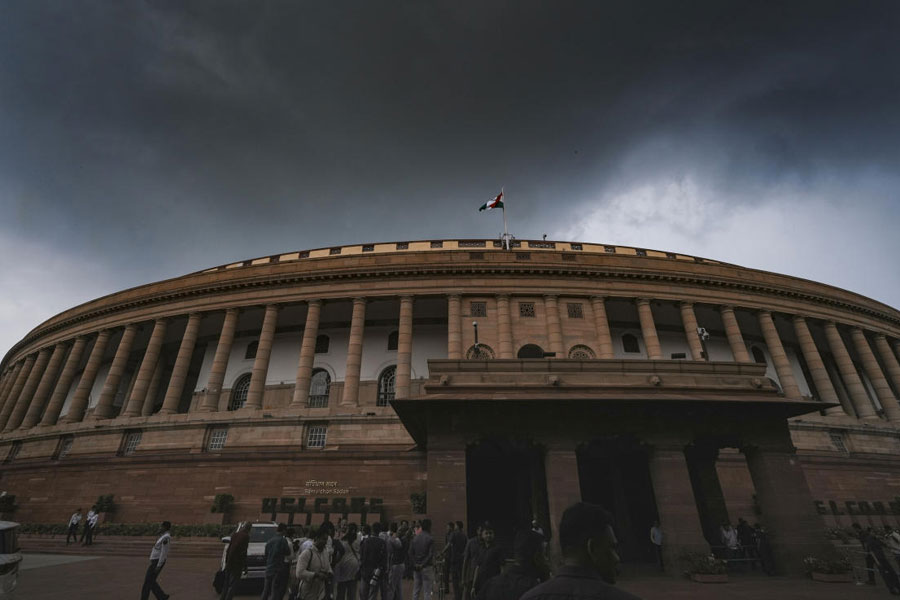
Parliament on Wednesday passed a bill to repeal or amend 71 obsolete and outdated laws with the stated objective of enhancing the ease of living for citizens.
The Repealing and Amending Bill, 2025, was cleared by the Rajya Sabha through a voice vote. The Lok Sabha had approved the legislation a day earlier.
Piloting the Bill in the Upper House, Union law minister Arjun Ram Meghwal said the exercise was aimed at removing outdated laws, correcting errors that had crept in during the law making process and eliminating discriminatory aspects of certain statutes.
Replying to the discussion, Meghwal said one of the main objectives of the Bill was to improve the ease of living for citizens.
"We give priority to ease of living along with ease of doing business," the minister said, adding that if laws have become obsolete, the government would bring legislation to repeal them.
Referring to the Indian Succession Act, 1925, Meghwal said that if a Hindu, Buddhist, Sikh, Jain or Parsi made a will in the then Madras, Bombay and Calcutta presidencies, it was mandatory to obtain probate, while a similar provision does not apply to Muslims.
"Why not Muslims? Will there be no consideration over it? This is the Narendra Modi government and the country will function according to the Constitution," he said, adding that any discrimination on the basis of religion, caste and sex is prevented by the Constitution.
"These reforms are a step towards liberation from a colonial mindset," the minister added.
Vivek K. Tankha of the Congress disagreed with the minister’s contention that the Bill was meant to free the country from a colonial mindset.
He alleged that the government had only completed technical formalities on paper without assessing the impact of the Bill on people at the ground level.
The legislation seeks to repeal 71 Acts, including the Indian Tramways Act, 1886, the Levy Sugar Price Equalisation Fund Act, 1976, and the Bharat Petroleum Corporation Limited (Determination of Conditions of Service of Employees) Act, 1988.
It also proposes amendments to four Acts. These include the General Clauses Act, 1897, and the Code of Civil Procedure, 1908, to update terminologies for registered posts.
Amendments have also been proposed to the Indian Succession Act, 1925, to remove the requirement of obtaining validation of wills by courts in certain cases.
In addition, the Bill amends the Disaster Management Act, 2005, to rectify a drafting error.
Meghwal said that since 2014, a total of 1,577 old and archaic laws have either been repealed or amended. Of these, 1,562 laws have been repealed and 15 have been reenacted.
During the discussion, Subhash Barala of the BJP said people had been suffering because of old laws and that the Bill would remove the hindrances faced by them.
Sushmita Deo of the All India Trinamool Congress said the legislation provided an opportunity for course correction, allowing the government to examine which provisions of existing laws were working against civil liberty, democracy and dissent.
KRN Rajeshkumar of the DMK, Subash Chandra Bose Pilli of the YSR Congress Party, Niranjan Bishi of the BJD, M. Thambidurai of the AIADMK, A. A. Rahim of the CPI(M), Haris Beeran of the IUML, Madan Rathore of the BJP, Ramji of the BSP, Ashok Kumar Mittal of the AAP, Kalpana Saini of the BJP and Mahua Maji of the JMM also participated in the discussion on the Bill.