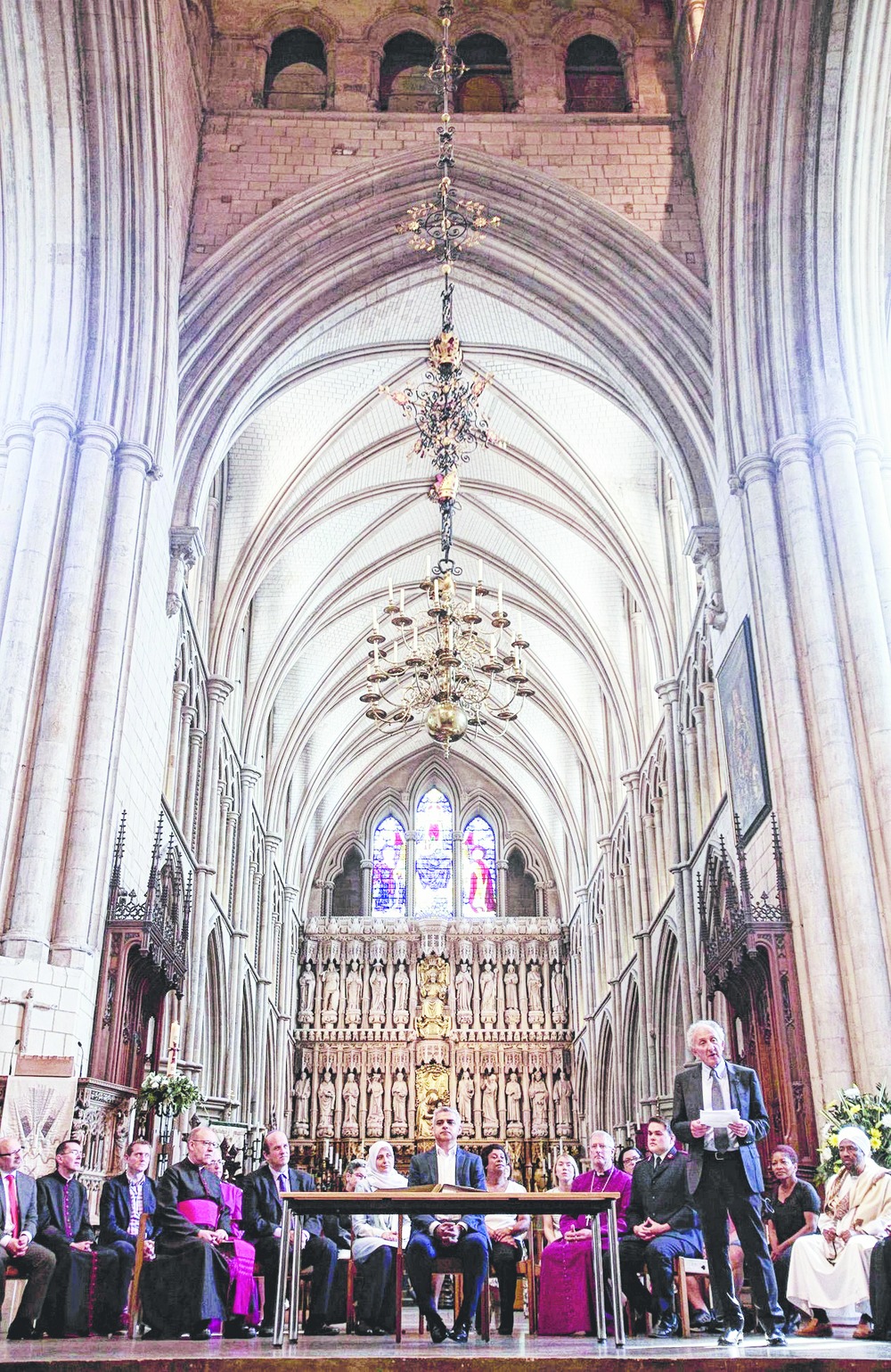

May 7: The election of Sadiq Khan as mayor of London has prompted Omar Abdullah to wonder whether any second-generation immigrant from a minority community would be voted in India to such a high-profile post.
"Well done #London. @SadiqKhan's victory shows the world that you don't need to scare people into voting for you. An example for all cities," the former Jammu and Kashmir chief minister tweeted.
"Gotta wonder if any of our cities in India would ever vote a second generation immigrant from a minority community to such an important post," he added.
That Omar touched a raw nerve was evident from the response on social media. Some asked whether any Kashmiri Pandit could ever become chief minister of Jammu and Kashmir. "Forget immigrants, will a refugee KP (Kashmiri Pandit) get such a post in Kashmir Valley on his return to his legit home?" asked one Twitterer.
Jammu and Kashmir never had a non-Muslim chief minister after Partition but a tradition has struck roots in the state in which the chief minister has always been a Muslim and the governor a Hindu.
One Twitterer mentioned a "first generation immigrant" who won elections in Rae Bareli, in an indirect reference to Sonia Gandhi.
Another reminded Omar of an "immigrant from a minority community" who became Prime Minister of India.
"Sirji, we had a first generation immigrant from minority running this entire country for a decade! I mean Dr Singh! Not SG!! (second generation)," said a tweet attributed to Sanjaya Baru, who used to be Manmohan Singh's media adviser.
Singh, who was born in what is now Punjab on the Pakistan side, and his family had moved to India sometime during the Partition.
Omar was not available for comment. Agha Ruhullah, the chief spokesman for Omar's party National Conference, appeared to suggest that his boss was referring to a Muslim immigrant.
"It is not possible in India the way politics goes in India. Do you see a chance for a Muslim, especially an immigrant, to become Prime Minister of India, especially in a time when RSS is calling the shots?" Agha asked.
Zafar Mahmood, a former Indian Revenue Service official who had worked in the PMO in 2005-2006 under Prime Minister Singh, told this newspaper the people of London had sent a right message in these trying times.
Mahmood said there was bias against minorities in India but it's different from London. He pointed out how Aruna Asif Ali, who had taken part in the Quit India movement, had become Delhi's first mayor in 1958.
Independent India has had some Muslim chief ministers outside Jammu and Kashmir but not many, especially in the years after the Babri Masjid demolition.
Abdul Gafoor served as Bihar chief minister, Barkatullah Khan in Rajasthan and C.H. Mohammed Koya (for less than two months) in Kerala in the 1970s. In the following decade, Begum Anwara Taimur was chief minister of Assam for less than a year and Abdul Rahman Antulay in Maharashtra for less than two years.
After the Mandal agitation and the Babri demolition, even secular parties like the Congress have shied away from appointing Muslim chief ministers.
The Indian states where Muslims have considerable voting clout -- Assam, Bengal, Bihar, Uttar Pradesh, Andhra, Telangana and Kerala - are yet to see a Muslim home minister with independent charge. In some states like Bengal and Assam, there had been ministers of state for home from the minority community.
In Kerala, the Muslim League, the second largest ally of the ruling United Democratic Front after the Congress, wields enormous influence and has been holding the education and industries ministries.
Elsewhere, however, Muslim MLAs are usually given ministries looking after matters relating to Waqf, the minorities, Haj, culture, urban affairs and environment.
Barring a handful of Left leaders, several Muslim MPs have been elected from seats with a heavy concentration of minority voters.
In 1952, Maulana Abul Kalam Azad had initially refused to contest the general election from Rampur, a Muslim-majority constituency, saying his objective was not to represent Muslims alone in Parliament. In 1957, he moved to Mewat in Haryana, which too had a sizeable Muslim population.
"The historic election (in London) is a rebuke to all the extremist forces, be it in India or abroad," said Navaid Hamid, the president of All India Muslim Majlis-e-Mushawarat, an apex body of several Muslim organisations.
"This is also a big message for political parties in India, especially the BJP and the RSS who divide people along religious lines for their narrow political ends. By electing Sadiq as the first Muslim mayor, Londoners have shown that all religions can peacefully exist," he said.
Farida Abdulla Khan, a member of the National Commission for Minorities, said Sadiq's election could not be compared to the situation in India. "There are many Muslim politicians in India who had been elected to important posts. At the same time, Muslims in India are not first or second generation. So, the comparison is not apt," she said.
Navaid said there had been an undeclared policy in India not to give top political and government posts to under-privileged classes. He cited how it took 60 years for a Muslim to be appointed director of India's Intelligence Bureau. UPA-II had appointed Asif Ibrahim as IB director in 2012.
Traditionally, he said, no Muslim officers had been appointed to senior posts in the IB and the Research and Analysis Wing (RAW), the external intelligence agency, as there was bias against the community and a "deliberate policy" to exclude Muslims from sensitive and strategic services.
One of the most tantalising "what-ifs" in the 20<+>th<+> century was a version that Mahatma Gandhi had suggested that Muhammad Ali Jinnah should be made Prime Minister to prevent the Partition.
Various theories abound on why the suggestion did not materialise. Some say Jawaharlal Nehru and many Congress leaders were not keen on the idea while others say it has never been conclusively established whether the proposal would have been acceptable to Jinnah at that stage.
India did have several Muslim Presidents but the post is largely ceremonial and the most important job in the country still remains that of the Prime Minister.