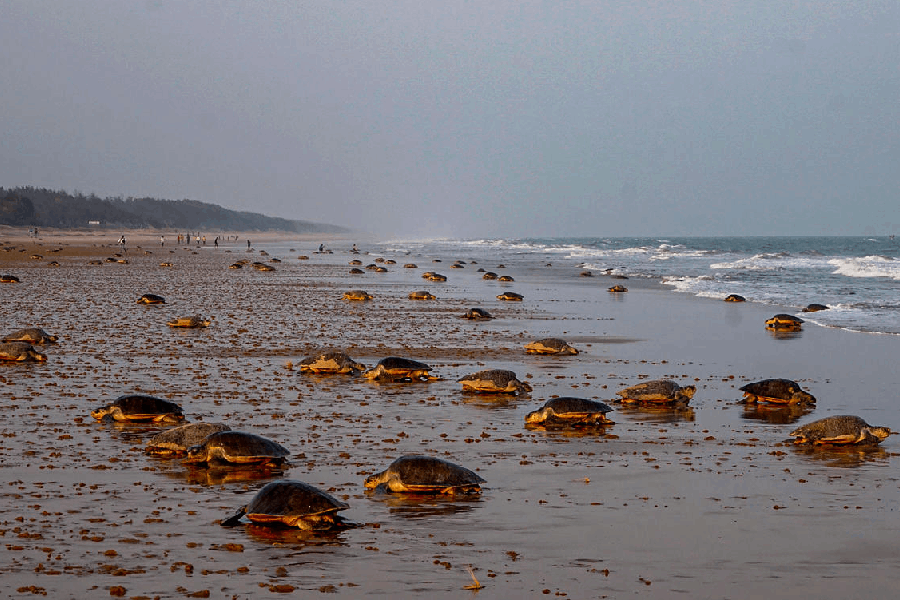
Nature lovers and wildlife experts in Odisha are worried that the endangered Olive Ridley turtles skipped their annual visit for mass nesting to the Gahirmatha coast in Kendrapara district this year.
The Gahirmatha beach, close to Bhitarkania National Park in Kendrapara district, has the distinction of being the World's largest-known rookery where millions of olive ridley turtles converge annually for laying eggs.
According to Varadaraj Gaonkar, Divisional Forest Officer (DFO), Mangrove Forest Division (Wildlife), Rajnagar, each year these turtles in millions of numbers used to turn up for laying eggs during January-March along the Gahirmatha beach. However, there are instances in the past when turtles made their appearance towards the fag end of March.
"But it was never delayed beyond that," the DFO said.
Meanwhile, turtles have already emerged at Rushikulya river mouth, another rookery in the state's Ganjam district, for mass nesting. But they are yet to appear at the nesting ground at Gahirmatha, the officer said.
"Though there is a possibility of turtles skipping mass nesting this year as they had done in 2014, we are not entirely ruling out the emergence of turtles for mass nesting as weather conditions and beach profile at the Agarnasi are ideal and perfect for marine animals to turn up en masse for laying eggs, the DFO said.
It's a unique natural phenomenon called 'arribada', a Spanish term that describes the millions of these marine species converging on the nesting ground in Gahirmatha in Odisha's Kendrapara district for laying eggs.
It is tough to predict what has prompted them not to appear at the nesting beach so far, he added.
Wildlife experts, however, tend to believe that unchecked trawl fishing and human interference might have affected their privacy, prompting them to play truant. They are yet to arrive at a definite conclusion that has led to the disappearance of turtles.
Though studies are going on on the behaviour of the turtles, another official said that a mystery hovers around their habitation pattern of these marine species. Research is yet to throw much light on these.
Non-emergence of turtles along the Gahirmatha might be due to the multiplicity of factors. But these conclusions are in the realm of speculation, they added.
While turtles did not turn up at Gahirmatha for arribada last time in 2014, they also did so in 2008, 2002, 1998, 1997, 1988 and 1982, according to official records. In 2025, as many as 6.06 lakh turtles emerged from the seawater to crawl and dig pits on the beaches to lay eggs, a phenomenon otherwise described as 'arribada' (a Spanish term) in a five-day span starting from March 5.
It's only the female turtles that virtually invade the nesting beaches, usually at the dead of night for laying eggs. After indulging in instinctive egg-laying, the turtles leave the nesting ground to stride into the deep seawater.
Hatchlings emerge from these eggs after 45-60 days. It is a rare natural phenomenon where the babies grow without their mother, said the officials.
Except for the headline, this story has not been edited by The Telegraph Online staff and has been published from a syndicated feed.