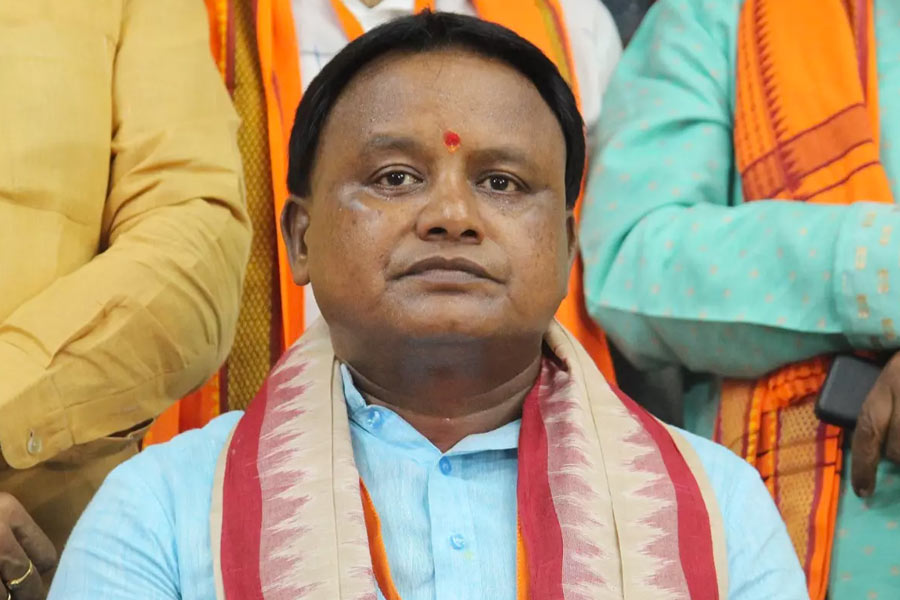
Chief minister Mohan Charan Majhi on Friday suspended four State Council of Educational Research and Training (SCERT) officials and initiated disciplinary proceedings against six others after a committee found lapses in the large-scale errors in school textbooks.
The high-level committee, headed by the development commissioner Deoranjan Kumar Singh, was constituted by the chief minister after widespread criticism over mistakes in the textbooks. It was tasked with assessing the nature and extent of the errors, identifying where the lapses occurred and fixing responsibility on the officials or agencies involved.
The officials concerned have been asked to submit a comprehensive report within seven working days. Textbooks prepared by the SCERT for Classes I to VIII have been found to contain nearly 1,678 identified errors. The highest number, 705, was found in the Class VIII textbooks, including 294 in jijnasa (curiosity), 114 in Sanskrit, 25 in social science and 31 in literature, besides several significant mistakes in English and mathematics.
Among the glaring errors, a photograph of the Karnataka Assembly was presented as that of the Odisha Assembly, Odisha’s sacred Niyamgiri Hills were shown as being in Jharkhand, Ganjam district was referred to as Brahmapur district, and the names of noted Odia personalities such as Sunanda Patnaik and Pandit Nilakantha Das were misspelt.
Development commissioner Singh submitted the report on Friday. Acting on its recommendations, Majhi suspended former director of Teachers’ Training and SCERT, Manoj Padhi, and three assistant directors — Pralipta Mishra, Dilip Kumar Sahu and Bharati Tudu. Padhi is currently serving as the special secretary in the school and mass education department.
The government also initiated disciplinary proceedings against six assistant directors — Bandita Pattnaik, Manas Ranjan Rout, Manoranjan Mahapatra, Dr Prashant Kumar Sahu, Manas Kumar Nayak and Dr Sudarshan Santara.
Chief minister Majhi announced that all 14 recommendations of the committee would be implemented to prevent such lapses. The government will publish a Master Errata Register within seven days, provide replacement pages or reprinted inserts for serious errors, supply printed correction sheets to all students, and declare the corrected PDF as the official teaching version.
The government will also conduct immediate orientation for teachers on the corrections, prepare a responsibility matrix for every error and issue show-cause notices to the Desktop Publishing (DTP) agency, printer and approving authority.
A textbook quality assurance cell will be set up in SCERT, along with subject-wise curricular area groups and book-wise textbook development committees on the NCERT pattern. A four-stage proofing system and a final locked PDF mechanism will also be introduced.
The recommendations also include setting up a Public Errata Portal, introducing penalties, performance scoring and blacklisting of erring printers or vendors and conducting pilot testing of every new textbook.
The state government has also made it clear that no textbook will go to print in future without final academic, language, fact-image and production clearance.