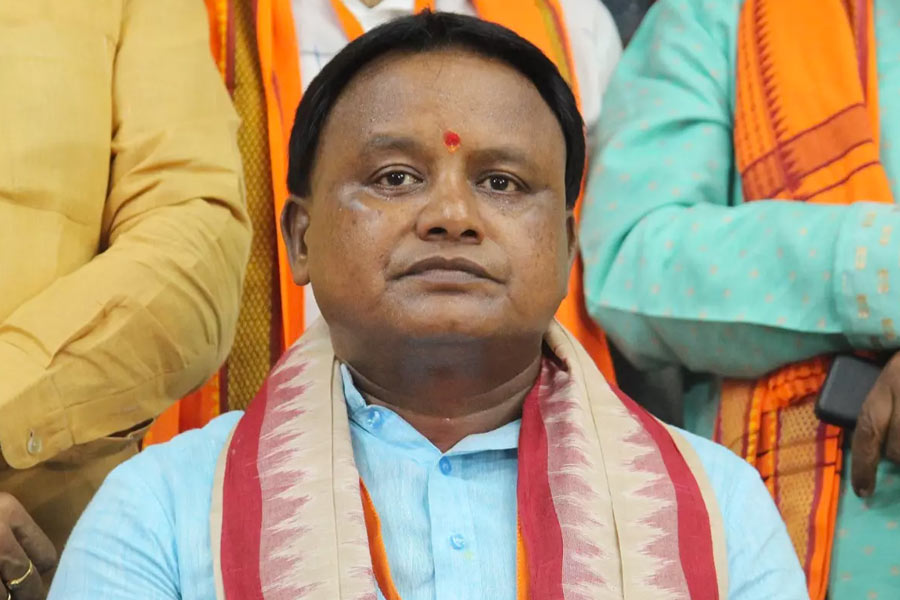
Odisha chief minister Mohan Charan Majhi on Monday laid the foundation stone for the construction of a new Lok Seva Bhavan (state secretariat) and Assembly building.
The new Assembly building and Lok Seva Bhavan will be constructed at an estimated cost of ₹3,623 crore. Both structures will come up as part of a single integrated complex spread across 71.13 acres.
The construction of the Lok Seva Bhavan building will be taken up in the first phase, while work on the Assembly building will begin subsequently.
Addressing the gathering after laying the foundation stone, Majhi said the new buildings were being planned with a long-term perspective, keeping in mind future requirements arising from the possible increase in the number of legislators.
“Today we have 147 MLAs in the state Assembly. It can accommodate another two to three MLAs. The number of Assembly seats could increase after delimitation. I am not sure, but after the delimitation, the number of members could be 200. We need to construct a building which could accommodate 300 members. We need to construct the new buildings keeping in view the next 50 to 100 year,” he said.
The existing Assembly and secretariat structures are around 68 years old.
Officials said the tender process for the proposed iconic 12-storey Lok Seva Bhavan building has already been floated, and the government is targeting completion of the new secretariat by 2029.
The new Lok Seva Bhavan will be modelled on the Central Secretariat in New Delhi. Each minister will have a dedicated chamber along with an attached lobby and conference hall. At present, ministers’ chambers are spread across two floors and are located away from their respective departments, often causing coordination difficulties.
Both the Assembly building and Lok Seva Bhavan will include underground facilities to accommodate a larger number of vehicles through improved space management. For this purpose, the existing Head of Department buildings, popularly known as Naa Mahalaa, will be demolished. Within the same campus, the existing Nirman Soudh at Kharavela Nagar will be retained.
The government has argued that the new structures are essential as it has become increasingly difficult to accommodate the expanded number of departments and staff within the existing infrastructure.
Works minister Prithviraj Harichandan said a comprehensive master plan for the project had already received the approval of the state government. “The campus, officially Lok Seva Bhavan and Mantralaya building, is envisioned as a state-of-the-art hub for governance and public service delivery,” he said.
Sources said the new Assembly building would feature three basement levels, a ground floor and a single-storey structure above, and would be built broadly in line with the architectural concept of the new Parliament building in New Delhi.
Majhi also laid the foundation stone for a dedicated elevated corridor from Jaydev Vihar Square to Nandankanan in Bhubaneswar, aimed at strengthening the city’s transport infrastructure. The ele project will be executed at an estimated cost of ₹952 crore.
As part of the plan, a four-lane cable-stayed bridge will be constructed at Jaydev Vihar Square. The government has proposed plantation of 22,410 trees on both sides of the corridor.
The state government has also shelved the proposal for a metro rail project for Bhubaneswar. The foundation stone for the metro project had been laid by the then chief minister Naveen Patnaik on January 1, 2024.