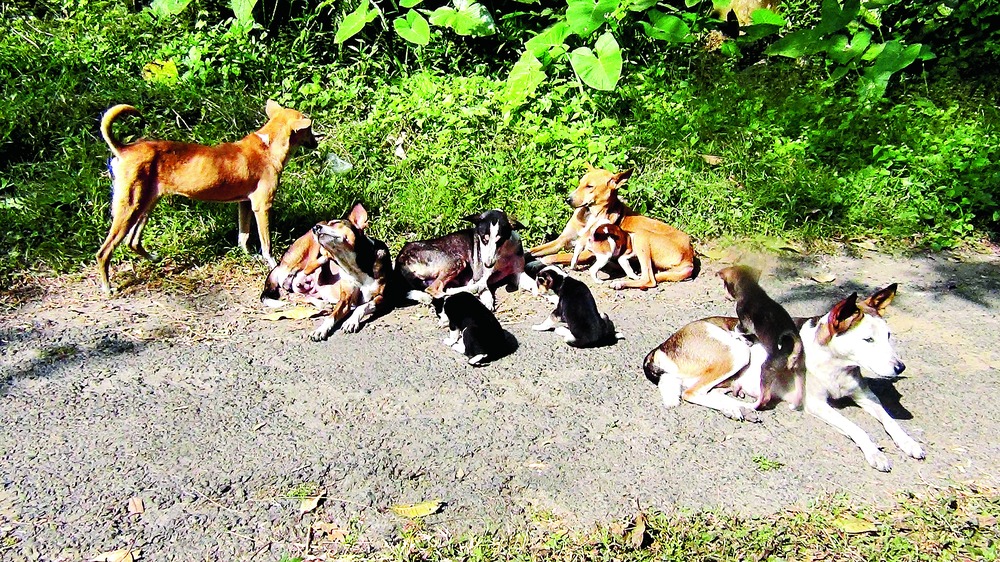

New Delhi, March 7: Two Indian biologists specialising in canine studies have spotted pups engaging in milk theft from surrogate mother dogs, documenting in a carnivore species a rare behaviour primarily observed earlier in select herbivores.
The researchers at the Indian Institute of Science Education and Research (IISER), Calcutta, have observed pups suckling milk from dogs who are not their mothers in nine of 11 groups of mother-pups among 15 packs of stray dogs around their campus in Mohanpur in Nadia.
They observed about 590 bouts of such allonursing behaviour in the nine groups of mother-pups. The pups initiated every allonursing bout and allomothers never volunteered to allonurse, the scientists said, describing their findings in a paper published in the journal PLOS One.
The allomothers terminated most of the allonursing bouts, irrespective of the ages of the pups. While mothers nursed their pups voluntarily until the onset of weaning, the allomothers never volunteered to nurse non-filial pups but appeared to be "victims of milk-theft", the scientists said.
Allonursing has until now been documented mainly among some species of ungulates such as guanacos, reindeer and zebras. Some animal behaviour scientists have observed what appears to be adoption of young ungulates by allomothers but milk theft cannot be ruled out in groups of large herds.
"Milk theft is a rare behaviour, until now almost never reported in carnivores," said Anindita Bhadra, assistant professor at IISER department of biological sciences, who led the study.

Bhadra and IISER research scholar Manabi Paul followed 22 mother-litter units from the 15 packs of dogs they studied over a span of five years. Paul typically tracked the dogs twice a day, between 9am and 12 noon and from 2pm to 5pm, documenting nursing and allonursing bouts.
"Pups appear to adopt a snatch-and-run strategy while suckling from allomothers, as allomothers terminate the suckling whenever they identify free-riders and do not altruistically offer milk to non-filial pups," the researchers wrote in their research paper.
While allonursing is clearly beneficial for the pups, the biologists say it throws up a question: why should this behaviour have evolved in dogs given that it provides no obvious advantage to the mothers?
The scientists speculate that the snatch-and-run strategy would benefit the pups for stray dogs in their competitive environment marked by limited food resources and high mortality.
Dogs have evolved from wolves which have strict hierarchies and cooperative breeding.
"In wolves, only the alpha pairs reproduce and the subordinates provide care to the pups, but there is no question of lactation by allomothers," Bhadra said.
However, dogs have flexible social systems - they can live as solitary pets or in social groups.
During their study, the IISER biologists also observed that allonursing mothers were almost always related to the pups - they were either older sisters, aunts, or grand-mothers.
This observation, Bhadra and Paul speculate, might help explain the evolutionary puzzle of allonursing in dogs.
"Such behaviour may have no benefit to individual mothers, but when related females den close to each other and pups engage in milk theft, the population as a whole benefits," Bhadra said.