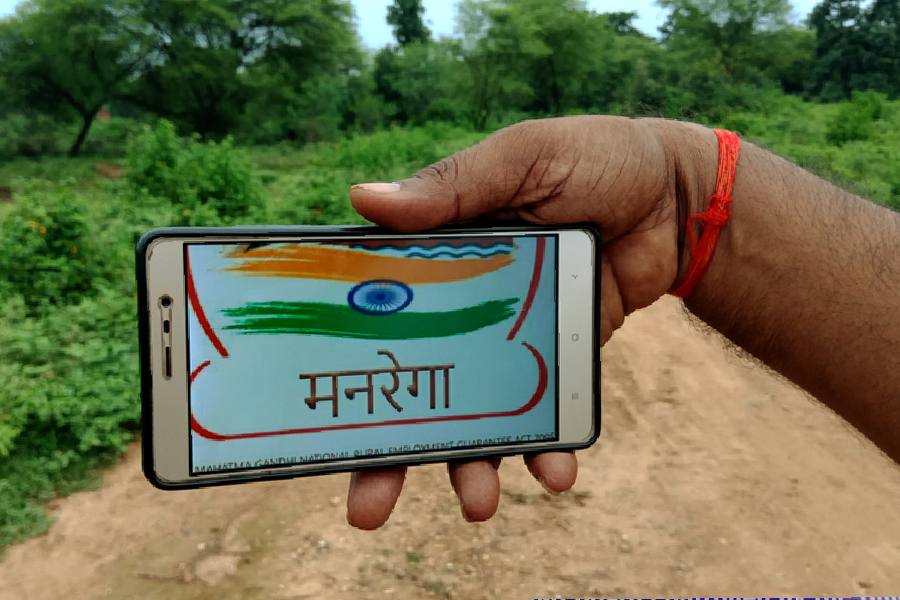
Job creation under the MGNREGA declined sharply in 2025-26, the year the Centre repealed and replaced it with the Viksit Bharat-Guarantee for Rozgar and Ajeevika Mission (Gramin) (VB-G RAM G) Act.
The MGNREGA provides for up to 100 days of unskilled work to every rural household in a year.
According to a national report titled “Declining Employment and Earnings Under MGNREGA in FY 2025–26”, released by private research organisation LibTech India, person-days of work generated under MGNREGA declined from 312 crore in 2023-24 to 268 crore in 2024-25 and 211 crore in 2026-27. The average person-days per household dropped considerably from 50.18 in 2024-25 to 42.92 in 2025-26. While 0.37 crore households completed 100 days of work in 2024-25, the number of such families dropped to 0.22 crore in 2025-26
Households registered under the MGNREGA increased from 14.98 crore in 2024-25 to 15.46 crore in 2025-26. Despite more households showing interest in the scheme, access to employment declined. Compared to 2024-25, nearly 44 lakh fewer households and 67 lakh fewer workers got employed under MGNREGA in 2025-26.
Mukkera Rahul, a researcher at LibTech India, said 2025-26 could be seen as one of the difficult years for employment generation under the MGNREGA.
“What we have seen in recent years is allocation under the MGNREGA remaining stagnant while the government has introduced several interventions in the name of reforms and weeding out corruption. The online attendance system, eKYC
registration and the Aadhaar-based payment system (ABPS) have created challenges for workers. Both the factors of funds crunch and technological interventions may have contributed to the sharp decline in employment generation under the job scheme,” Rahul said.
Under the NREGA mobile monitoring system (NMMS), panchayat-level officials have to take pictures of workers and upload them on the app. Earlier, gram panchayats used to maintain attendance on paper, which was discontinued from January 2023.
From February 2023, the rural development ministry mandated states to use ABPS to process wage payments. For ABPS, a worker’s Aadhaar has to be seeded to his job card, bank account and the bank’s institutional identification number in a database created by the National Payment Corporation of India.
From November 2025, the government made eKYC mandatory for MGNREGA workers to be able to get work. The eKYC is done through face and iris recognition and the feature is part of the NMMS app.
The report found 45.4 of 25 crore workers and 9.5 of nearly 10 crore active workers did not complete eKYC in May 2026.
Rahul said workers found these technological interventions difficult to comply with.
The LibTech report found that 45.4 per cent of all workers and 9.5 per cent of active workers under the NREGA did not complete eKYC.