
From a distance, the one-room brick house with a tin shed looks like an abandoned godown. It isn't.
Three young men sit on a charpoy under the shed, listening to a happy "Goendi" song on a cellphone. One of them, his torso bare, taps his foot to the mysterious rhythm of the Adivasi song under an overcast sky.
They look happy as they munch betel nut and tobacco. A woman, sitting in the front porch, had rushed inside, too shy to face visitors.
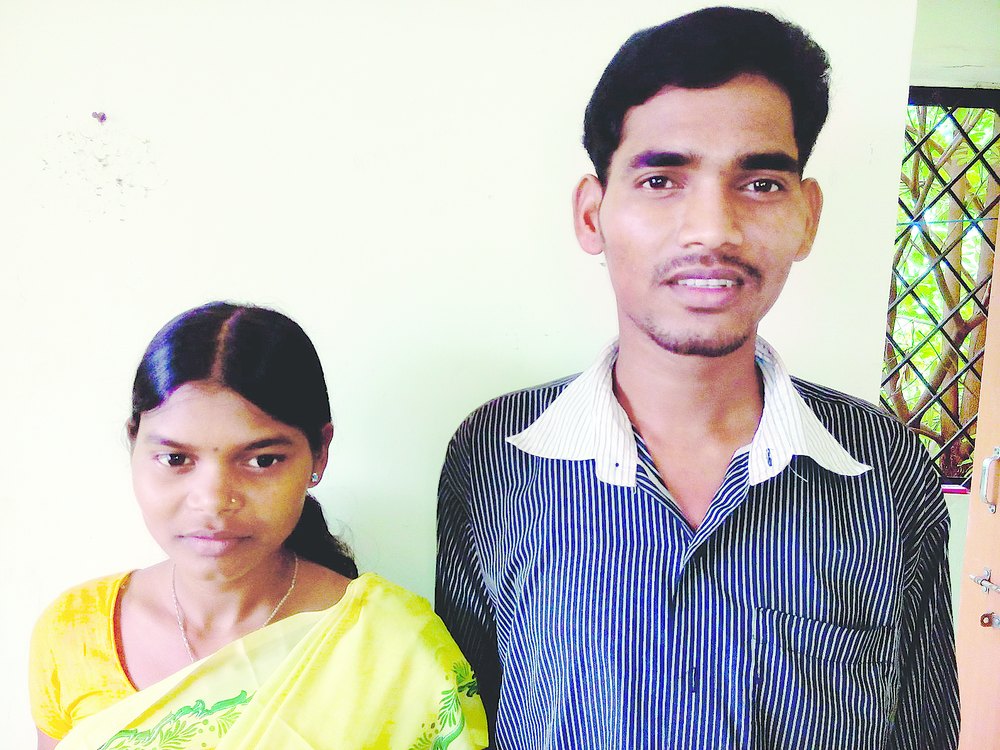
The bare-chested man is Sukhdev Vadde, 26, a Gond from a remote south Gadchiroli village. The woman inside is his wife, Nanda, a fair, slim woman from a different tribe, Muria, from Konta in Chhattisgarh's Bastar region. This is their home.
If the sky is pregnant with rain, the ground is an expectant hum. Late last year, Sukhdev and Nanda welcomed a new member into their family - a baby girl, finally getting what they wanted: a settled life with kids.
The two fell for each other in Dandakaranya - a forest region stretching from Gadchiroli to Odisha's Malkangiri and covering Bastar - when they were part of a Maoist guerrilla army.
They carried guns, trudged through difficult terrain day and night, hid in dense thickets of bamboo and teak, held sway over villages that dot what is today one of the fiercest conflict zones in the country and, in between, snatched private moments together.
They aren't the only couple to have left behind the life of a rebel.
Increasing numbers of CPI (Maoist) cadres in these parts have been laying down arms to start families. The trend, officials say, has picked up in the past few years. Gadchiroli alone throws up over 100 couples in a total of 450-odd cadres who have surrendered in a decade or so.
The latest to surrender as a couple in mid-June are Vijay alias Dhaniram Keshari Dugga, a 26-year-old commander of a local operational squad in north Gadchiroli, and Radha alias Vasanti Kowa, 23, a member of the same squad. After leading several ambushes on the police over six years, Vijay told the media on his surrender that he and his wife wanted a normal family life.
From love affairs to disillusionment with the banned party to a stepped-up pressure from security forces in the areas they once moved freely to a lucrative rehabilitation under the Centre's new surrender policy, a number of reasons are at play for the cadres to give up the fight, officials say. Most of the surrendered couples are in their 20s or 30s.
Around 280 cadres are now active in the district, far fewer than a decade ago, according to local intelligence records. Nearly half are women.
Sukhdev and Nanda wouldn't say who prevailed over whom to give up arms but sometime in 2010 they decided it was time. "We wanted to raise kids," Sukhdev told The Telegraph, after much prodding.
Some of his comrades were gone, some had been killed, some wanted to surrender. "Life is difficult in the jungle," he conceded. He was in his early teens when he joined a local squad and went on to become, according to his own admission, a section commander in south Gadchiroli. Post-surrender, it took them four years to start a new life. They did it after their families gave them the go-ahead.
Sukhdev had to go for a minor surgical procedure called reverse vasectomy. "Every male cadre has to compulsorily have vasectomy," he said. Cadres aren't allowed to raise a family, though they are allowed to marry.
The couple don't answer too many questions about their past. It's a past they would rather forget, explains another ex-Maoist, a mentor to most newly surrendered cadres.
"Most of us don't wish to be identified for several reasons; one is, of course, the threat from the party and the other is a sort of ostracism we face out here; people, especially the families of policemen, don't easily accept us."
That's one reason Sukhdev and Nanda live in a secluded place. The two men in the house are also ex-Maoists, now day labourers with families. One of them, sporting a cap, says he too got married when he was in the forest and came out with his wife a year after Sukhdev and Nanda did. The other, in his 40s, was a member of a local militia.
In the beginning, Naxalite groups had allowed - in fact, promoted - weddings within local operational squads to keep cadres in the party. Now, officials say, the wedding bug seems to have become a bit of a concern, all the more since it's not only foot soldiers who have opted out.
A senior Maoist and member of the all-powerful Dandakaranya Special Zonal Committee, Venkata Krishna Prasad alias Gudsa Usendi, surrendered before Andhra police with his wife Raji in 2013. The same year, Rakesh alias Komti Dugga gave up arms before Gadchiroli police along with his second wife Girija after fighting the "war" for 22 years. Mahendra Kerame, a gunman of the CPI (Maoist)'s area committee secretary of Gadchiroli-Gondia division, gave up arms in May 2014 before Rajnandagaon police with his wife Lata Gota, ostensibly to raise a family.
While working in the same wing of the banned outfit, Kerame, 26, an active member of the military platoon, fell in love with Lata, he told the police. They got married earlier this year and wished to have kids, but when the organisation forced them to undergo sterilisation, they decided to quit.
Too many are embracing love over guns, chuckled a veteran Gadchiroli police officer who has been part of the district's anti-Maoist wing for over 30 years. "The party (CPI-Maoist) is concerned; you can read it in their recently seized documents."
On January 16, 2014, a Naxalite commander, Vinod alias Gandram Yadav, 30, and his wife Jaymati, 26, of the Abujh Maadh region, surrendered in the Maoist-hit Narayanpur district of Chhattisgarh.
"There is an unwritten rule in the party (CPI-Maoist) that male cadres can't marry for the first two years of joining and female cadres for three years," revealed Chute, a short and slim man with sharp features. He looks like a child craving for chocolates. He was a section commander, leading a team of motivated guerrillas in south Gadchiroli, according to the officer in-charge of the rehabilitation cell. He too surrendered earlier this year with his wife, a woman older than him. "Many cadres break that rule," he says, with a smile. "We broke it too."
Chute joined the outlawed party in 2005 and coaxed his childhood love from his village in south Gadchiroli into joining him in 2009 when he learnt she was being married off to a cousin. Once in the party, the two tied the knot but could not have children.
His wife, Seema, then prevailed upon him to give up arms, Chute says.
While love, along with the desire for a settled life, is a strong pull, other factors are at play too. "I saw no revolution coming through," says Vikas, who now works as a day labourer. "So we decided to come out even if the party thought of us as traitors."
An ex-platoon leader, Vikas surrendered last year and married his fiancée at a ceremony hosted by Gadchiroli police in May 2013. That's when nine other couples got married too.
A police source said this was his second marriage. His first wife had surrendered long ago and got married to another man. The platoon that Vikas commanded had carried out quite a few ambushes on the police - a couple of them in 2009 killed at least 31 policemen.
But somewhere down the line, disillusionment set in. "I didn't see any point in continuing with the party," says the 31-year-old. "I moved from one place to another in the forests, living a difficult life, but I didn't see any people's government. The orders usually came from above and we implemented them."