
The soft-spoken poet from Jammu, Liaqat Jafri, has been struggling to come up with a line on the brutal rape and killing of the eight-year-old Asifa Bano in Kathua and the events following the tragedy. He says, "I tried, but this has been such a shocking incident. And the reaction of the people... it has drained me emotionally."
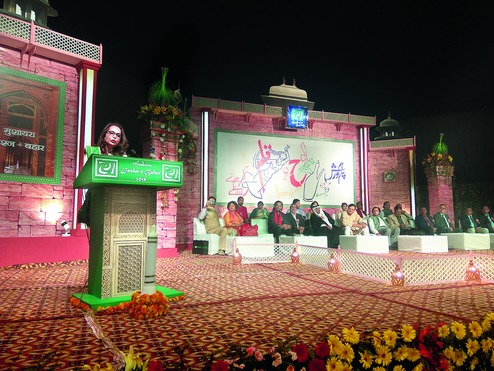
We are at Jashn-e-Bahar, an annual Urdu poetry event held in Delhi. Jafri takes the podium. He may not have been able to put to paper the emotions currently raging within him, but he cannot ignore them either. He plucks two lines from a poem he had written a few years ago. Haaye afsos ke kis tezi se duniya badli/ Yeh jo sach hai, yeh kabhi jhoot hua karta tha. Meaning: What a pity that the world should change with such speed. What is the accepted truth today, used to be a falsehood once upon a time.
For the connoisseurs of Urdu poetry gathered at the mushaira organised on the grounds of Delhi Public School, Mathura Road, that April evening, the compositions of Jafri and some others would have certainly had a cathartic effect. Meerut poet Dr Popular Meeruthi takes a dig at politicians with his "Karega kya koi leader ki bartari tasleem, Agar na saath mein chamchon ki ik kataar chale... Would anyone respect a leader, if he did not have a long line of sycophants following him." Deepti Mishra, who is from Mumbai, reads, " Dil aur dimaag karte hain jhagde kamaal ke, Ab faislaa karoongi main sikka uchhaal ke... The heart and the mind are stuck in a perennial tug of war. The time has come for me to take sides, so I will toss a coin."
A painting by M.F. Husain, showing a dancing girl, forms the backdrop of the stage. It is also the logo for the Jashn-e-Bahar Trust. The words emblazoned on it belong to the legendary poet, Kaifi Azmi. It reads, " Hum parvarish-e-lauh-o-qalam karte rahenge. Jo dil pe guzarti hai raqam karte rahenge... I shall keep nurturing the pen. I shall continue to give voice to what the heart is going through." And that is the resolve upon which Jashn-e-Bahar was founded and has been sustained for two decades now. Every year, poets from within India and abroad - Bangladesh, Saudi Arabia, the United States, Canada, Japan - come together to share their musings. There is nobody from Pakistan this time unlike previous years. The reasons are obvious, but that's a loss.
Jashn-e-Bahar will for the first time have a Calcutta edition this year. It is slated for today at south Calcutta's Nazrul Manch.
The gathering is many things, but primarily it is a celebration of Urdu. In recent years, Urdu has come to be identified strictly with Muslims. And in 2017, a scuffle broke out between BJP and BSP partyworkers, when one of the newly-elected BSP corporators in Aligarh took oath in the language. Says Kamna Prasad, the organiser of the event and Urdu activist, "Urdu is not just a language. It is a tehzeeb, a culture in its own right. We Indians should celebrate this language as it is ours and it represents our composite culture."
Poet and professor of Urdu at Osaka University in Japan, So Yamane, says one should learn Urdu just to experience the richness of the language. He tells us that those who feel it is a language of foreign origin are not aware of its history at all. "It used to be called Hindustani when we introduced it in Osaka University 97 years ago. Tokyo University has an Urdu department that is 115 years old. This language is as Indian as any other Indian language," he says.
Ashfaq Hussain, an Indian-origin poet settled in Canada, says, "A language has no boundary or religion. We don't think of Christianity or the British when we speak in English. Why should Urdu then be identified with a religion," he asks.
Prasad talks about how Urdu has enriched other languages. "It is so integral that even our religious texts and songs in praise of Hindu deities have words derived from Urdu," she says and gives examples. She quotes from Bajrang Baan, "Jay Hanuman hitakari, sun leejey arj hamari." The word " arj" comes from "arz", which has Urdu roots.
As for Urdu being associated with Islam, S.Y. Quraishi, former chief election commissioner of India, points out that the flag-bearers of the biggest mushairas in India are Prasad of Jashn-e-Bahar, Sanjiv Saraf of Rekhta and Madhav B. Shriram of Shankar-Shad Indo-Pak mushaira - non-Muslims all.
Urdu itself has undergone a change in recent years. Many modern day poets prefer to use the Devanagari script. Hussain Haidry, a Mumbai-based lyricist and one of the poets attending the event says, "I know how to write Urdu in the Arabic script, but more often than not I use Devanagari. It doesn't hinder my skill as an Urdu poet."
Last year, Haidry's poem Hindustani Musalman went viral on social media. It goes: Apne hi taur se jeeta hoon. Daaru cigarette bhi peeta hoon. Koi neta meri nas nas mein nahi, main kisi party ke bas mein nahi. Main Hindustani Musalman hoon... I live the way I want to. I smoke. I drink. I have not sworn my allegiance to any politician or political party. I am what I am, an Indian Muslim.