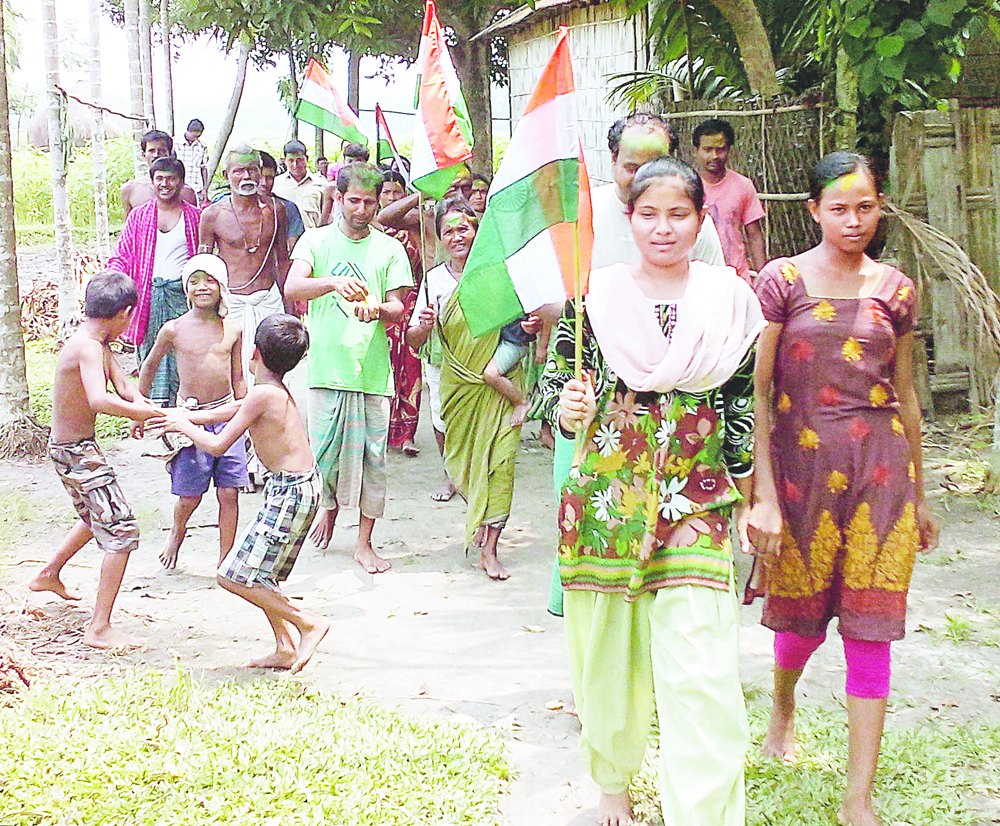

Nalgram (Cooch Behar), June 6: Rupali Khatun, 21, stood outside her home at Nalgram, joyfully waving the Indian flag although she is technically a Bangladeshi citizen.
"It's like gaining Independence," the third-year arts student of a college in Sitalkuchi, 35km away, beamed.
Nalgram was one of the 51 Bangladeshi enclaves that became part of Indian territory today when, in Dhaka, officials from the two countries exchanged the instruments of ratification of the 1974 Land Boundary Agreement that mandates an enclave swap.
These enclaves were small "islands" of one country's territory, populated by its citizens, embedded deep inside the territory of the other. They remained largely ungoverned by either country.
Now a date will be set for the residents to decide whether they would stay back in their new country and acquire its citizenship, or shift to their mother country with a rehab package.
Most of the 37,000 residents of the former Indian enclaves in Bangladesh are expected to seek resettlement in India, while the 14,000-odd in the former Bangladeshi enclaves largely prefer staying back and gaining Indian citizenship.
Rupali has no doubt which way she would decide. She and her friends smeared one another with abir (colours) today and waltzed around the enclave in celebration, their laughter echoing in the lanes.
"See, the Tricolour is fluttering in front of every house," said Abul Rehman, a Nalgram resident who has done his master's in Sanskrit. "It's no less than Independence Day for us."
"Independence" is an allusion to the promised citizenship rights and benefits, without which life had been a struggle in the enclaves down the decades.
"I had to use the address of a relative from an Indian village to enrol in school and college," Rupali said.
"Like the other youths from the enclaves, I introduced myself as an Indian and lived in fear and insecurity."
Tears rolled down her cheeks as she added: "From now on, I shan't have to conceal my parents' identity."
Even jobs - or a mobile connection - had to be acquired under false pretences, with the authorities generally turning a blind eye on humanitarian grounds. There was no electricity, health centres, ration cards, welfare benefits.
Government officials, police and the fire services stayed away. The lone consolation was that movement out of the enclaves was barrier-free.
"Since I was a boy, I had dreamt of becoming an Indian citizen. That day has finally arrived," said Dulal Hussain, a middle-aged Nalgram resident.
"Our youngsters can now dream of a better life with a job and proper identity."
All the 51 Bangladeshi enclaves in India were in a single Bengal district: Cooch Behar. Nalgram, with a population of 1,822, is in Mathabhanga subdivision. Nearby Falnapur is home to 936 people.
Many of the enclaves held feasts today. "Since there's no electricity in any of the enclaves, we hired a television set, a dish antenna and a battery to watch the event in Dhaka," said Saddam Hussain in Mashaldanga, an enclave near Dinhata.
Bablu Rehman, 30, of Falnapur, had walked to the "nearest Indian village" this morning and sat in front of a television set.
"For us, it had been a life without identity. That identity crisis is finally over. Now we hope to see the government speed up the process of giving us citizenship," he said.
Many of the elders in the enclaves were huddled this afternoon, discussing the legal and administrative processes the government must now take up.
"Our fingers are crossed. We want to see government officials turn up at our enclaves to ensure we are officially counted as Indian citizens and provided all the benefits," said Abdul Rashid, 65.
Diptiman Sengupta, assistant secretary of the India Bangladesh Enclaves Exchange Coordination Committee, which had initiated a movement in the 1980s demanding the enclave swap, was a happy man.
"It's a historic day. The enclave residents' movement and years of toil has paid off. We hope both governments will implement the agreement at the earliest," Sengupta said.