 |
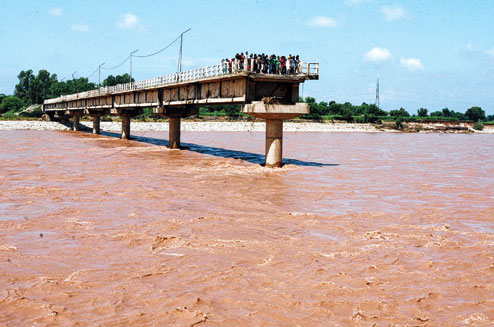
| People stand on a damaged bridge, a part of which was swept away by floods on the river Tawi on the outskirts of Jammu, on Sunday. (Reuters) |
Srinagar, Sept. 7: In a matter of a few hours today, Ishtiyaq Ahmad saw the waters enter Lal Ded, Kashmir’s premier maternity hospital where he works, and rise 15ft to submerge the ground and the first floors.
The tide sparked panic among the hundreds of patients, attendants and staff. The hospital is one of numerous structures in Srinagar partly submerged from the worst floods in Jammu and Kashmir in decades that have already left around 150 dead and countless trapped in the upper stories of buildings.
“It’s as if we are floating in water or are in the middle of the Dal Lake. We can see the surroundings submerged. Cars parked at the hospital are floating. Small structures, including shops, have disappeared and some residents in nearby Ganikhan are on rooftops, crying for help,” Ahmad said.
Inside the hospital, located close to the city centre, patients and attendants have been shifted to higher stories of a newly constructed building but are running short on food, water — even oxygen cylinders for infants.
“There are many who are weeping. It is scary. It was quite normal in the morning but within hours, the waters were all around. We had to shut the labour room and shift all patients and attendants to the adjoining building. Hospital equipment worth crores are in water,” Ahmad said.
Lal Ded is one of the three major health care units in Srinagar that are inundated, the others being a hospital for children and the main Shri Maharaja Hari Singh Hospital. Hundreds of patients have taken refuge on higher floors in these hospitals, which have no power supply.
The situation in the uptown localities, alread
 |  |
| Vehicles plough through the waterlogged Exchange Road in the heart of Srinagar on Sunday. (PTI) | A woman wails as she stands near her submerged house in Srinagar. (AP) |
 |  |
| A police vehicle makes its way through a waterlogged street in Srinagar. (PTI) | Prime Minister Narendra Modi during an aerial survey of the flood-affected areas. (PTI) |
y bad since heavy rain lashed the Valley last week, turned worse today as the Jhelum burst its banks, even though there was no rain today. Some 3,000 villages and areas have been partially or completely submerged across the state.
Several localities in downtown Srinagar were inundated today, forcing the residents to flee to safer areas or seek safety on upper floors.
The authorities had to open the sluice gates of the Dal Lake after the water levels rose, endangering many localities in the vicinity.
The officials said they had received countless calls for help from the affected zones. Those who called were among the lucky few to be able to do so — telephone connectivity was badly hit, adding to the panic as people were left wondering about the plight of trapped relatives.
“My sister and her mother-in-law were rescued from the Rajbagh locality in boats early today but we have no information so far where they have been taken despite searching for them all day,” said Khalid Ahmad, a resident of Lal Bazar.
Several shops and commercial establishments in the commercial hub were under water. Many fear the losses could run into several crores.
The troubles swelled as Prime Minister Narendra Modi visited state to take stock of the damage and called the situation a “national disaster”.
He announced a special assistance of Rs 1,000 crore, besides Rs 2 lakh for the kin of the dead and Rs 50,000 for those seriously injured.
Chief minister Omar Abdullah said earlier in the day that while the floodwaters had receded in Jammu, they rose in the Valley.
“I appeal to people to not panic. I know the circumstances are bad but I request them to stay on the upper floors. We promise to reach them,” Omar told reporters in Jammu.
What is making rescue operations difficult is that many roads are under water. Traffic on the Jammu-Srinagar national highway remained suspended for the fourth day today.
The army, police and the National Disaster Response Force said they had rescued thousands over the past few days.
An Indian Air Force official said 29 planes and helicopters had been pressed into service, a disaster monitoring cell set up and all its bases alerted to a high state of readiness.