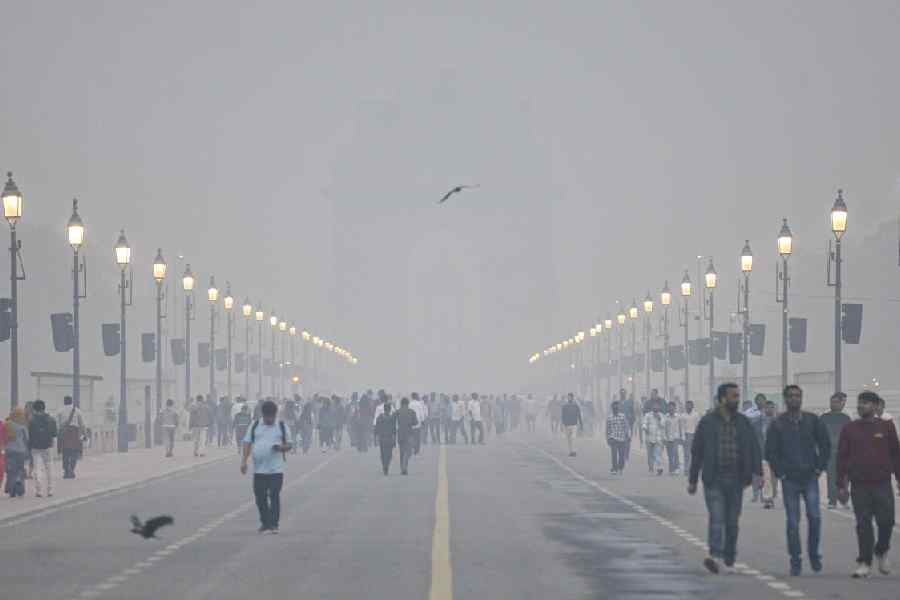
India tightened anti-pollution measures in Delhi and adjoining areas after the capital's air quality deteriorated to the season's worst.
The Commission for Air Quality Management invoked stage four, the highest level, of the Graded Response Action Plan for Delhi and surrounding areas on Saturday evening, according to an advisory by India's environment ministry.
On Sunday, Delhi's air quality was "severe" with official index readings over 450 across several monitoring stations, up from 430 on Saturday and the highest so far this winter season, Central Pollution Control Board data showed. Readings below 50 are "good".
The curbs ban the entry of older diesel trucks, suspend construction, including on public projects, and impose hybrid schooling.
The area, home to 30 million people, is often covered in smog during winter, as cold, dense air traps emissions from vehicles, construction sites and crop burning in neighbouring states, pushing pollution levels to among the highest in the world and exposing residents to severe respiratory risks.
The authorities urged residents to stay indoors, especially children and those with respiratory or cardiac ailments, and to consider masks if stepping out.
The worsening of the air quality was driven by high moisture and a shift in wind direction, conditions that hinder dispersion of pollutants and foster smog formation, according to the Commission for Air Quality Management.
In light of the deteriorating air quality in the national capital, the Delhi Directorate of Education on Saturday directed all schools to conduct classes for students up to Class IX and XI in a hybrid mode The Commission for Air Quality Management (CAQM) has invoked Stage-IV actions under the Graded Response Action Plan (GRAP) with immediate effect to curb further worsening of air pollution levels in Delhi-NCR.
Recently, the Delhi Chief Minister’s Office said the capital has recorded zero cases of stubble burning this year, despite nearly 7,000 acres under paddy cultivation.
Chief minister Rekha Gupta credited strict monitoring and strong cooperation from farmers, calling it a crucial step towards cleaner air.
The development marks a significant environmental milestone for the national capital, which often faces severe air pollution during the crop residue burning season in neighbouring states.