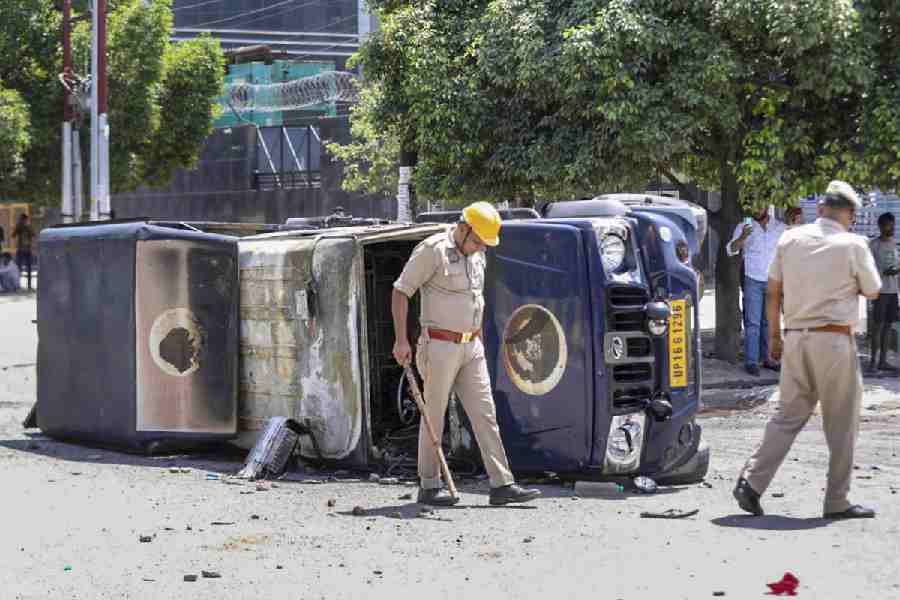
Calcutta, Feb. 8: Calcutta High Court today expressed concern over the “syndicate raj” in Bengal, pointing out that it has not spared even the judiciary.
“Syndicate” is a colloquialism for construction material cartels run with the alleged backing of a section of ruling party leaders that force contractors to buy inferior building materials at high prices. The syndicates are mostly manned by unemployed foot soldiers who had been promised jobs that have failed to materialise in the absence of industrialisation.
“Ask your police to take strong measures against such syndicate raj. The situation is so alarming that members of syndicates are not even sparing Calcutta High Court,” Justice Dipankar Dutta today told the state government’s lawyer.
“Calcutta High Court has been facing similar problems while constructing court buildings at Salt Lake and Asansol…. The Asansol incident has been reported in an English daily recently,” the judge said.
On February 5, The Telegraph had reported that in Asansol, an alleged Trinamul-backed syndicate had stalled work on a Rs 11-crore court complex, demanding that the private contractor buy construction materials from the group.
Along with the Trinamul-led government’s hands-off land policy, the problem of syndicates is considered to be a deterrent to industrialisation in Bengal.
The judge was hearing a petition filed by a promoter who said his housing project in Mahestala in South 24-Parganas was stuck because the local syndicate had refused to let construction commence before he made an advance payment on building materials.
During the hearing, Justice Dutta observed that the problem had spread across the state. He directed the counsel appearing for the Mamata Banerjee government to ask the police to take steps to curb the problem.
Allegations of involvement in syndicates have been made in the past few years against several ruling party leaders.
Justice Dutta was hearing a petition moved by Howrah-based promoter Mohammed Ismile. The syndicate, according to Ismile’s advocate Anirul Haque, has refused to allow the project to source materials from any other supplier.
When the judge asked who ran the syndicate, Haque named a person called Mangal Panja, said to be a political activist. The lawyer said that even after repeated complaints to the district police, no step had been taken against Panja yet.
Advocate Sakya Sen, appearing for the state, said the allegation against the police was not true and that Mahestala police station had started a case on the basis of Ismile’s complaints.
Justice Dutta directed Mahestala police station to file a report within seven days, stating the progress of the investigation.
Justice Dutta instructed Sen to make sure the police took stern action. “The situation will go beyond control if the state administration does not immediately intervene,” he added.
According to a city-based economist, lack of industrialisation was giving birth to groups like syndicates that thrive on extortion. “There are no large labour-intensive industries, especially in the manufacturing sector. So, not enough new jobs are being generated. That is directly resulting in youths turning to syndicates,” the economist said.
A Trinamul MP said the chief minister had instructed her party members on a number of occasions to steer clear of syndicates, but “precious little” had been done on the ground to enforce the directive.