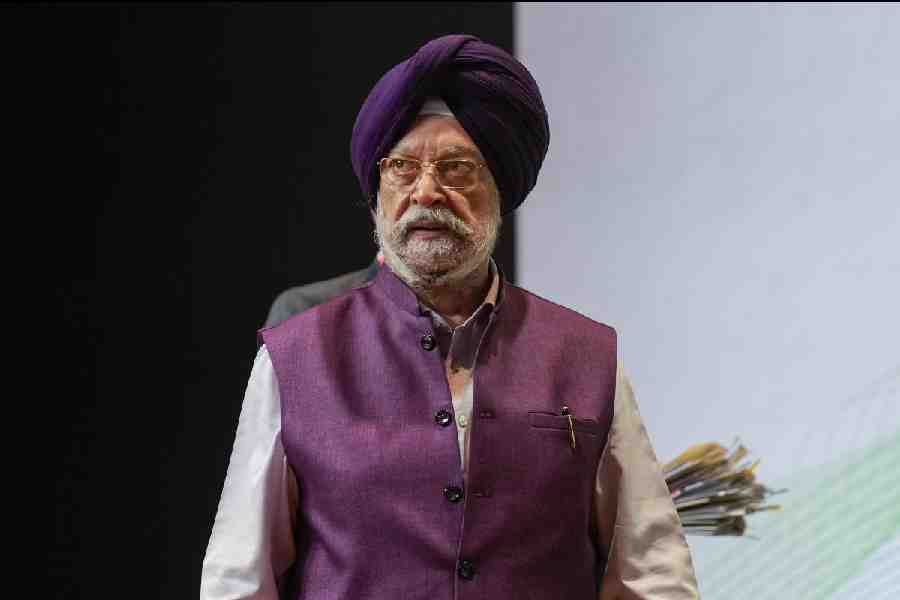
India’s strategic petroleum reserves can sustain the country for 74 days in the event of global turbulence, Oil Minister Hardeep Singh Puri told the Rajya Sabha on Monday, stressing that the government was closely tracking energy security amid geopolitical uncertainty.
Replying to supplementary questions during Question Hour, Puri said a fast-growing economy like India needed a “very viable and secure” petroleum reserve to avoid vulnerability during global supply disruptions.
“For any country like India, which is growing at a phenomenal pace, there must be a very viable and secure reserve, so that it is not in a vulnerable situation in the case of global turbulence,” the minister said.
Puri noted that India had a strong refining backbone, with refineries spread across both the western and eastern coasts.
“According to the International Energy Agency (IEA), today we are the world’s third largest consumer of crude oil. We have the world’s fourth largest refining capacity — currently around 260 million metric tonne per annum going on to 320 million metric tonne per annum. And, we are also the world’s fifth largest exporter of petroleum products,” he said.
The minister explained that the strategic petroleum reserve was meant to ensure adequate stock during a severe global crisis, pointing out that the IEA recommends maintaining reserves equivalent to 90 days of consumption.
“The strategic petroleum reserve is designed to ensure that in case of total global turbulence, we must have enough stock left to meet our needs. The IEA stipulates that there should be about 90 days of holding as a strategic petroleum reserve,” Puri said.
He added that India now calculated its reserves by combining stocks held in underground caverns, refineries, floating storage and petroleum products at ports.
“Our reserves in the caverns are in Andhra Pradesh and Karnataka and we are hoping to get started in Odisha soon,” the minister said.
“Together, if you look at the reserves in our caverns and what is held by our refineries and our floating platforms at our ports and our products, it comes to 74 days. Ideally, it should be 90 days. I feel as the minister, safe with something at 74 days. But, we can consider raising it going forward,” Puri added.
"Overall, the strategic petroleum reserve is a very important component in economic stability. This is a very important component in our energy security," he informed the House.
In his written reply to the question, the minister said, "the Government, through a Special Purpose Vehicle called Indian Strategic Petroleum Reserve Limited (ISPRL), has established Strategic Petroleum Reserves facilities with total capacity of 5.33 Million Metric Tonnes (MMT) of crude oil at 3 locations in Andhra Pradesh and Karnataka. Quantity of the crude available in the caverns varies depending on market conditions." "Currently, ISPRL has around 4.094 MMT of crude stock available which is around 77 per cent of the total storage capacity. Out of total storage capacity, 50 per cent is utilized for commercial activities by ISPRL.
"Since the first purchase of crude oil for filling the reserves in 2015, crude oil prices (Indian basket) have fluctuated from a high of USD 80.08 per barrel in October 2018 to a low of USD 19.90 per barrel in April 2020 during the COVID period to as high as USD 112.87 per barrel in March 2022," Puri said.
Taking advantage of low crude oil prices in April/May 2020, Strategic Petroleum Reserves (SPR) were filled to full capacity, leading to notional savings of approximately Rs 5,000 crore. The weighted average procurement cost of crude oil filled in SPRs from Government Budgetary Support is still half of the currently prevailing crude oil prices, he said in his written reply.