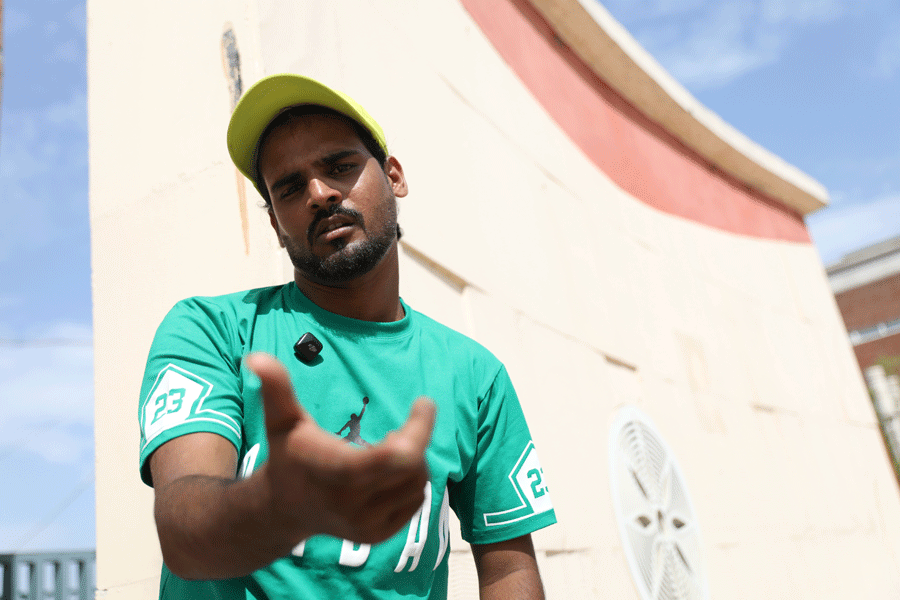
Aftab Khan, a rider for Swiggy in Jaipur, was stunned by a delivery instruction that flashed across his smartphone screen on a recent afternoon: “Don’t send a Muslim delivery boy.”
For Khan, who is also an aspiring rapper who goes by the name Rocking Aftab, the words were a sharp, unexpected sting. He could have cancelled the order or passed it along to another rider in his local WhatsApp group.
"As a human, I was very sad to see this," Khan recalled. "But I wanted to know the person behind this. I wanted to know his opinion."
Climbing the stairs to the third-floor apartment with the order in hand, Khan felt a tremor of fear, acutely aware of the country's sensitive social climate. What happened next entirely upended his anxieties.
The customer opened the door with a warm smile. When Khan gently asked him about the discriminatory note, the man’s demeanor shifted instantly from confusion to deep embarrassment, Khan said.
The customer explained that it was an old message instruction left in a moment of anger during a different phase of his life and he didn't know how to delete that instruction.
Khan didn't argue or lecture. He took the customer's phone, navigated the app and removed the text. The interaction ended with a handshake and an offer of a glass of water.
"Everyone makes mistakes," Khan said simply. "He apologised to me, and that relieved my heart. Our aim is to spread love in the country."
The Cost of a Dream
Raised in a financially strained household, Khan’s father is a vegetable vendor. Khan was forced to leave his studies early. In his conservative neighborhood, his musical ambitions were initially mocked or dismissed as a distraction.
Yet, music remained his lifeline. Inspired by the sudden rise of Indian rap in his school days, he began writing lyrics in 2015. By 2024, he won Swiggy’s corporate talent hunt, Swiggy Viggy, performing an original track titled Swiggy's Partner.
"In the society I come from, having a dream is more expensive than fulfilling it," Khan said. "Most people just follow the herd. But I believe only my talent can bring me out of this situation."
In a snippet from his latest track, Khan’s lyrics plead for a return to common humanity:
Ram ne bola nahi, maaro Musalmaan ko,
Allah ne farmaya nahi, maaro insaan ko...
Jisne tujhe banaya, usne hi mujhe banaya,
Insaan ke aukaat ka hai mel nahi.”
[Neither Ram nor Allah asked to kill another human...
The one who made you, made me too.]*
Khan said the “delivery instruction” incident was not an indictment of his hometown. He said he encounters profound kindness on his routes, like the monsoon afternoon last July when a customer noticed him drenched to the skin and gave him a cup of hot milk.
By turning a bigoted delivery note into a quiet moment of reconciliation, Rocking Aftab proved that sometimes, the most powerful way to change a narrative isn't to shout over it, but to deliver the truth face-to-face.