|
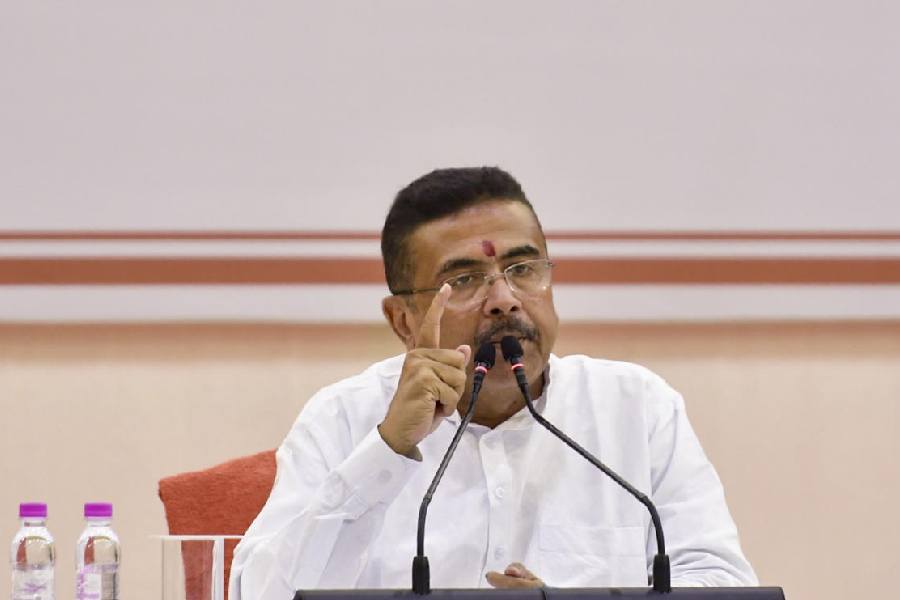
| AK Antony outisde Parliament on Friday. (PTI) |
New Delhi, Sept. 6: Defence minister A.K. Antony today said recent face-offs between Indian and Chinese troops on the undetermined Line of Actual Control was partly a consequence of improved connections to the frontier that allowed the Indian Army to get to certain points faster than in the past.
However, he admitted, Chinese border infrastructure was far superior to India’s. He denied that the National Security Advisory Board chairperson and former foreign secretary, Shyam Saran, had given a report saying that China had occupied or had denied access to 640sqkm of India-claimed territory in eastern Ladakh.
“There is no question of India ceding to China any part of Indian territory,” the defence minister told both Houses of Parliament.
“This government keeps a constant watch on India’s security and takes all necessary measures to safeguard it... it will do all to protect India’s integrity,” he said.
In the Rajya Sabha, where the minister was asked for clarifications, he said the patrolling patterns of the armies were drawn from an agreement between India and China reached in 1976, when Indira Gandhi was the Prime Minister.
India and China are also currently in discussions on a new border defence cooperation pact that may be signed later in the year.
Antony said the longest face-off was in April-May this year, after Chinese troops pitched camp at Raki Nala near Daulat Beg Oldi in Ladakh. He also insinuated that the television news media overplays the face-offs by showing old footage of Chinese “incursions” on what is still an undemarcated boundary.
“Shyam Saran’s report has not said China has occupied, or has denied access to any part of Indian territory,” he asserted; the report focuses on border infrastructure and development, he said.
Information gathered independently by The Telegraph suggests that at three points in eastern Ladakh, Chinese troops were able to reach landmarks faster than Indian troops because they have motorable roads to these places.
When patrols come across each other the norm is to go through a banner drill, each side unfurling banners claiming that the other was in its territory.
Typically, the Line of Actual Control perceived by China is within Indian territory and the Indian perception is within Chinese territory. But nearly all along the frontier, the terrain is friendlier to the Chinese who also built a border roads network more extensively and over a longer time than India.
India reversed its border infrastructure policy only in 2007. Till then — and the defence minister referred to this in Parliament — the policy was not to develop border roads on the China frontier because the fears of 1962, when Chinese troops overran nearly all of Arunachal Pradesh before withdrawing, shaped the policy.