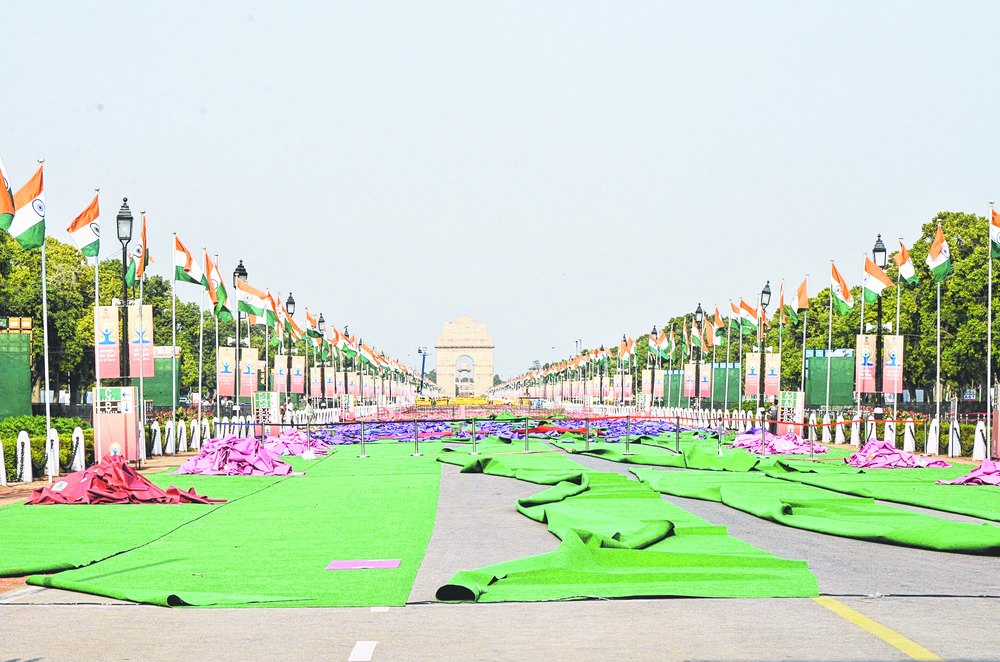

New Delhi, June 20: When Prime Minister Narendra Modi presides over a 35,000-strong crowd bending, stretching and twisting tomorrow, the spectacle will be unlike anything that veteran yoga teacher Hansaji Yogendra has taught her students for over 40 years.
But the 69-year-old Mumbaikar isn't complaining. Nor are most other yoga preachers across India, who acknowledge that the plans for June 21 are a 21st-century avatar of yoga, distant from the version authored over 2,000 years ago by the ancient sage Patanjali.
A globe-trotting, western-returned set of neatly defined and easy-to-market exercises that will be performed on an industrial scale on Rajpath has stirred hopes among these gurus that India will rediscover a heritage that some feared New York was appreciating more than New Delhi.
"Yoga is usually not done on a mass scale; it is a very individual pursuit," said Yogendra, director of the Yoga Institute, which has been in operation since 1918.
"But we needed the government to do this: mass acceptance comes with government push."
She added: "Don't parents force their reluctant children to go to school? It's the same here: our own people had forgotten yoga - they need to learn it for their own good."
The scale and ambition of the International Yoga Day celebrations - from an attempt to make it to the Guinness World Records to coaxing 192 nations to host similar events - are far removed from the concept of yoga as it originated in India.
The Modi government has drafted celebrities like Virat Kohli and Amitabh Bachchan to woo fence-sitters into joining the celebrations, hoping for a repeat of how Hollywood stars like Demi Moore and Julia Roberts helped expand the yoga industry in the US.
The website of an American yoga teacher, David Frawley, who is scheduled to join Modi on the dais tomorrow morning, offers pizza-outlet-style $50 discount coupons for yoga lessons.
Even the physical exercises outlined in the Common Yoga Protocol - a 34-page guidebook for Yoga Day - are far removed from anything Patanjali had prescribed, experts and yoga historians say.
"The Yoga Protocol has two distinct visions: the introduction talks about ancient Indian tradition but the actual content prescribed is 21st-century, pop-school yoga," Andrea Jain, a yoga historian at Indiana University, Bloomington, told The Telegraph.
"What Modi and his government are trying to do is reclaim yoga for India, but the problem is that yoga has constantly evolved, and there's no one yoga."
Patanjali's yoga was anything but prescriptive, said H.R. Nagendra, vice-chancellor of the Swami Vivekananda Yoga Anusandhana Sansthana, Bangalore, and a key adviser to the Modi government on yoga.
Nagendra and other yoga specialists point out that Patanjali's concept of yoga involved the use of any steady, comfortable and relaxed position that allowed a person to concentrate and meditate.
"In Patanjali, we have no mention of specific asanas," Nagendra said. "It has to be an effortless state of calm, and the goal is to tune the mind to the infinite."
Many of the current set of asanas practised worldwide are variants of exercises known as the Hatha Yoga, described in three key texts written between the 15th and 17th centuries - long after Patanjali, Nagendra said.
These exercises have become popular in the West since the mid-20th century, and then evolved further over the decades to cater to modern lifestyles.
But the brand of yoga planned for Sunday, and the tools marketing it, may be just what India needs, said Atika Dhandhia, a yoga instructor with Ravishankar's Art of Living in New Delhi.
"Just as every nukkad (corner) in India has a paan shop, every street corner in New York has a yoga studio," Dhandia, a practitioner for the past 18 years, said.
"As a society, especially the youth, we love to ape the West. So if Western tools and modern marketing help us spread yoga in our own country, I think that's just great."
Many view the government's initiative and the Yoga Day celebrations as a mere launch pad for something much bigger and long-lasting that will provide tangible benefits to the population.
The ministry for ayurveda, siddha, unani, naturopathy and yoga (Ayush) has set up a task force to draw up plans to propagate yoga after International Yoga Day, Ayush minister Shripad Yesso Naik said on Tuesday. "We want yoga to reach all households and all people," Naik said.
Among the first post-Yoga Day initiatives will be the inclusion of a yoga-teaching curriculum for the BEd and MEd courses. The first book with the yoga curriculum for BEd - a necessary qualifying degree in India for aspiring secondary school teachers - will be released on Sunday.