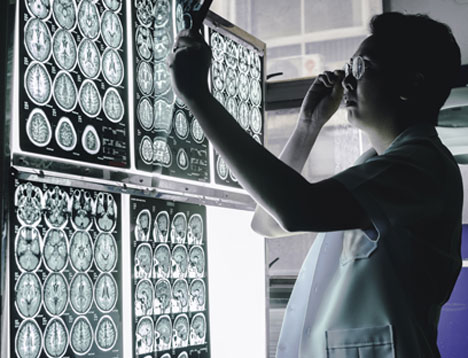

New Delhi: A painless medical intervention that uses direct currents to stimulate the brain can reduce aggressive intentions and enhance perceptions that acts of physical and sexual assaults are morally wrong, a team of scientists announced on Monday.
The scientists have shown through controlled laboratory experiments that just 20 minutes of such stimulation on the prefrontal cortex - a brain region that controls behaviour and complex thoughts - can reduce a person's intention to commit a violent act.
In their study, volunteers for the experiment who received transcranial direct current stimulation of the prefrontal cortex rated hypothetical scenarios of physical and sexual assaults as more morally wrong than did volunteers who did not receive such stimulation.
In transcranial stimulation, low intensity currents are passed through electrodes placed over the head.
"The ability to manipulate such complex and fundamental aspects of cognition and behaviour from outside the body has tremendous social, ethical and possibly someday legal implications," Roy Hamilton, associate professor of neurology at the University of Pennsylvania, said in a media release.
The study's findings were published in the Journal of Neuroscience on Monday.
The science of criminal psychology has long focused on social factors, including experiences of individuals, to analyse why people commit violent crimes. While the social factors contributing to violent acts are important, the researchers say studies of brain imaging and genetics suggest that biological factors also influence violence.
"We're trying to find benign biological interventions that society will accept and transcranial direct current stimulation is minimal risk," Adrian Raine, a specialist in neurocriminology and coauthor of the study, said in the release. "This is not the magic bullet that'll wipe away aggression and crime," he cautioned.
But, Raine said, the study's findings raise the question of whether such transcranial direct current stimulation could be offered as an intervention to first-time offenders to reduce their likelihood of recommitting a violent act.
The scientists say they picked the prefrontal cortex for stimulation because earlier studies have documented that anti-social individuals have deficits in this region of the brain.
Harvard University researchers had last year found through brain scans of prison inmates that psychopaths have higher activity in a region called ventral striatum involved in feelings of reward, but poor connections between the striatum and regions of the prefrontal cortex involved in decision-making.
Psychologist Joshua Buckholtz who led the Harvard study, published last July in the journal Neuron, believes the lack of connection between the striatum and the prefrontal cortex is significant. The region of the prefrontal cortex is believed to help people envision the future consequences of actions and with a poor influence of the prefrontal cortex, the value of immediate choice of actions may be over-represented.
"We need the prefrontal cortex to make prospective judgments (about) how an action will affect us in the future - if I do this, then this bad thing will happen," Buckholtz had said in a media release issued by the university last year. "If you break that connection in anyone, they're going to start making bad choices because they won't have the information that would otherwise guide their decision-making."
Transcranial stimulation may be viewed as a non-invasive intervention that targets a biological risk factor for crime, said Olivia Choy, a psychologist and assistant professor at the Nanyang Technological University in Singapore and lead author of the transcranial stimulation study. "It is viewed as a relatively safe procedure with minimal side effects," Choy told The Telegraph.
Earlier studies have investigated the use of transcranial stimulation on children with attention deficit hyperactivity disorder as well as normal children to enhance cognitive functioning.
The findings raise the question of whether transcranial stimulation may be offered to adolescents who show behavioural problems.