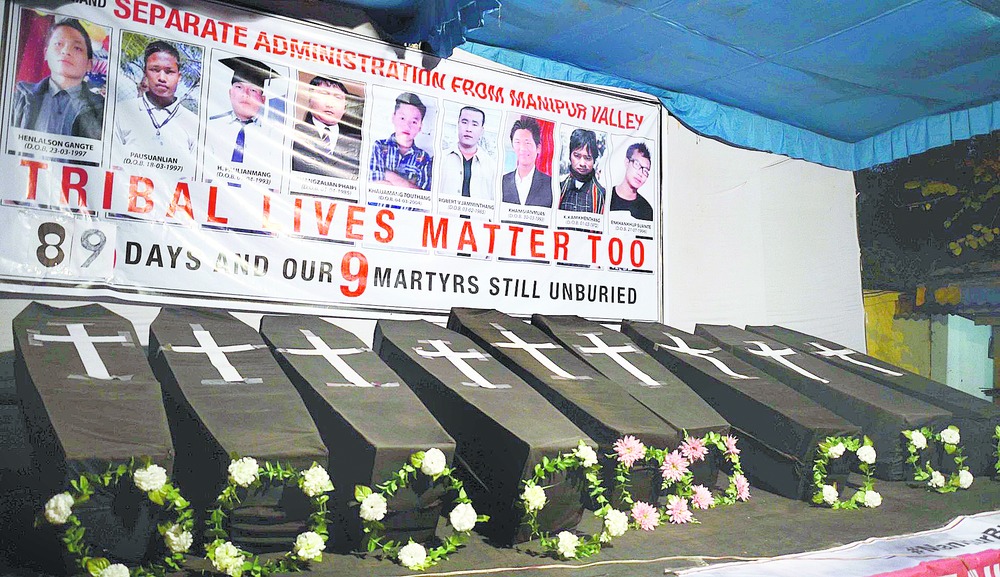

New Delhi, Nov. 29: Nine empty black coffins have been lying under the arc lights on Jantar Mantar Road, the capital's protest plaza, since November 4.
Every evening since that day, young men and women from Manipur's hill districts who reside in Delhi have been coming here to shout slogans, sing songs and demand separation from Manipur.
Nine youths had died in Manipur's hill district of Churachandpur three months ago, some of them allegedly falling to police bullets, while protesting the passage of three bills that hill residents claim dilute their traditional land rights.
It's an issue that has pitted the state's majority Meiteis, who mostly live in the Manipur valley, against the several dozen hill communities that include Nagas, Kukis, Paites, Hmars and others.
The nine coffins symbolise the nine dead, whose families have refused to bury them in protest at the police action. They are lying un-embalmed in an air-conditioned hall in Churachandpur.
In Delhi, the protesters --- students and young professionals and teachers from 38 tribes --- are demanding a separate state or a Union territory.
In the interim, they want President's rule in Manipur and the extension of the Sixth Schedule of the Constitution to the hill districts, giving them autonomy similar to that enjoyed in states like Mizoram and Nagaland.
Their cause has received support from MPs including the Tripura CPM's Jitendra Chaudhury, the Mizoram Congress's C.L. Ruala, former Speaker P.A. Sangma of the National People's Party (Meghalaya) and Majeed Memon of the Nationalist Congress Party (Maharashtra).
"Bodies are lying unburied in my hometown and I can't concentrate on my academic work any more. The bodies have decomposed and the families are using white pumpkinand lemongrass to mask the smell," L. Lamkhanpiang, JNU sociology lecturer, told The Telegraph.
Lamkhanpiang visits the protest site almost every evening.
"Here in Delhi, the difference between us hill district communities of Manipur and other northeasterners is apparent. We mostly live in areas like Gandhi Vihar that have low rent - small rooms with many of us together - but are considered unsafe," he said.
"So, we fall victim to hate crimes. Other northeasterners are more affluent and live in safer areas near Delhi University."
Some 30-40 protesters gather round the coffins on weekday evenings for four to five hours, the number going up to 100 on weekends. All of them blame the Manipur government for their plight.
"We have no major educational institutes or employment avenues in the hills. We all flock to Delhi to find whatever job we can get, as security guards or in spas," said Romeo Hmar, convener of the Manipur Tribals Forum, which manages the protests.
"The Meiteis come to Delhi by choice --- with jobs or for admission to better colleges than we have back home. We come here out of desperation."
Every evening, placards are laid on the road and requiem hymns for the dead sung. Then the boys and girls take the microphone to make speeches.
"We gave memoranda to the President, Prime Minister and home minister. We have met every senior leader," Maivio J. Woba, a co-convener, said.
"We are holding this protest with coffins after the petitions failed. It has also brought our people in Delhi together."
The controversial bills await presidential assent. The home ministry has said that both hill and valley residents of Manipur would be consulted before any action is taken on the bills.