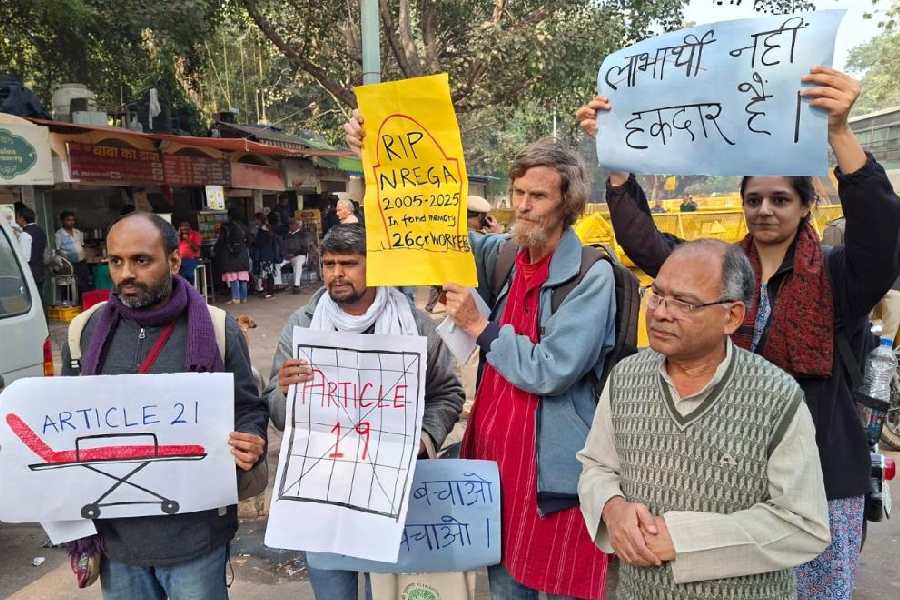
The chief ministers of four Opposition-ruled states have objected to the VB-G RAM G Bill, arguing that it would deepen rural distress and enfeeble the last line of defence against hunger and forced migration.
The chief ministers of Karnataka, Kerala, Tamil Nadu and Himachal Pradesh have criticised the Viksit Bharat Guarantee for Rozgar and Ajeevika Mission (Grameen) Bill passed in Parliament on Thursday for giving discretionary powers to the Centre to decide on allocations, areas for implementation and altering the funding pattern between the Centre and the states.
In a long post on X, Karnataka chief minister Siddaramaiah wrote that the passage of the VB-G RAM G Bill, which would repeal the two-decade-old Mahatma Gandhi National Rural Employment Guarantee Act (MGNREGA), marked a deeply troubling moment for the rural poor and democracy.
“A law that protected the right to work of crores of rural families for nearly two decades has been dismantled through an undemocratic process — without proper debate, without consultation with state governments, and in complete disregard of repeated demands by the Opposition to refer the Bill to the Standing Committee. Such a far-reaching change to a people’s law should never have been forced through Parliament in this manner,” the Congress leader wrote.
Siddaramaiah contended that the MGNREGA gave dignity to labour, bargaining power to workers and income security to families during times of distress. “During crises such as Covid-19, MGNREGA became the rural poor’s last line of defence against hunger, debt, and forced migration,” he said.
Siddaramaiah said the provision for increasing the number of work days to 125 from 100 was “nothing more than headline management”.
“Under the new law, employment will depend on allocations, notifications, and discretion exercised from Delhi,” he wrote.
Kerala chief minister Pinarayi Vijayan opposed the dropping of Gandhi’s name from the new law. “By erasing Gandhiji’s name and weakening the demand-driven character of the MGNREGA, the Sangh Parivar reveals its hostility to the Mahatma’s legacy and to the very idea of dignity through work,” the CPM leader posted on X.
He said the provision for a mandatory 60-day pause during peak agricultural seasons would deepen rural distress and lead to job insecurity.
In a letter to Prime Minister Narendra Modi, Tamil Nadu chief minister M.K. Stalin said the Centre should not implement the bill, arguing that it would adversely affect state finances and the livelihoods of millions of poor rural labourers. He objected to the powers given to the Centre to fix state-wise normative allocations based on centrally prescribed parameters.
“This caps expenditure and requires states to bear any excess costs, departing from the MGNREGA’s demand-driven nature. In Tamil Nadu, where demand is high due to climatic and geographical factors, such fixation (potentially based on population without considering local needs) will reduce person days and wages, causing hardship to rural workers,” he wrote.
“The new 60:40 funding pattern (wages, material and administration) will impose a tremendous additional burden on states, many of which are already facing fiscal constraints,” he added.
Himachal chief minister Sukhvinder Singh Sukhu opposed the bill that “seeks to take away rights of hardworking people”.