
New Delhi, Oct. 2: India has promised to significantly expand its clean energy targets, pledging that 40 per cent of its installed electricity capacity by 2030 will come without fossil fuels as part of efforts to curb Earth-warming greenhouse gas emissions.
India's government has outlined to the United Nations its intended contributions to help avert the worst impacts of global warming. It has also signalled the enormity of the challenge it faces as it seeks to simultaneously reduce poverty too.
India's 38-page document estimates the country will need, between now and 2030, at least $2.5 trillion - more than its 2014 gross domestic product - to implement its targets of curbing emissions and adapting to climate change.
The UN said that 146 countries, together representing about 87 per cent of the world's greenhouse gas emissions, have submitted their climate action plans.
Climate change negotiators will analyse these plans ahead of a conference in Paris in December that is expected to lead to a pact to prevent global temperatures rising beyond two degrees Celsius.
"India has not been part of the problem, but we want to be part of the solution," environment minister Prakash Javadekar said today.
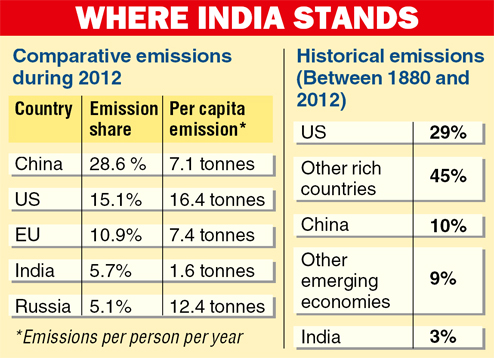
He contrasted India's three per cent "historical emissions" with 29 per cent by the US and 45 per cent by other developed countries.
India has also used the document to iterate its long-standing demands of finance and technology from developed countries to help it pursue clean energy, and to emphasise the need for the world to adopt "sustainable lifestyles".
Although India's historical emissions are low, it is now the world's third-largest greenhouse gas emitter. New Delhi had sought an extension to submit its plans, citing its desire to do so close to October 2, Mahatma Gandhi's birthday.
"If today Mahatma Gandhi was among us, he would ask if we have used the resources of the planet for our needs or for our greed, if adapting our lifestyle choices and reducing extravagant consumption would help us correct the course," foreign minister Sushma Swaraj said in New York last night while addressing the UN General Assembly.
India has expressed hope that developed countries would provide funds and support the transfer of technology on affordable and easy terms to help the country adopt clean energy technologies.
The document has listed a range of technologies - clean coal, wind turbines, solar power components and energy storage devices, among others - that India might need in its bid to curb emissions.
Senior environment ministry officials said the estimated $2.5 trillion would be generated from a mix of domestic and international sources. "We don't know yet what proportion will be from developed countries," an official said.
Among India's clean energy targets is a plan to expand installed electricity without fossil fuels from the current 30 per cent to 40 per cent by 2030 through a massive increase in solar, wind, nuclear and hydroelectric power and biomass fuel.
"This will be a challenging but not an unrealistic goal," said Thiagarajan Jayaraman, a senior climate change policy analyst at the Tata Institute of Social Sciences, Mumbai.
"This will require massive investments to increase the share of solar, nuclear and large hydro-power."
India wants to increase its installed solar energy fivefold from 20GW (one gigawatt equals 1,000 megawatts) to 100GW by 2022, using canals, rooftops and railway coaches to generate solar power; run all 55,000 petrol pumps in the country on solar energy; and install 100,000 water pumps powered by the sun on farms. The nuclear energy target is 63GW by 2032, a 12-fold increase from the current 5GW.
While promising to reduce dependence on fossil fuels, India also pledged to add enough forests or tree canopy by 2030 to cover over five million hectares - more than half of Bengal's area.
This afforestation and tree plantation programme will be distributed across the nation. For instance, a "green highways" policy will plant trees along both sides of about 140,000sqkm of highways.
The additional trees and forests - which serve as sinks for carbon dioxide emissions --- will mop up an estimated three billion tonnes of carbon dioxide.
Climate policy analysts have said India's intended plans lack any major surprises.
"The plan does a good job combining opportunities to reduce emissions in the near term and includes clear goals to restore landscapes that will bring long-term benefits," said Nitin Pandit, chief executive officer with the World Resources Institute, India, a non-government climate and environment think-tank.
"These efforts will be critical to building India's resilience to severe droughts, deadly heat waves and other climate impacts. We expect India can even exceed its carbon intensity target in the course of shifting to non-fossil fuel energy."
Some analysts, however, believe that the goal of reducing the rate of growth of India's emissions by 35 per cent by 2030 would hinge on an "aggressive pursuit" of clean energy and higher energy efficiency across sectors, such as industry and transport.
"This will also pose a big challenge if industrial growth occurs at about nine per cent per annum as projected. A high rate of industrial growth will make reaching the 35 per cent goal that much harder," Jayaraman said.