
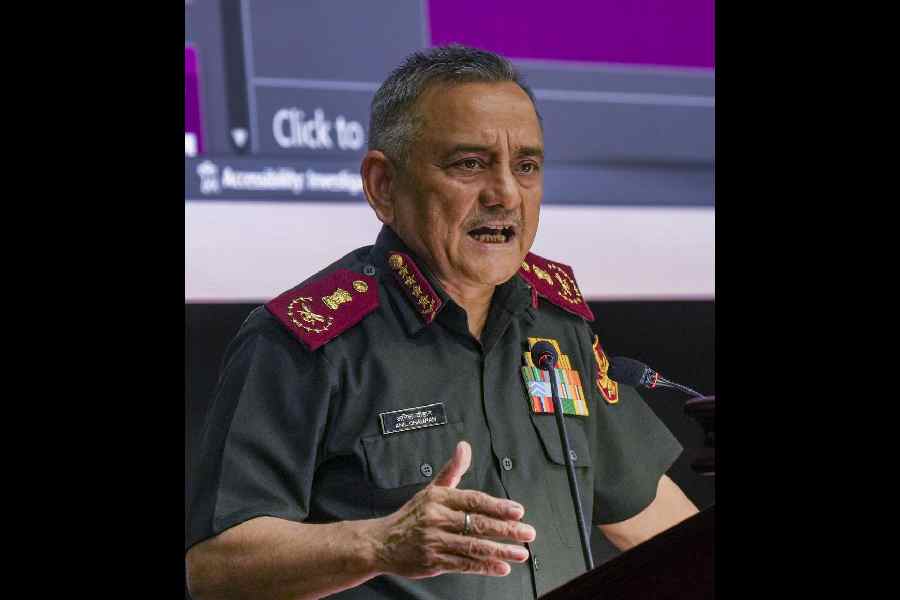
Invoking Netaji Subhas Chandra Bose, chief of defence staff General Anil Chauhan on Friday said the Indian National Army (INA) had awakened national consciousness and was an “expression of unity in diversity” as the organisation did not concentrate on region, caste, religion or gender.
Speaking at the inaugural Subhas Chandra Bose Anniversary Lecture at Jawaharlal Nehru University, he said the freedom fighter fought not only to free India but also to eradicate a mindset rooted in servitude and submission.
Chauhan said Netaji was a classical military leader and credited him for building an army, planning campaigns, negotiating alliances, and managing logistics, demonstrating a close relationship among political vision, astute diplomacy and military operations.
“He was not just a freedom fighter but a military leader who understood power politics, alliance-building and logistics,” the CDS said, adding that the INA symbolised national unity and bore extraordinary losses, challenging colonial narratives written by the British.
Gen. Chauhan asserted that Netaji’s policy of assertive diplomacy and strategic realism is more relevant for India today than ever for navigating the unstable and uncertain global disorder.
India, he said, continued to grapple with a colonial mindset and cognitive colonialism even decades after Independence. He explained that while visible symbols such
as colours and ranks had largely been Indianised, the deeper challenge lay in changing mindsets.
Describing cognitive colonialism as a newer and more complex threat which reshapes societies to serve the interests of external powers, Chauhan said modern national security now rests on three pillars — territory, people and ideology.
India’s responses, he underscored, must reflect this expanded definition.
As global power centres multiply and instability rises, Netaji’s ideas offer a blueprint for how India should think, act and defend its interests, Chauhan said.