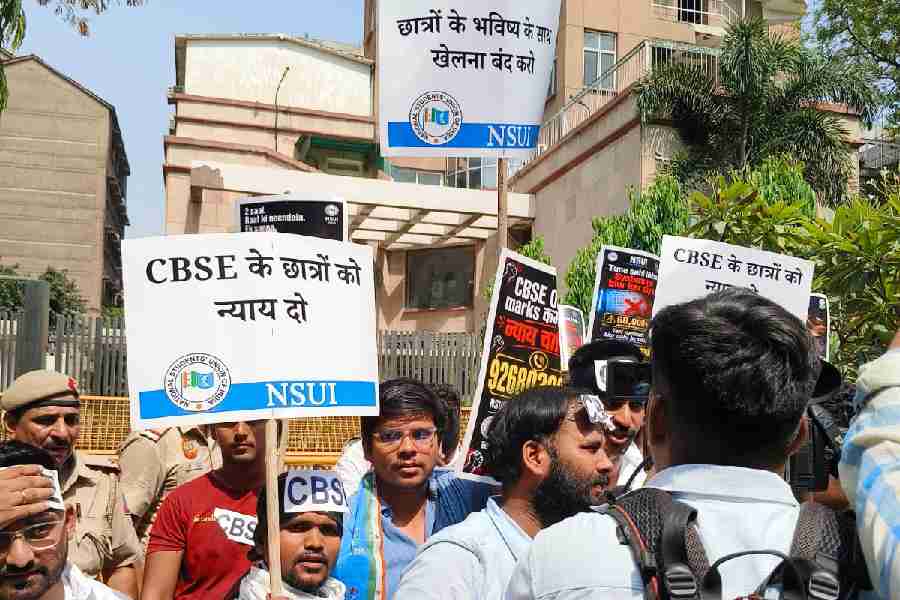
The National Students’ Union of India (NSUI), the Congress’s students wing, moved Delhi High Court on Tuesday seeking an independent inquiry into alleged large-scale irregularities, deficiencies and technical issues in the CBSE’s on-screen marking (OSM) system that has affected several Class XII students this year.
The NSUI has also sought manual rechecking and physical verification of the answer sheets of aggrieved students.
Asserting that students cannot suffer due to deficiencies in a system introduced by the authorities, the NSUI petition sought a direction to the Centre and the CBSE to keep its portal open for one month for verification and re-evaluation of answer sheets of affected students.
The petition filed by NSUI president Vinod Jakhar through advocate Rishav Ranjan flagged serious concerns regarding the OSM system that left students perplexed over answer sheet mismatches and unexpectedly low marks.
The CBSE declared the Class XII results on May 13. Citing CBSE’s official data, the NSUI submitted that overall pass percentage this year stood at 85.20, the lowest in the last seven years and 3.19 percentage points lower than last year. The petitioner pointed out that the number of students scoring 90 per cent and above also witnessed a substantial decline.
Linking the drop in performance with the debut of the OSM system, the petitioner submitted that students across the country raised concerns over evaluation accuracy, improperly scanned answer sheets, portal glitches and verification-related grievances.
“The concern was not confined to a small set of students. It became a nationwide issue because the digital system itself was being questioned by the very persons it was meant to serve,” the petitioner said, urging the court to formulate and implement proper safeguards, protocols and guidelines for future digital evaluation systems so that similar grievances do not recur.
“The Respondent No. 2 (CBSE) itself acknowledged, through its own public communications, that the portal for obtaining scanned copies of answer books suffered technical glitches and that a very large number of applications, approximately 1,27,146 applications concerning 3,87,399 scanned answer books, had been submitted in a very short time,” the petitioner said.
This figure reflects an extraordinary level of concern and lack of confidence among students regarding the process, it added.
“When such a large number of students seek scanned copies immediately after result declaration, the matter cannot be treated as a routine post-result formality,” the petitioner said.
The NSUI sought direction from the court to the CBSE to award compensatory marks to students whose answer scripts were missing, blurred or incorrectly checked.
“Students whose answer sheets were properly scanned and evaluated stand in a different position from those whose answer sheets were affected by scanning defects, mismatch errors or other technical failures. Such unequal treatment, caused by the respondents’ own system, is arbitrary and violates Article 14 of the Constitution,” the NSUI said.
Calling the existing grievance mechanism inadequate, the NSUI said students were left with limited digital remedies and no meaningful process for manual verification or independent rechecking of disputed answer sheets.