|
 |
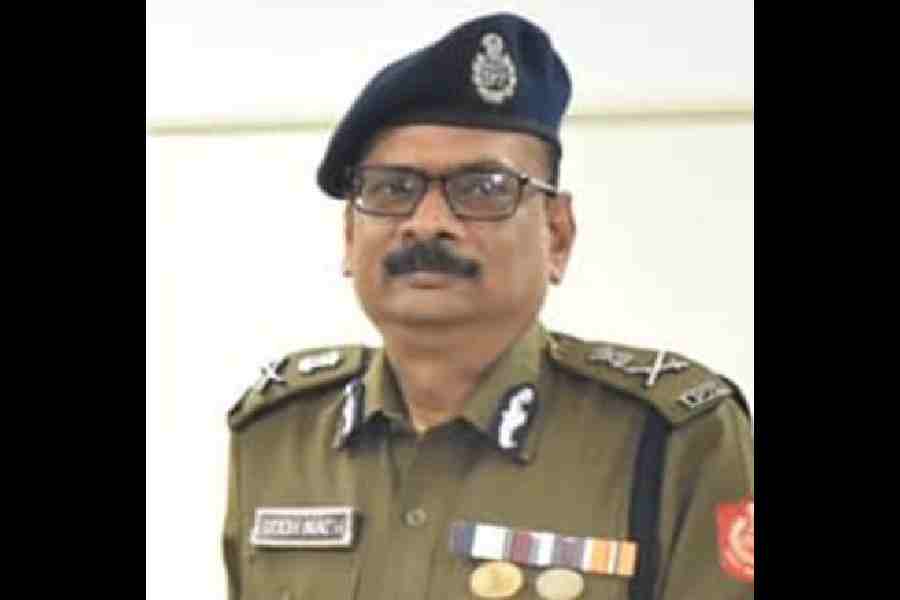
| (From top) The portrait of Rufus Daniel Isaacs and marquess Simon Charles Henry Rufus Isaacs |
London, June 7: An English marquess who is anxious to trace a portrait of his great-grandfather, who was viceroy of India from 1921-26, has said the missing painting could be “somewhere in Calcutta”.
Almost as in a detective story, the hunt for the painting of Rufus Daniel Isaacs, the 1st marquess of Reading (1860-1935), is being organised by his great-grandson, Simon Charles Henry Rufus Isaacs, the 4th marquess of Reading.
In the English aristocratic hierarchy, marquess ranks high up: king/queen, duke, marquess, earl, viscount and baron.
In an interview at his club, the Cavalry and Guards in London’s Piccadilly, the 4th marquess, who was born in 1942 and refers to himself as simply “Simon”, said if anyone in India was able to help him find the painting, “I would be very, very grateful. It is a magnificent painting larger than life size, 10ftx7ft or something like that.”
“Rufus”, as Simon likes to call his great-grandfather, was viceroy from April 2, 1921, until April 3, 1926, having taken over from Lord Chelmsford and, being succeeded, in turn, by Lord Irwin, known later as the Earl of Halifax.
The painting of Rufus was done in London by Philip Alexius de László, (born 1869, Budapest, died 1937, London), a Hungarian artist famed for his portraits of royals and aristocrats wearing all their finery.
Before being sent to India by Lloyd George, the Liberal Prime Minister, Rufus had served as the Lord Chief Justice of England, the senior law officer in the land, and simultaneously from 1914-18, as British ambassador in Washington. In the latter post, he was credited with bringing America into the First World War on the side of the UK against Germany.
“He was a politician, a lawyer and a statesman,” Simon says of his great-grandfather.
On returning from India, Rufus served as foreign secretary and also Liberal leader in the House of Lords in a coalition government that lasted for 14 years.
“When he came back he became chairman of The Daily Telegraph; he was president of ICI, one of the biggest companies,” Simon says. “He was always doing quite a lot for India. He spent a lot of time working on legislation on India. He died in December 1935, a month before King George V in January 1936.”
An extra dimension to Rufus’s achievement lay in his being Jewish.
Benjamin Disraeli, a Jew, was Prime Minister in 1860, Simon points out. “Rufus was the only Jewish viceroy of India. He was the second Jew in the cabinet: I mean (he was) Jew by faith as well as by blood whereas Disraeli was there by blood but not by faith. Rufus was a practising Jew but he was a liberal Jew and he was more English than he was Jewish.”
Simon gives one reason why he is anxious to find his great-grandfather’s portrait: “I am proud he came from humble beginnings in the late Victorian/Edwardian era (and rose) to all those remarkable positions, really. He was the first person to be raised from commoner to marquess since Marlborough in 1714.”
His painting was sent to India, almost certainly to the Government House in Calcutta, where the viceroy continued to live while Edwin Lutyens was completing the Viceregal Lodge in Delhi following the transfer of the capital of British India in December 1912.
“We know the portrait exists and the László Foundation have confirmed it. It may have been destroyed, we don’t know but it was definitely done, without any shadow of doubt,” Simon emphasises. “We know for certain it did exist.”
When Rufus became viceroy in 1921, it was a troubled period for the Raj only two years after the Jallianwala Bangh massacre of 1919. According to some historical accounts, “although Reading preferred a conciliatory policy, he ended up using force on several occasions, and imprisoned Mahatma Gandhi in 1922”.
Simon, who has studied family history a bit more deeply, ponders the question: “Was Rufus a good chap?”
One the whole, he thinks he was. His relationship with Indians was good, Simon believes. “His relationship with Gandhi was particularly good. They were both barristers, of course. And they were both reasonably ascetic. For example, my great-grandfather would have taken tea without milk or sugar.”
He jokes: “Gandhi would take tea without tea. They were ascetic — they had that in common. The fact is that my great-grandfather was not a member of the aristocracy here and therefore didn’t follow in the viceregal tradition. He was a self-made man and Gandhi appreciated that he was dealing with somebody who had come through the ranks like he had.”
Simon also argues that “Rufus started to lay the path towards independence. He started a dialogue, probably more covertly than overtly. One of the things he did was to create the Princes’ Chamber so the Indians had more of a say in the running of their country.”
There is a hospital in Peshawar, the Lady Reading Hospital, started by Rufus’s wife, Alice. And In Delhi, Reading Road has been renamed Mandir Marg.
A “magnificent” statue of Rufus was repatriated from Delhi to the city of Reading in 1961 and re-erected in 1971 in Eldon Square Gardens. The sculptor was Charles Jagger, “(Rolling Stone) Mick’s grandfather, funnily enough”.
India appears to have remained in the Reading family’s DNA. Simon has been to India half a dozen times since his first trip in 1985. “I have seen 27 years of change,” he says.
In 1998, he went with the descendants of viceregal families and was shown round Rashtrapati Bhavan which houses the portraits of many viceroys (though not Rufus).
On another occasion, Simon went to Hyderabad as a director of the Flying Hospital which is capable of conducting “28,000 small operations in 12 working days”.
Simon’s last trip was in early 2011 when he went to support his daughter Natasha, a rising fashion designer who campaigns against trafficking and helps women in the red light area of Calcutta.
Simon is characteristically understated: “I would like to see if one can’t in some way contribute a little to Anglo-Indian relations.”