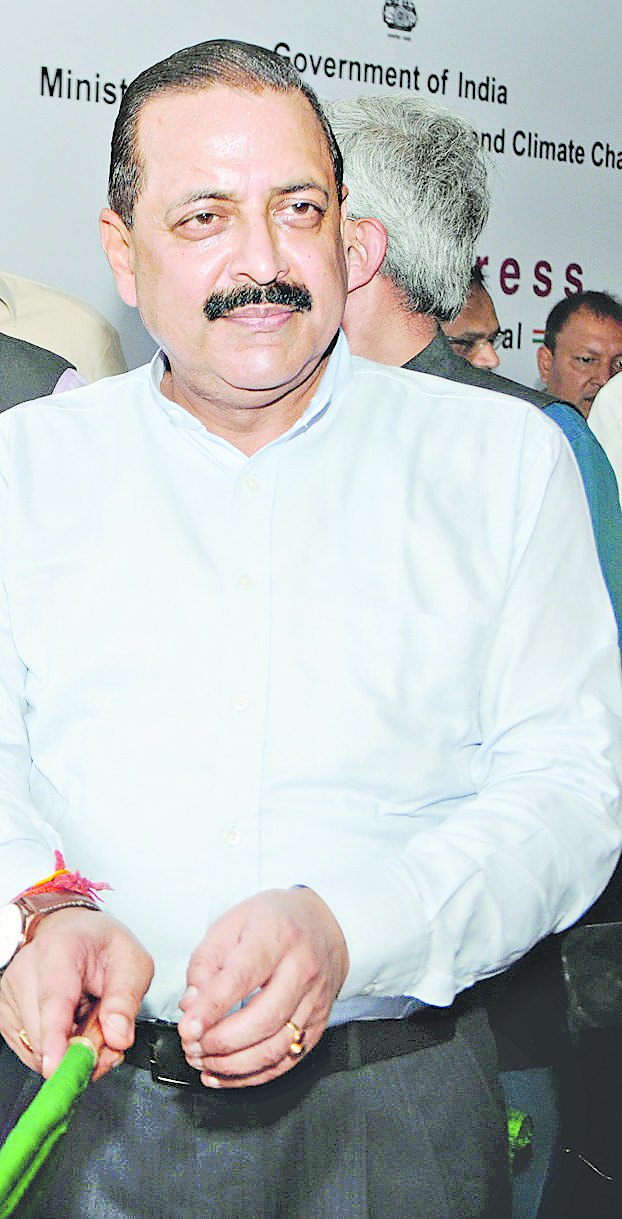

Srinagar, June 4: The Amarnath Yatra can be conducted throughout the year, Union minister Jitender Singh who was the face of the 2008 temple land agitation said today, claiming "scientific evidence" and brushing aside concerns of a threat to the area's fragile ecology.
"You can have the yatra throughout the year. There is no embargo. The two months' duration (fixed by the Amarnath Shrine Board) is worked according to a religious calendar. That is a different thing. It is a question which has to be addressed scientifically...I have substantial geology survey reports with me (to prove it can be held through the year)," Singh, a BJP MP from the Jammu region, told a news conference in Srinagar.
The yatra and its duration have been a touchy issue in Jammu and Kashmir.
The 2008 agitation started after the state allotted 100 acres of forest land to the shrine board to build permanent structures for the pilgrims at the Baltal base camp, only to reverse the order following a backlash in the Valley. This triggered counter-protests for the land, with Singh as one its key figures.
Civil society groups in the Valley and the separatists have long demanded a shorter yatra, like the one to Gangotri in Uttarakhand, claiming increased traffic was playing havoc with the area's ecology.
Hurriyat hawk Syed Ali Shah Geelani last month stirred a row when he sought curtailment of this year's yatra - scheduled to start from July 2 - from two months to 15 days or a month.
Singh did not call for a round-the-year yatra but sought to buttress his point for an increase from the current duration by saying India's first Prime Minister, Jawaharlal Nehru, undertook the pilgrimage with his newly wed wife in February and March.
A vast swathe in and around the Amarnath cave, where the Shiva temple is located, remains snow-bound for most part, making it almost impossible to reach for six to eight months a year.
Singh acknowledged the environmental concerns as "relevant" but cautioned against attempts to "politicise" them. "...to politicise it and say it (the yatra) should be for two months or 15 days, it is not like this...our scientific report says that barring a storm...there is no problem in conducting the yatra from May to September."
The minister's remarks triggered a row instantly. The Kashmir Centre for Social and Developmental Studies (KCSDS), a civil society group, challenged Singh to produce the "scientific evidence".
"There is lot of scientific evidence to prove how unbridled development, large influx of tourists and pilgrims, and militarisation have disturbed the bio-diversity and ecology of the Valley," Nayeema Hameed, a member of KCSDS, said.
"The glaciers in and around Amarnath are a big source for water for the Valley and there is evidence their warming will cause them to melt. Let him (Singh) produce the scientific evidence. Otherwise, we will produce ours," Hameed said.
Shakeel Qalender, another of the institute's members, said Amarnath's topography was similar to that of Gangotri. "Will the minister contest the Nitish Sengupta report on the Gangotri, which was approved by Supreme Court, that (only) 150 yatris should be allowed to undertake that yatra a day for a limited number of days a year?" Qalender asked.