
New Delhi, Aug. 27: Naba Mondal views a room built 150 storeys below the ground in a uranium mine in Jaduguda, Jharkhand, as an opportunity for India to return to a unique class of experiments it abandoned 25 years ago.
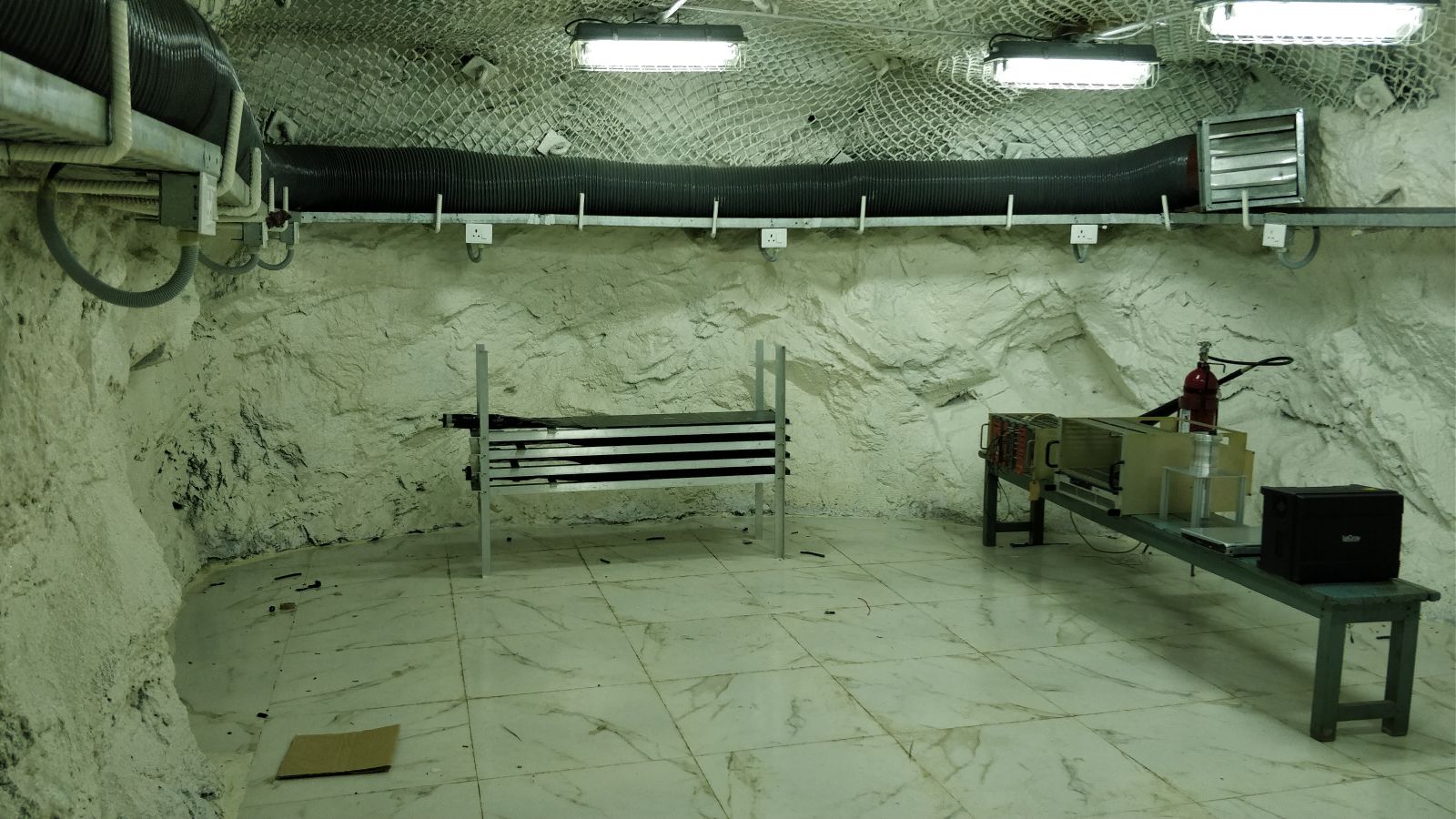
The room, carved in granite rock at a depth of about 550 metres and housing instruments designed to look for signatures of subatomic particles, will become India's only underground physics laboratory since a 2.3km-deep lab in the Kolar Gold Fields shut down in 1992.
Sekhar Basu, chairman of India's department of atomic energy, is expected to inaugurate the Jaduguda lab on September 2 for preliminary studies of "background" signatures of subatomic particles, a preparatory exercise for more ambitious goals.
"We're excited because we're going back to studies underground," said Mondal, a Raja Ramanna Fellow at the Saha Institute of Nuclear Physics (SINP), Calcutta.
Scientists at the SINP led the initiative to turn a small part of the mine, managed by the Uranium Corporation of India, into a lab but researchers from multiple institutions across the country are expected to participate in studies there.
Mondal was among physicists who had to stop their experiments involving subatomic particles called protons and neutrinos in Kolar after the company operating the mine determined the site had run out of gold and was no longer worth keeping open.
The Jaduguda lab will help a new generation of Indian physicists gain expertise in working on underground experiments, said Ajit Mohanty, SINP director. "If required, the instruments could be moved to a deeper level of more than 800 metres (below the ground)," he said.
Scientists had turned to Jaduguda after their proposal to build a cavern under a mountain near Madurai in Tamil Nadu faced regulatory roadblocks. The Madurai laboratory was primarily intended to study subatomic particles called neutrinos but in Jaduguda, the physicists will look for the mysterious dark matter.
Astronomical studies of the distribution of galaxies show that about 23 per cent of matter in the universe is invisible dark matter, which physicists have hypothesised might be an unknown set of subatomic particles. Although many scientific groups across the world have tried to identify dark matter, it remains a puzzle.
Physicists need deep underground facilities to study neutrinos and look for dark matter because the Earth is constantly bombarded by subatomic particles from space that block out the feeble signatures created by either neutrinos or dark matter.
The Rs 1,500-crore Indian Neutrino Observatory (INO), proposed to be set up near Madurai and approved by the Union cabinet in 2015, has been stalled - initially by false claims from sections of activists that the project would harm water and a dam in the region.
Then, petitions filed in Madras High Court and the National Green Tribunal claimed the INO could harm wildlife in a forest 4.9km away. Project scientists, who now need to obtain fresh environment and forest clearances, say they cannot predict when construction can begin at the site.
The delay has threatened a key goal of the INO - to study neutrinos originating in the Earth's atmosphere. Laboratories in China, Japan and the US are now engaged in neutrino-related science that, Indian physicists fear, could make the INO's prime objective redundant.
"We don't have a timeline yet, but even if construction was to begin in January 2018, it would take about 15 years for results to emerge," said Brajesh Choudhary, a physicist at Delhi University and a member of the INO collaboration. "The delay has made its primary objective less relevant."
But other physicists said the INO was also intended to house an experiment to search for dark matter, which could proceed if and when the project is approved.
In Jaduguda, scientists from SINP and other collaborating institutions have set up instruments that will initially be used to track and count cosmic muons, subatomic particles that originate in the universe and pass through the Earth.
"Cosmic muons are a menace in the search for dark matter - they can mimic signatures we expect to see from dark matter candidates," said Satyajit Saha, a physicist at the SINP who is coordinating activities at the lab.
"We need to determine the count of cosmic muons. This is preparatory work before we actually begin the search for dark matter."
The instruments will also be used to measure background neutrons - another class of subatomic particles that can interfere with observations. Physicists also use theoretical calculations and simulations to predict background and, Saha said, such observations are important to compare the predictions from simulations with actual values.