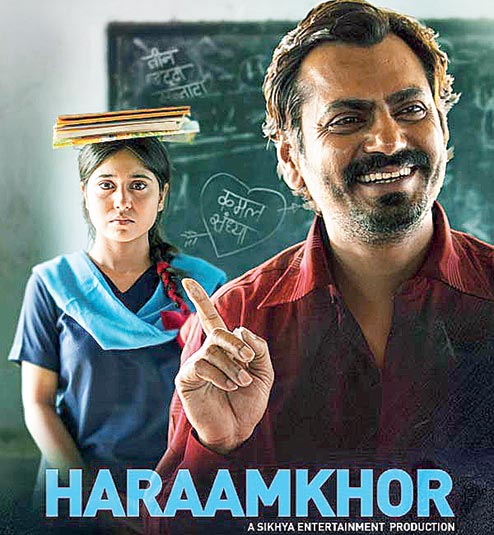
After being stuck at the censor board for years, Haraamkhor — about the relationship between a schoolteacher and his 14-year-old student — releases today. A chat with debutant director Shlok Sharma.

What’s the overriding emotion, nervousness, excitement or relief... that your debut film is finally releasing?
When I was first told it’s finally releasing, I couldn’t really believe it. Now that it’s releasing, I am having mixed feelings. It’s difficult to express it in a word. Maybe when I watch the film with an audience in the theatre, my emotions will pour out simultaneously or one by one. Now I am just waiting for January 13.
What prompted you to write a film about the relationship between a teacher and his much younger student?
I had read a newspaper article about a teacher-student romance. The teacher in question was humiliated by smearing ink on his face, he was made to sit on a donkey and paraded through the streets. The girl was beaten up by her parents. That set me thinking… as a society we are so quick to judge people and we don’t think what prompted a teenager like this to fall for a man who’s her teacher… what is the hope she sees in him? There are a lot of perspectives involved, which we tend to ignore. I haven’t tried to justify anything in Haraamkhor… I have just tried to show the point of view of a 14-year-old.
Kids today know what they are doing… my film says that the 14-year-old knows what she’s doing, it’s just that she may not be aware of the repercussions. I am aware that it’s a controversial subject, but these kind of cases are rampant and it’s time someone spoke about them. It’s an important film.
Do you think this is a universal story?
This happens everywhere… sometimes these things come out in the open, most often they don’t. When we had gone location hunting, I remember telling the story of the film to the owner of the house where we shot it and his wife promptly said that such a case had happened in their locality itself… and that couple are happily married today. So it works out for some, it doesn’t work out for many. I spoke to a lot of friends who told me that they had a crush on this teacher or that teacher. So yes, this infatuation for a teacher has happened to all of us at some point of time.
What does Nawazuddin Siddiqui bring to the film?
When I wrote the film, the first person that came to my mind was Nawaz bhai. I was assisting Anurag Kashyap on Gangs of Wasseypur and it was on that set that I narrated the germ of the story to Nawaz bhai. He said ‘yes’ almost immediately. He has immense trust in me and he brings the right mix of emotions and the right body language to the role.
Why cast Shweta Tripathi, who is 31, and not a teenager?
I didn’t want to cast a teenager because I didn’t want to put such a young actor in a role that could potentially turn out to be awkward, given the boldness of theme and the language. As a director, I have a certain responsibility and I felt I should cast someone who will be able to understand what the character is, where she’s coming from, why she’s doing what she’s doing… a young girl would probably not have got that.
Shweta had done a short film called Sujata with me in which she had played a 10-year-old. When I was writing Haraamkhor, I thought of her and felt she could do it because she anyway looks much younger than her age.
When the film was stuck, was there ever the temptation to self-censor some scenes or change the title?
I come from the Anurag Kashyap school of thought (smiles). Like him, I believe ki agar kuch galat nahin kiya hai toh daro mat aur apne film ko support karne ke liye khulke khade ho. When I kept the title Haraamkhor, it wasn’t done to titillate or create a stir. When you watch the film, you will know it’s an apt title because every character in the film is a haraamkhor at some level. All the years it was stuck at the censor board... was obviously a dark period because here we were trying to say something and we were being prevented from saying it because it didn’t fit in with the censorship guidelines. We told them to certify the film, but they wanted to bring in huge cuts. Thankfully, we approached the FCAT (Film Certification Appellate Tribunal) and the film got cleared for release. It was necessary to take a stand.
How much did Anurag’s win during the Udta Punjab controversy encourage you?
A lot. When I saw Udta Punjab, I was shocked that the censor board wanted to stop a film like this, that shows Punjab to be a lot more than just lassi-paratha and sarson ke khet.
Priyanka Roy