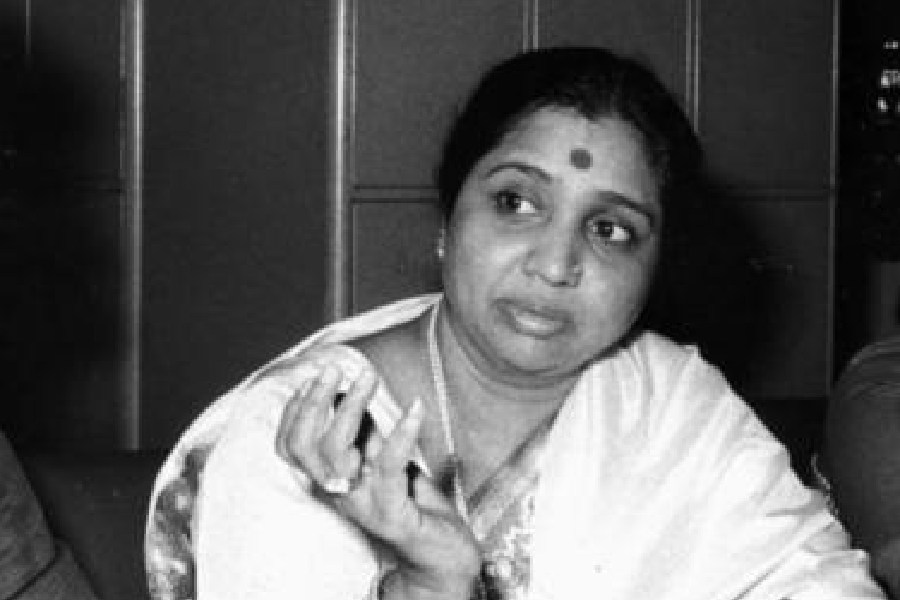
On September 8, 2023, the day Asha Bhosle turned 90, she got onto a stage in Dubai for a concert conceived on an expansive scale and planned meticulously for over a year.
Her elder sister, Lata Mangeshkar, more celebrated and revered, had spent her 90th birthday with close family. The occasion was inward-looking, reflective. For Asha, life began at 90 as it did for her every year.
Asha’s work, like her life, defies summary. It spanned styles and settings, from single-microphone recordings in modest studios to the most technologically advanced productions. It encompassed genres, languages, and nearly eight decades of performance. Any attempt to place her in a single category is impossible.
It is said that she was the go-to singer for leading ladies of B-grade films. She also lent her voice to the fun-loving sister, the bereft mother, but majorly, to the “other woman”, be it the vamp or the moll.
Today, it is difficult to imagine Helen without Yaar Badshah Yaar Dilruba (CID 909, 1967); Shashikala without Sheeshe se Pee ya Paimaane se Pee (Phool aur Patthar, 1966), Bindu without Mera Naam Hai Shabnam (Kati Patang, 1970); Mumtaz without Yeh Hai Reshmi Zulfon ka Andhera (Mere Sanam, 1965), Jayashree T without Reshmi Ujala Hai (Sharmilee, 1971). Or even Nadira without Mud Mud ke Na Dekh (Shree 420, 1955).
Asha’s vocals did more than accompany the songs; apart from shaping the characters, they defined an era of Hindi film music.
Move on to the mid- and late 1950s. Madhubala, who once insisted on having Lata Mangeshkar as her playback singer as a contractual stipulation, becomes unforgettable when she lips Aaiye Meherbaan (Howrah Bridge, 1958). Asha’s was a voice that recalibrated itself to the emotional grammar of an actress.
It could be argued that Asha Bhosle’s rise in the 1950s was shaped by circumstances rather than any single cause. O.P. Nayyar’s unwavering faith in her, the prolonged estrangement between S.D. Burman and Lata Mangeshkar, and, finally, the industry’s growing hesitation around Geeta Dutt.
None of these diminishes Asha’s achievement. But it does explain how opportunity, once it appeared, found a singer ready to inhabit it fully.
Asha has always acknowledged Saawan Aaya Re from Chunariya (1948) as her first playback in Hindi films. For this song she provided supporting vocals to Geeta Dutt and Zohrabai Ambalewali.
Within a decade, Zohrabai had all but faded from popular memory and Asha Bhosle had quietly become what Geeta Dutt once was — the voice filmmakers turned to when they needed vitality, flexibility, and a certain emotional immediacy, something that started with Naya Daur (1956).
Discussions of Asha’s career have long suffered from two familiar fixations: O.P. Nayyar and the Burman family. Lost in this narrowing of focus is the quietly crucial role played by Ravi.
In Vachan (1955), which was music director Ravi Shankar Sharma’s first silver-jubilee hit, Asha sang for the film’s lead, Geeta Bali, most memorably in Chanda Mama Door Ke.
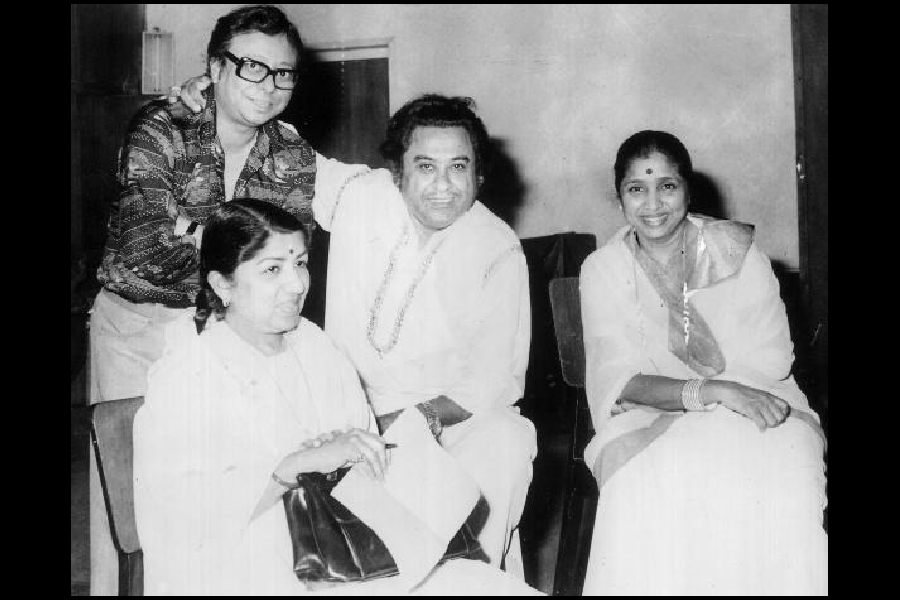
RD Burman, Lata Mangeshkar, Kishore Kumar and Asha Bhosle Sourced by The Telegraph
With B.R. Chopra’s sustained preference for the younger sister’s vocals, Asha soon became a regular presence in big-banner productions, eventually singing for Meena Kumari in Kaajal (1965).
With the success of Gharana (1961) and Do Badan (1966), she also came to embody the emotive range of Asha Parekh — an actress otherwise identified with a tomboyish charm — proving her capacity to both complement and deepen a screen front.
It was Asha who brought out Tanuja’s playfulness in Salil Chowdhury’s composition Baag Mein Kali Khili (Chand Aur Sooraj, 1965). A year later, the art of seduction found near-perfection when Tanuja lip-synced to S.D. Burman’s Raat Akeli Hai (Jewel Thief, 1967).
By the latter half of the 1960s, major productions and their music directors had begun to see in Asha not merely the alternative voice but a parallel one. She could go where Lata Mangeshkar’s carefully guarded vocal persona could not.
And then came the prodigal son — R.D. Burman. In Caravan (1971), barring Monica, O My Darling, the gold standard for cabarets, and Daiya Yeh Main Kahan Aa Phansi, the pivotal rap-a-scat moment in her career, most of the frothy songs were earmarked for Lata.
Asha had the formidable task of singing for two actresses and diametrically contrasting moods in the same song, Ab Jo Mile Hain Toh. She nailed it. Reason enough for Pancham to trust her for the mushy Jab Tak Rahe Tan Mein Jiya while elder sister Lata took on the raunchy Bangle ke Peechhe in Samadhi (1972).
After her split with Nayyar in 1972, Asha was reinventing herself. With Nayyar, her strengths were short notes, complex phrases, gay abandon, and bass voice — something which, according to Asha, happened after the birth of her first two children.
Post-Nayyar, she was getting longer notes, multiple scales within the same song, melodies with polyphonic structures, and space to establish her strong breath control, an example being the theme song of Shaan (1980).
And her duets were vivacious, her voice powerful, as if two strands were running side by side, often throwing her male singers off balance. Melody and power, even when the heroine was a petite Jaya Bhaduri, was no longer a male bastion in Hindi cinema.
Suffice it to say that if Lata was a melancholic phrase on a Stradivarius, Asha was the layered resonance on John McLaughlin’s electro-acoustic guitar. She was regularly straddling genres in the 1980s and later. Singing ghazals solo or with Ghulam Ali, collaborating on albums with Ali Akbar Khan — who, incidentally, was her guru in later years — recording duets with Boy George, even adjusting her style to suit Rahman’s electronic music.
Now that Asha is no more, we will be flooded with obits from across the globe. Her résumé will float on social media. Reel makers will copy, paste and blast her songs over YouTube and other forms of audio-visual media. Baby Boomers and Gen Z from Sangli to Pune will recall stories narrated to them by their grandparents.
Tales of the grit and resolve of a woman who lost not only two husbands but also two of her three children might make it to essay collections on feminism. But for someone who refused to either wash dirty linen in public or expose her wounds to the media, we shall perhaps never know how many times she died before ultimately leaving us aggrieved and longing for more.
Like her song that was never featured — Chain se Humko Kabhi (Pran Jaye Par Vachan Na Jaye, 1974) — the real Asha shall remain an unresolved figure. Maybe songs like this will make us ponder. And the heart shall grow fonder.
Anirudha Bhattacharjee, an alumni of IIT Kharagpur, is the National Award-winning co-author of the biographies of RD Burman and Kishore Kumar