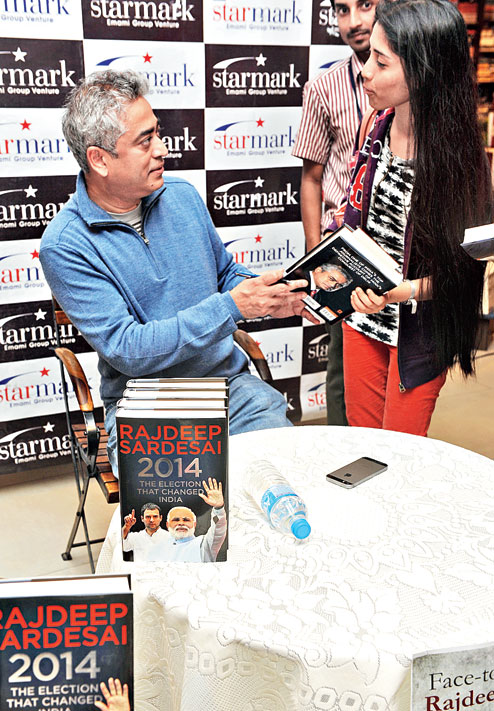

Rajdeep Sardesai signs copies of his book for fans at Starmark South City on December 14. Picture: Pabitra Das
Rajdeep Sardesai loves elections. In fact, he calls himself an election freak. So it’s no wonder that when he set down his mike to pick up the pen, it was to tell the story of the most riveting vote the country has seen in decades. According to Rajdeep, the 2014 election was fought between the outsider Narendra Modi — “who came to power on a four-letter word called hope” and the crown prince of Indian politics Rahul Gandhi — “who never missed an opportunity to miss an opportunity”. The consulting editor to the India Today Group launched 2014: The Election that Changed India (Penguin Books India, Rs 599) in the city recently.
t2 got the man who loves to talk to well, talk some more...
Tell us, do news anchors really wear shorts underneath the table?
(Laughs) I used to wear shorts and trackpants when I used to do a Sunday show in NDTV. That was in the 1990s. I just couldn’t handle the idea of dressing up on a Sunday! Nowadays I dress properly because once when I got up while doing a show, my trackpants were seen on TV! After that I’m very careful.
Do you wear make-up for the camera?
I am forced to! I have a make-up guy who comes and puts it on me. I hate it but I have to do it.
Do you remember your first assignment?
Yes! My first for print was to cover a BJP-Shiv Sena press conference in 1988 where I had tagged along with the main journalist and I wrote the copy. In TV, my first was when Brian Lara came to India in 1994. He had just broken the world record for the most runs in an innings and I was chasing Lara all over Delhi!
Your most enjoyable assignment?
There are lots which I have enjoyed. I’ve loved going to Pakistan over the years, it is the only country obsessed with India. I’ve loved doing live election coverage, I’ve loved meeting leaders like Lalu, Modi, Thackeray… all controversial. One likes to meet controversial figures. When I was in print, I remember doing an interview with Muhammad Ali in an old hotel in Juhu. It was to me the biggest thing… I was a Muhammad Ali fan as a kid.
And your toughest?
I think covering the ’92-’93 Mumbai riots and then covering the Gujarat 2002 riots.
Any journalist you have looked up to?
I’ve admired various journalists at various times for the work they have done. I was a great admirer of R.K. Laxman, I learnt a lot from him. Shekhar Gupta was a very fine editor. Vinod Mehta had his strengths… and I learnt a lot from Prannoy Roy and Radhika Roy. Prannoy was probably the closest I came to idolising, because I love elections and he loved elections, so we found a common ground there. And he was very good to me.
The most bizarre thing you have done for a story?
Lots of things. I have milked a cow (laughs) to do an interview with Lalu. He insisted that unless I learnt how to milk the cow he wouldn’t give me the interview. Then, I remember interviewing the Lashkar guys many years ago in Pakistan and for that I had to drive for miles to find them and we had Pepsi together and I convinced them as to why they should do the interview. Then the Lahore bus yatra. We had to go back from the border to Lahore in a truck, surrounded by buffaloes. So you do all these crazy things in life….
If not a journalist, what would you be?
I’d probably be a lawyer but I’d have liked to have been a Test cricketer.
We watch you on TV, what do you watch?
I watch sport on TV. I watch Premier League football. I’m a Premier League addict.
And your team?
For the longest time it was Manchester United. In recent times I am not as fixed on any one team. But ya, growing up it was only Manchester United. Now I suppose I support Arsenal… because my son supports Tottenham (Hotspur). So I try and build some sort of family rivalry. But I don’t have the same thing that I had for Manchester United. That was an obsession.
Many young and would-be journalists look up to you. If you had to give them five tips, what would they be?
1. Don’t do journalism!
2. If you are doing journalism, do it because you are passionate about news, not to become famous.
3. If you are doing journalism, don’t treat it as a 9-to-5 job.
4. If you are doing journalism, challenge your boss. Don’t always listen to those at top of the pyramid. Believe in yourself.
5. If you have decided to be a journalist, remember, always be a little crazy in life.
Things a news anchor must know?
I think a news anchor or a TV journalist must know the news. Must keep in touch with the news. Must be confident, have a lot of self-belief, be a good communicator — may be take a few tips from Narendra Modi on how to communicate in public... extempore — and not be too conscious.
When asking uncomfortable questions…
Remember that your job as a journalist is to ask questions. Never shy away from asking. Always ask the question that you think the viewer wants that person to be asked. Put yourself in the shoes of the viewer, think of yourself as an ombudsman on behalf of the public. And always remember that you can’t be shot for asking a question. So don’t be fearful.
Something that a TV journalist should NOT do…
Don’t get intimidated. Remember, you are in journalism, not in PR. Always feel free to ask the uncomfortable question. And… don’t take over the show.
Coming to your book, why did you decide to write one?
I always wanted to write a book. I have been a print journalist, then TV. Always believed in the power of the written word and in the power of books. I believe that 10 years from now people won’t remember a TV programme, they might read the book… I think books endure. I was looking to do something more enduring, I think I was tiring of this 24x7 cycle. I wanted to get out of the newsroom, and the best way, in a sense, to reflect on all that had happened was to write a book. And I thought 2014 was truly a historic election.
The book is called 2014: The Election that Changed India.
Why is that?
I’m an election freak. I love elections. Nothing gives me a bigger buzz than elections. As I say in the book, it’s the one day when the aam aadmi and the khas aadmi all have the same power. And to document that election and what had happened in the last few years… it was a great story, the prince and the pracharak! Rahul and Modi was just a cracking story waiting to be written. I am sure others have and will also write it. But I had a ringside view and I thought this was the best time to write it. And I was away from the newsroom, so that gave me the space to write it.
We hear you wanted to call your book ‘The Modi Juggernaut’?
No, one idea was ‘The Juggernaut’, the other was ‘Tsunamo’. ‘Tsunamo’ was seen as too, I guess, Modi-centric. ‘Juggernaut’ I thought was a nice word, but many thought it was too long, and too difficult for young India. Young India needs simple things, I am told. So 2014 seemed simple and direct for young India.
From reading this book, it seems you bet a lot of dinners with politicians…
(Laughs) See, I’m not a betting man, I mean I don’t bet money, ever. So dinner is a safe thing. And where you have the dinner depends… if I have to give, it’ll be a low-class place, if the politician gives, it’s five-star!
What kind of books do you read?
In fiction I am a great lover of John Grisham. He’s just fantastic. I think that’s because of my law background. And I read a lot of non-fiction.
Anything you’ve read recently and loved?
I’ve just started Atul Gawande’s Being Mortal and am loving it. And I love cricket books. I recently read a book on Shane Warne by Gideon Haigh (On Warne) which I liked a lot.
An overrated book, according to you?
Now that I have written a book, I hate to bring down any author. So, there are a couple in mind, but I am not going to mention them. Because I think every author feels terrible when his book is brought down.
What about the recent trend of tell-all books?
I think it’s fantastic. But, you know, I think many of those tell-all books could have been written better. I’d like to think this book is well-written.
Samhita Chakraborty
Do you think young India needs simple things? Tell t2@abp.in